Bird
Bird
Magnificent Frigatebird
Fregata magnificens
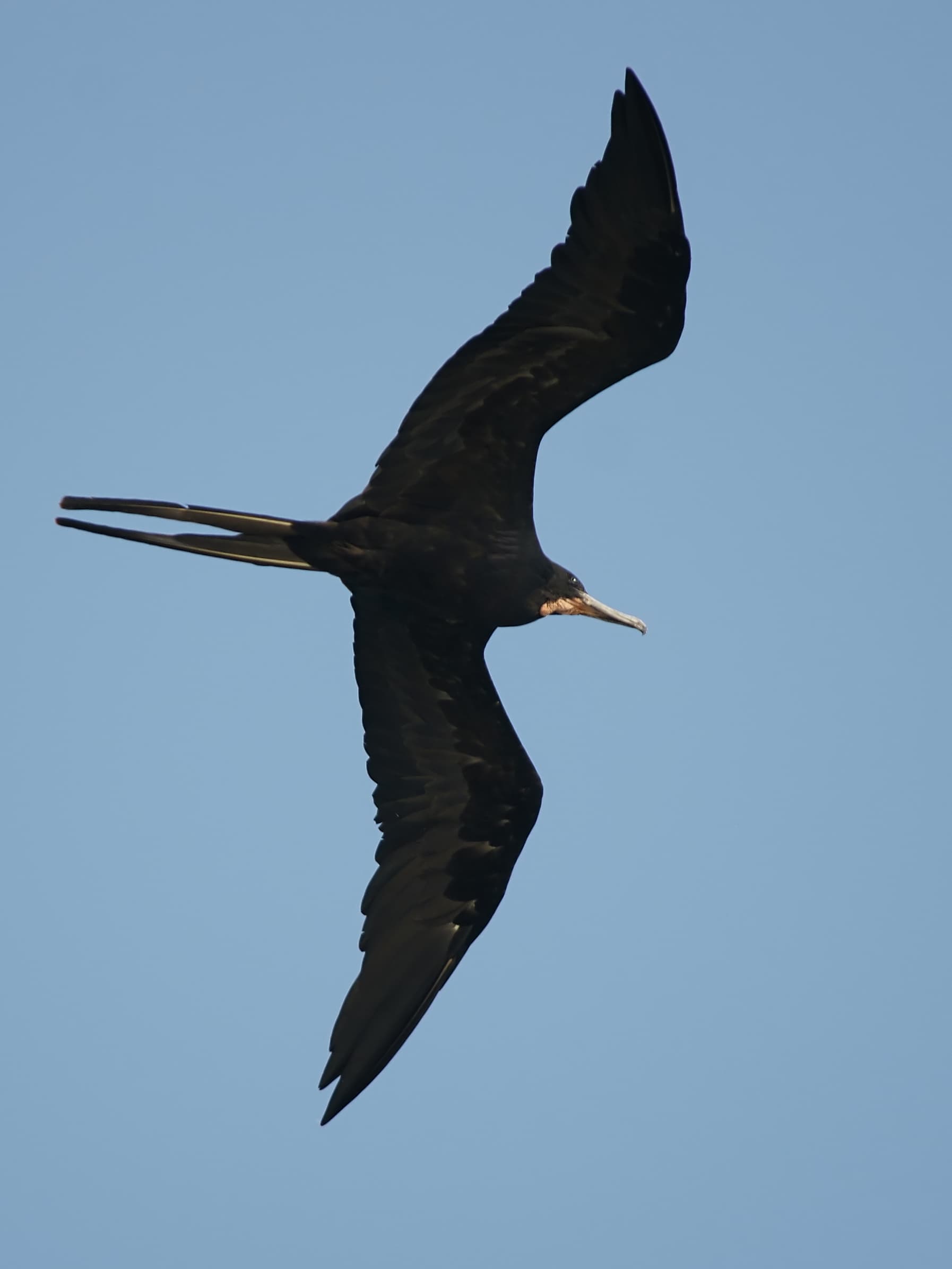
The Magnificent Frigatebird is a large, unmistakable seabird seen soaring over the coasts of both Trinidad and Tobago.
The Magnificent Frigatebird is a large, unmistakable seabird seen soaring over the coasts of both Trinidad and Tobago. With its long, angular wings, deeply forked tail, and effortless gliding flight, it is one of the most distinctive birds of the region's marine environment.
Identification
This is a very large seabird, reaching 95 to 110 cm in length with a wingspan that can exceed 2 metres. The silhouette is unmistakable: long, sharply angled wings and a long, deeply forked tail that is often held closed to a point in flight.
Mature males are glossy black and possess an inflatable red gular pouch, which they balloon out dramatically during courtship to attract females. Females have a white breast, while juveniles show a white head and underparts.
Ecology
Frigatebirds are masters of soaring flight, riding thermals and sea breezes for hours with barely a wingbeat. They feed mainly on flying fish and squid snatched from the surface of the sea, since their plumage is not fully waterproof and they avoid landing on the water.
The species is a notorious kleptoparasite, harassing boobies, gulls, terns, and other seabirds in mid-air until they drop or disgorge their catch, which the frigatebird then steals. Nesting occurs in low trees and shrubs on remote, undisturbed islands, where a single white egg is laid and tended by both parents.
Status in T&T
The Magnificent Frigatebird is a common and conspicuous seabird along the coasts of Trinidad and Tobago, frequently seen patrolling shorelines and harbours. Regional breeding is associated with the St. Giles Islands, a group of small islands off the northeast tip of Tobago that form an important seabird sanctuary.
The exact size and current status of any St. Giles breeding colony should be confirmed against recent local survey data, as reported colony figures vary and conditions change over time. Globally the species is listed as Least Concern by the IUCN.