Bird
Bird
Royal Tern
Thalasseus maximus
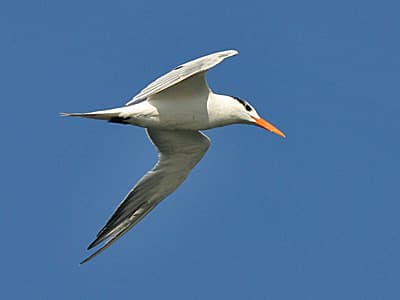
The Royal Tern is a large, elegant seabird of Trinidad and Tobago's coastal waters, recognised by its heavy orange bill and shaggy black crest, often seen resting in loose flocks on beaches and sandbars between plunge-diving bouts for fish just offshore.
The Royal Tern is a large, elegant seabird of Trinidad and Tobago's coastal waters, recognised by its heavy orange bill and shaggy black crest, often seen resting in loose flocks on beaches and sandbars between plunge-diving bouts for fish just offshore.
Identification
A large tern around 45 to 50 cm long, pale grey above and white below, with a stout, deep orange to red-orange bill and a black cap that recedes to a shaggy crest on the back of the head outside the breeding season, leaving a white forehead. In breeding plumage the black cap extends fully over the crown. Flight is strong and direct, with the bill typically angled downward while foraging.
Ecology
The Royal Tern hunts by plunge-diving from height into shallow coastal and estuarine waters, catching small fish and occasionally shrimp near the surface. It is highly social, roosting and loafing in dense flocks on beaches, sandbars, and mudflats between feeding bouts, often alongside other terns and gulls. It does not breed in T&T but is a regular non-breeding visitor and passage bird, with breeding colonies located on offshore islands and sandy coasts elsewhere in the wider Caribbean and North America.
Status in T&T
Regularly recorded along the coasts of both Trinidad and Tobago, particularly on sandy beaches, sandbars, and estuary mouths, as a non-breeding visitor rather than a local breeder. It is not threatened. It is protected under the Conservation of Wildlife Act and is not a game species.
Threats
- Beach and roost site disturbance from recreational activity
- Coastal development reducing loafing habitat