Marine Mammal
Marine Mammal
Humpback Whale
Megaptera novaeangliae
The Humpback Whale is a seasonal visitor to Trinidad and Tobago's waters, passing through on its long migration between high-latitude feeding grounds and warm-water breeding grounds in the wider Caribbean.
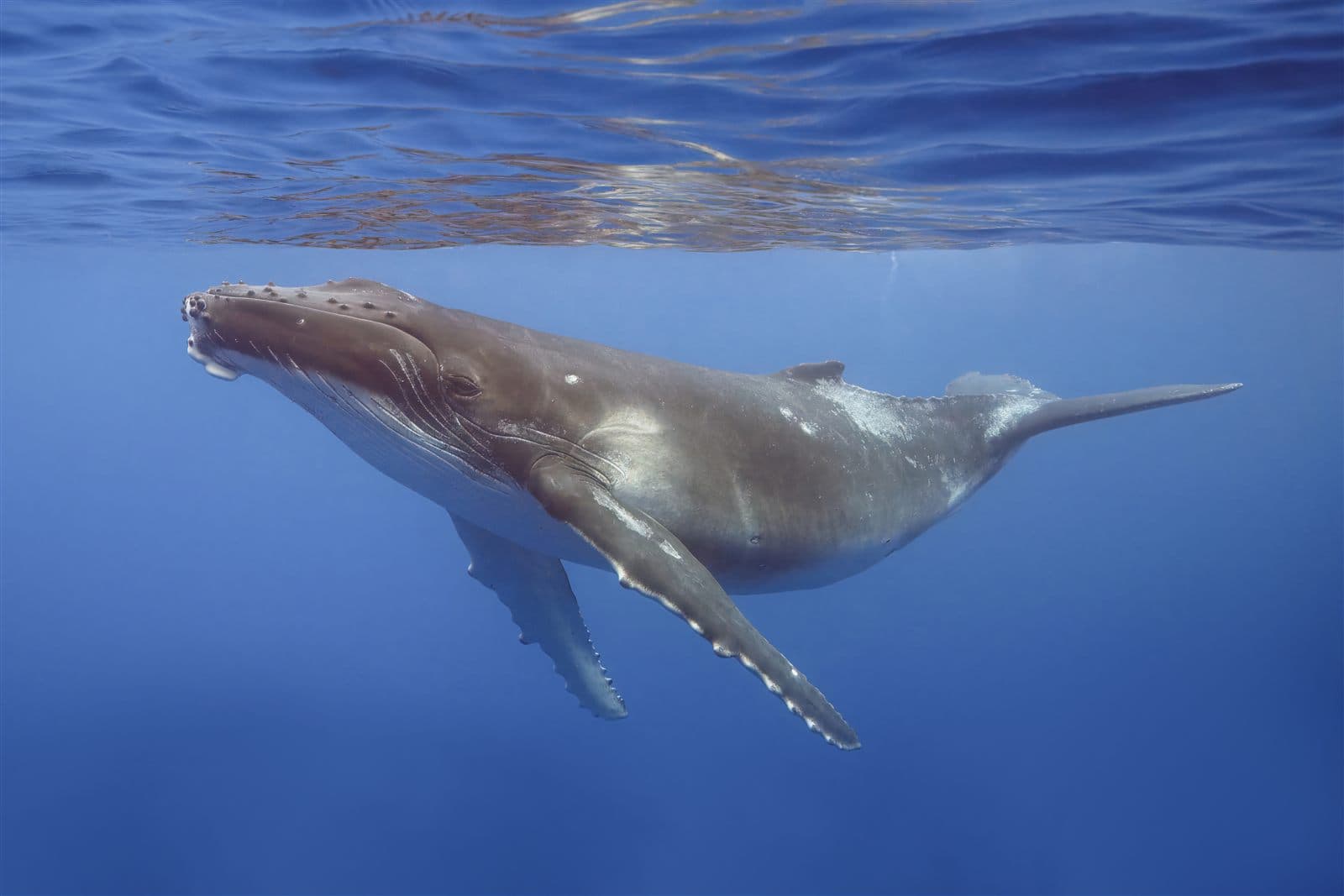
The Humpback Whale is a seasonal visitor to Trinidad and Tobago's waters, passing through on its long migration between high-latitude feeding grounds and warm-water breeding grounds in the wider Caribbean. Famous for its spectacular breaching, long pectoral fins, and complex, haunting songs, it does not breed in T&T but is occasionally sighted offshore during its migratory window.
Identification
A large baleen whale reaching 12 to 16 metres in length, readily identified by its extremely long pectoral fins, roughly a third of its body length, knobbly tubercles on the head and jaw, and a distinctive humped dorsal fin from which it takes its common name. Its tail flukes have irregular, individually distinctive black-and-white patterns on the underside used by researchers to identify individual whales, and it is well known for energetic surface behaviour including breaching, tail-slapping, and pectoral fin slapping.
Ecology
Humpback Whales undertake some of the longest migrations of any mammal, travelling thousands of kilometres each year between cold, productive high-latitude feeding grounds, where they consume enormous quantities of krill and small schooling fish using bubble-net and lunge-feeding techniques, and warm tropical or subtropical waters, where they breed, calve, and generally fast. Males produce long, complex songs during the breeding season, believed to play a role in mate attraction or male-male interaction. The North Atlantic population that transits the wider Caribbean and southeastern Caribbean, including waters near T&T, breeds primarily in the Samana Bay and Silver Bank areas near the Dominican Republic.
Status in T&T
Humpback Whales are not resident in T&T waters and do not breed here; sightings are occasional and associated with the whale's broader migratory movement through the southeastern Caribbean, generally in the cooler months. The species has recovered substantially since the end of commercial whaling and is no longer considered globally threatened, though regional subpopulations vary in status. As a cetacean, it is protected under the Conservation of Wildlife Act. Internationally, it is listed under CITES Appendix I, and is also covered by the Convention on Migratory Species (CMS) Appendices I and II, though Trinidad and Tobago is not a CMS signatory.
Threats
- Historical population depletion from commercial whaling
- Vessel strikes along migratory routes
- Entanglement in fishing gear
- Underwater noise pollution