Bird
Bird
Green-backed Heron
Butorides striata
The Green-backed Heron is a small, compact, and often secretive heron found throughout Trinidad and Tobago in any habitat with water and dense marginal vegetation, from mangrove channels and river banks to garden ponds and roadside drains.
The Green-backed Heron is a small, compact, and often secretive heron found throughout Trinidad and Tobago in any habitat with water and dense marginal vegetation, from mangrove channels and river banks to garden ponds and roadside drains. Often seen crouching motionless on a low branch over water or creeping along a muddy bank with exaggerated stealth, it is one of the most widely observed herons in T&T despite its retiring habits, partly because it tolerates human proximity in urban and suburban settings. It is notably one of a small number of bird species that uses tools, dropping feathers, insects, or other objects onto the water surface to attract fish.
Identification
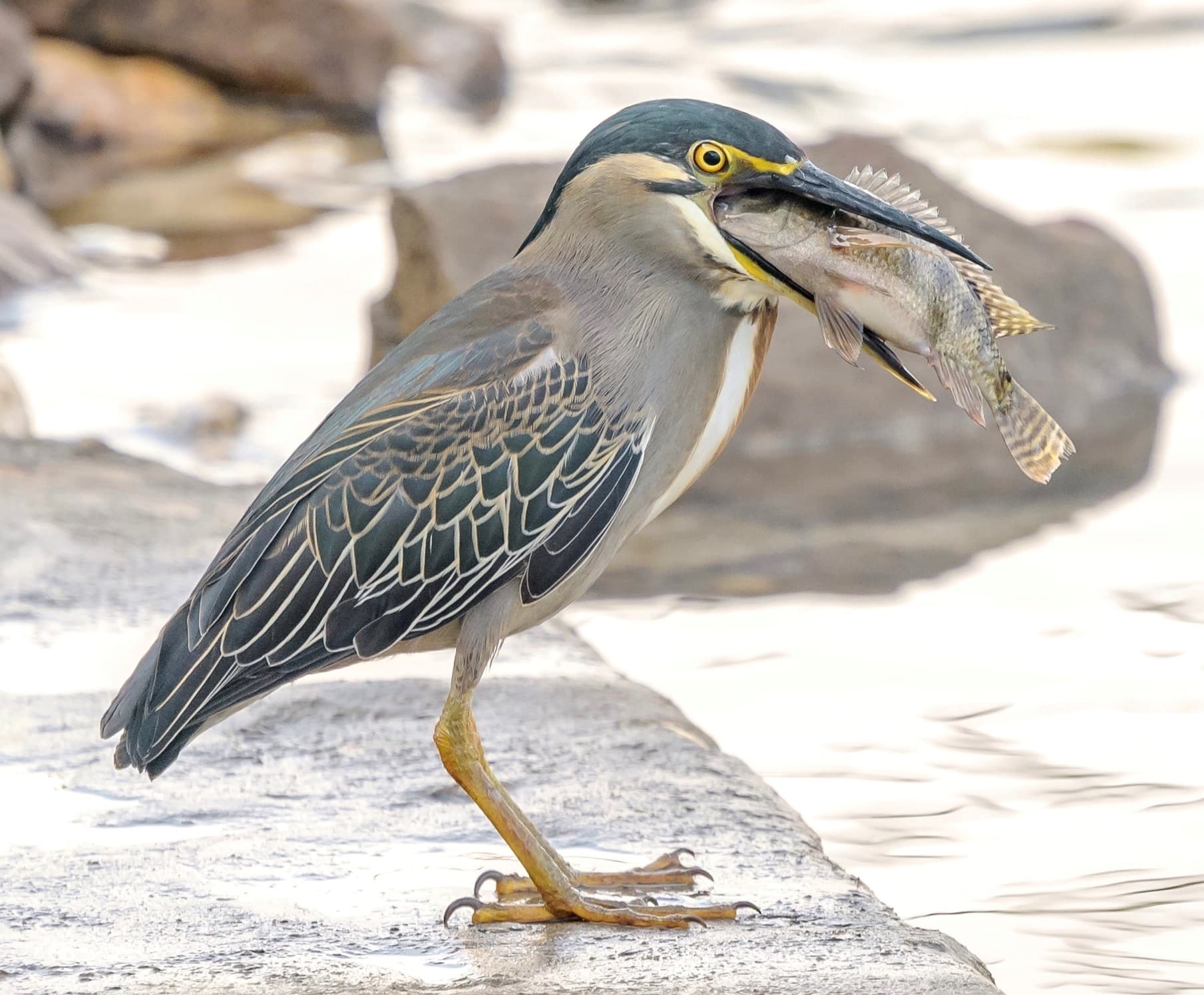
The Green-backed Heron measures 40 to 48 cm, much smaller than most other T&T herons. The upperparts are dark slate-green with a slight greenish gloss. The neck and face are chestnut-rufous with a white throat stripe and fine white streaking. The cap is dark, often slightly crested when alert. The underparts are pale grey-buff. The bill is long, dark, and dagger-like. The legs are bright yellow-orange in the breeding season, duller greenish-yellow at other times. Juveniles are browner and more heavily streaked than adults. The species crouches low and compact when resting, making it look shorter than it is.
Ecology
Green-backed Herons hunt by crouching at the water's edge and striking rapidly at fish, frogs, crustaceans, and aquatic invertebrates. They are one of the few bird species documented to use bait: individuals have been observed dropping small objects (feathers, bread crusts, insects) onto the water surface and waiting for fish to investigate, then striking. This tool use behaviour has been recorded at multiple sites and is not an isolated incident. They are largely solitary except when nesting in loose colonies in mangroves or dense waterside vegetation.
Status in T&T
The Green-backed Heron is a common year-round resident on both Trinidad and Tobago in virtually any aquatic habitat with marginal vegetation. It is one of the most adaptable herons in T&T and is regularly seen in suburban gardens with ponds, urban drainage channels, and agricultural water features, as well as natural wetlands. The species is fully protected under the Conservation of Wild Life Act and is not a game species.
Threats
- Urban pesticide use reducing aquatic prey
- Drainage of small wetlands and ponds
- Nest site disturbance in mangroves