Bird
Bird
Gray-necked Wood Rail
Aramides cajaneus
The Gray-necked Wood Rail is a large, boldly coloured rail of mangroves, freshwater swamps, and forest-edge wetlands in Trinidad, more often heard than seen as it calls loudly at dawn and dusk with a loud, cackling series of notes that echoes through swamp vegetation.
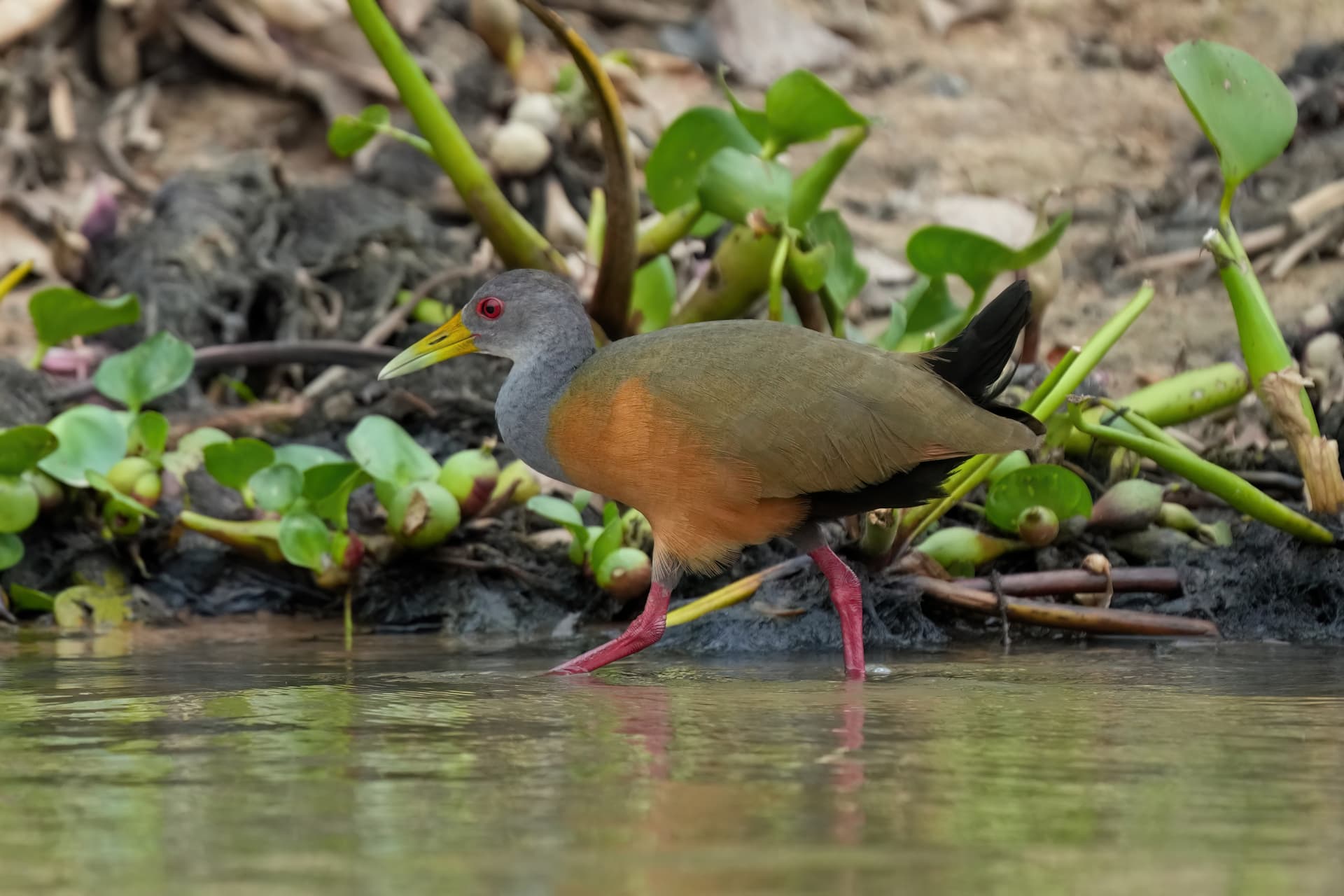
The Gray-necked Wood Rail is a large, boldly coloured rail of mangroves, freshwater swamps, and forest-edge wetlands in Trinidad, more often heard than seen as it calls loudly at dawn and dusk with a loud, cackling series of notes that echoes through swamp vegetation. Its combination of grey head and neck, chestnut-brown breast, olive-green back, and bright red bill and legs makes it one of the most colourful rails anywhere in its range, and when it does emerge from dense vegetation to forage at the water's edge it is a striking bird.
Identification
The Gray-necked Wood Rail measures 38 to 46 cm, large for a rail and somewhat heron-like in proportions when standing upright. The head and neck are grey; the upper breast and sides are rufous-chestnut; the back and wings are olive-green; the lower belly and undertail are black. The bill is bright red-orange, slightly decurved at the tip. The legs are also bright red. The eyes are red. In flight the wings are short and rounded, characteristic of rails, and the legs dangle. The call is a loud, raucous cackle delivered by both members of a pair together and carrying great distances through swamp vegetation.
Ecology
Gray-necked Wood Rails forage in shallow water and wet mud at the edges of mangroves, freshwater swamps, and forest streams, taking invertebrates, small frogs, fish, seeds, and plant material. They are territorial and pairs maintain year-round home ranges in suitable wetland habitat. Nesting is in dense vegetation near or above water, with a platform nest of plant material and typically 3 to 5 eggs. Though secretive by day, they become conspicuous at dawn and dusk when pairs call loudly and duet together. They swim readily across open water between vegetated patches.
Status in T&T
The Gray-necked Wood Rail is found on Trinidad in mangroves, freshwater swamp margins, and forested wetlands. It is less common on Tobago. Key sites include the Caroni and Nariva swamp systems. The species is fully protected under the Conservation of Wild Life Act and is not a game species. Mangrove clearance and freshwater wetland drainage are the primary threats to its habitat in T&T.
Threats
- Mangrove clearance and coastal development
- Freshwater wetland drainage
- Water pollution degrading foraging habitat