Bird
Bird
Greater Ani
Crotophaga major
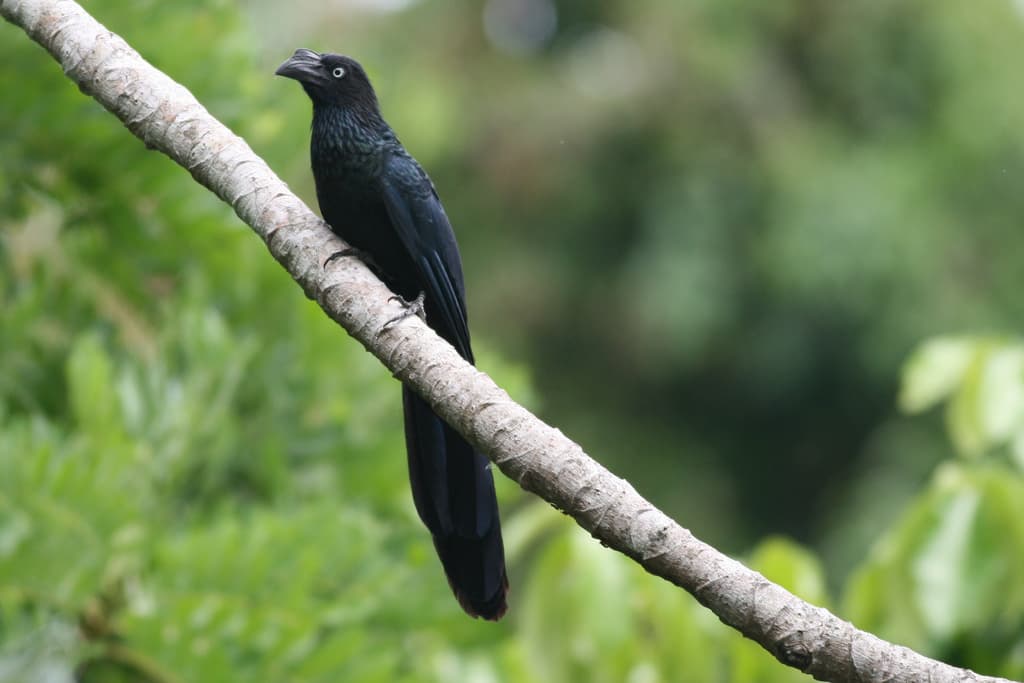
The Greater Ani is a large, glossy black bird of Trinidad's swamps and riverside vegetation, notable for its cooperative breeding system in which multiple pairs share a single nest, all contributing eggs and jointly raising the resulting brood.
The Greater Ani is a large, glossy black bird of Trinidad's swamps and riverside vegetation, notable for its cooperative breeding system in which multiple pairs share a single nest, all contributing eggs and jointly raising the resulting brood.
Identification
A large member of the cuckoo family, around 46 to 51 cm long, glossy black overall with iridescent blue-green and purple sheens visible in good light, a heavy, deep, laterally compressed bill with a distinct ridge along the culmen, and pale, straw-coloured eyes. It is notably larger and more heavily built than the smaller, more common Smooth-billed Ani found in drier, more open habitat.
Ecology
The Greater Ani feeds on large insects, small vertebrates including frogs and lizards, and occasionally fruit, foraging in small groups through waterside vegetation, marshes, and swamp forest. It is one of the relatively few birds practising communal nesting, in which several female-male pairs build and defend a single large stick nest together, all females laying eggs in the shared clutch and all group members cooperating in incubation and feeding of the combined brood. Groups are noisy, giving a range of gurgling and whooping calls.
Status in T&T
Found in swamp forest, marshes, and riverside vegetation on Trinidad, notably around Nariva Swamp and Caroni Swamp, generally favouring wetter habitat than the more widespread Smooth-billed Ani. It is not threatened. It is protected under the Conservation of Wildlife Act and is not a game species.
Threats
- Wetland and swamp forest habitat loss