Mammal
Mammal
Crab-eating Raccoon
Procyon cancrivorus
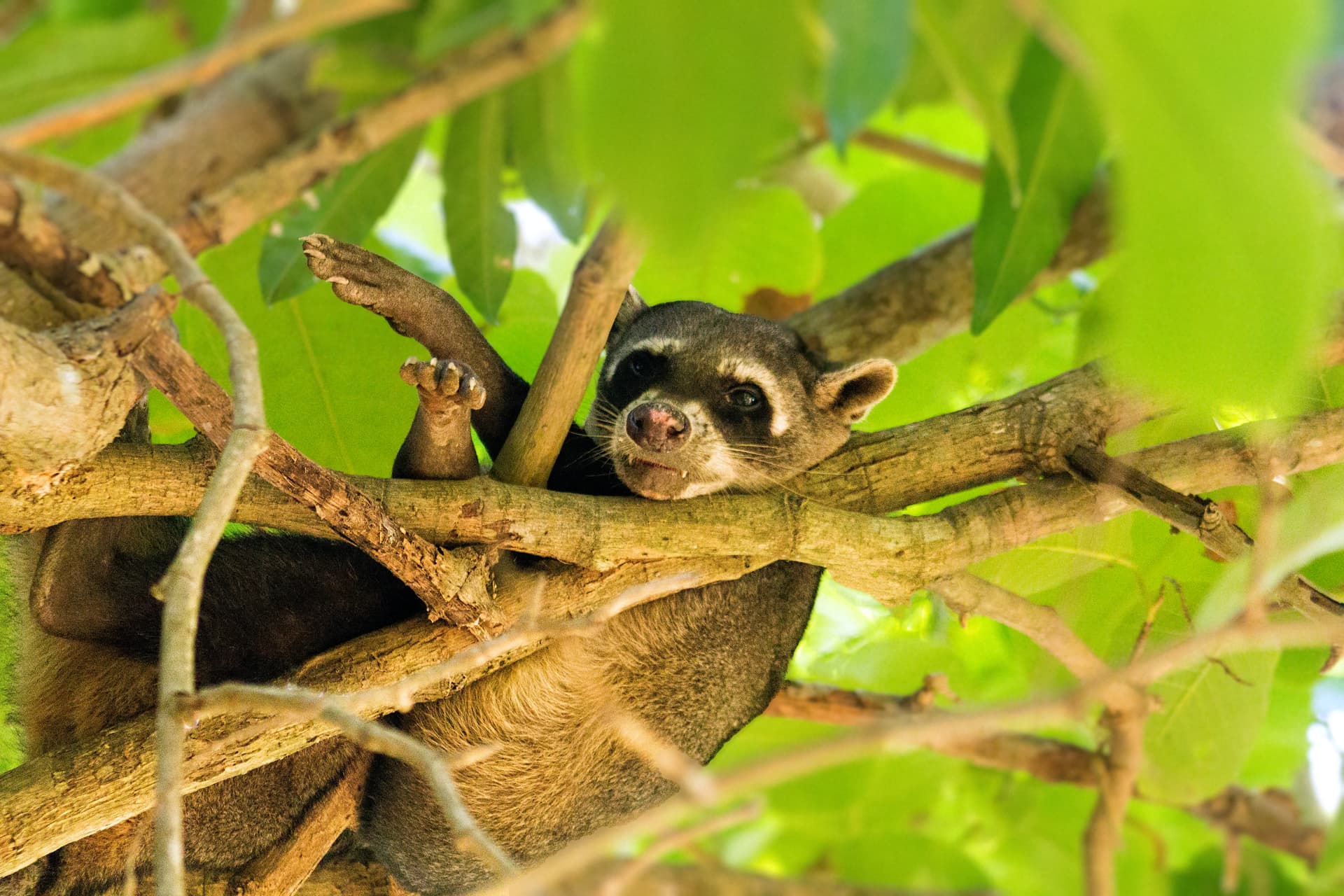
The Crab-eating Raccoon (Procyon cancrivorus) is Trinidad's only raccoon, a wetland-loving relative of the familiar North American raccoon.
The Crab-eating Raccoon (Procyon cancrivorus) is Trinidad's only raccoon, a wetland-loving relative of the familiar North American raccoon. It haunts the mangrove channels and swamp margins of sites like the Caroni and Nariva Swamps, where it forages by night for crabs and other shoreline prey.
Identification
A medium-sized member of the raccoon family with the classic black 'bandit mask' across the eyes and a bushy, dark-ringed tail. The body measures roughly 41 to 80 cm with a 20 to 56 cm tail, and adults usually weigh about 5 to 7 kg.
Compared with the northern Common Raccoon, it has noticeably coarser, shorter fur, longer and more slender legs, and sharper, narrower claws. Its cheek teeth are enlarged and adapted for crushing the hard shells of crabs and other crustaceans.
Ecology
This raccoon is solitary and strongly nocturnal, almost always staying near water such as streams, lagoons, and mangrove channels. Despite its name it is an opportunistic omnivore, taking crabs, crayfish, shellfish, fish, amphibians, insects, turtles, fruit, and nuts.
It uses its dexterous, highly sensitive forepaws to find and manipulate prey along the water's edge. Females hold territories based on food, water, and den availability, while young males disperse to new areas.
Status in T&T
In Trinidad the species is closely tied to coastal and freshwater wetlands, and the Caroni and Nariva Swamps support important local populations. It is widely described as the only raccoon occurring in Trinidad and Tobago, though confirmed records are concentrated in Trinidad and its status on Tobago is not well documented.
Globally the Crab-eating Raccoon is listed as Least Concern by the IUCN, reflecting its broad Central and South American range. Locally, drainage and degradation of mangrove and swamp habitat remain the main pressures.