Bird
Bird
Common Potoo
Nyctibius griseus
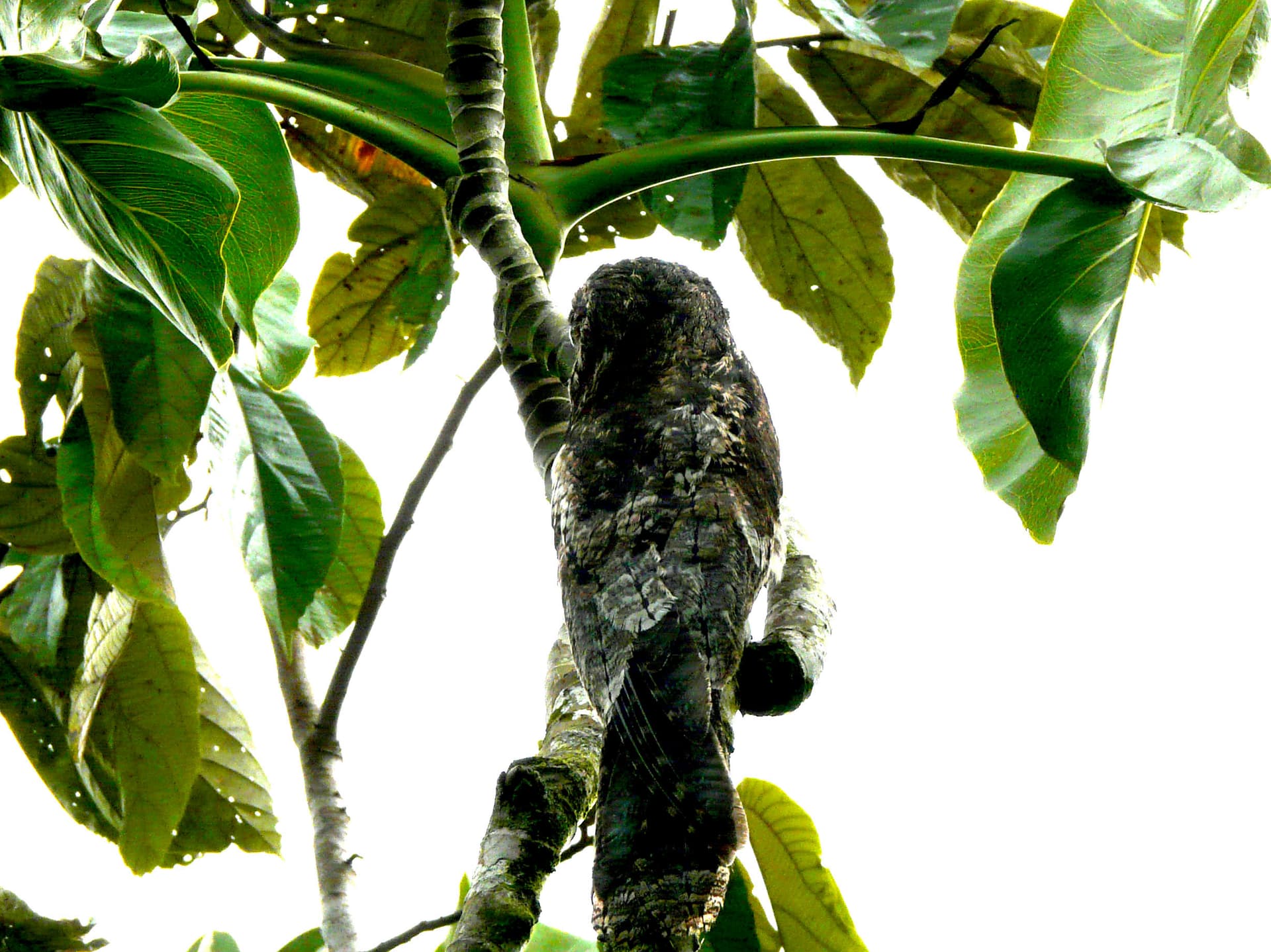
Photo: Leyo · Pantanal, Brazil (CC BY-SA 2.5)
The Common Potoo is one of the most cryptic and otherworldly birds in Trinidad and Tobago, a nocturnal hunter of the forest edge whose cryptic bark-like plumage and habit of roosting bolt-upright on a broken tree stub make it almost impossible to detect by day.
The Common Potoo is one of the most cryptic and otherworldly birds in Trinidad and Tobago, a nocturnal hunter of the forest edge whose cryptic bark-like plumage and habit of roosting bolt-upright on a broken tree stub make it almost impossible to detect by day. Its haunting, descending wail, given at dusk and on moonlit nights, is a characteristic sound of T&T's forested landscapes and has given the bird an eerie reputation in local folklore.
Identification
The Common Potoo measures 33 to 38 cm. The plumage is a complex pattern of grey, brown, black, and buff that perfectly mimics the texture and colour of weathered bark. When roosting on a broken stub or branch, the bird closes its large yellow eyes to narrow slits, stretches its neck upward, and tilts its head back to become virtually indistinguishable from the wood. The large, gaping mouth with a tiny bill and the enormous eyes adapted for nocturnal vision are visible only when the bird is alert or active at night. The call is a loud, descending series of mournful notes.
Ecology
The Common Potoo is an aerial insectivore, sallying from a fixed perch to catch large flying insects including moths, beetles, and large flies in the darkness. It hunts by sight, the enormous eyes collecting available light on dark and moonlit nights. By day it roosts motionlessly on a dead stub or branch, relying entirely on camouflage rather than flight to avoid detection. A single egg is laid directly on a depression in a broken branch or stub, with no nest construction at all; the incubating bird becomes part of the branch. Both sexes share incubation and chick care.
Status in T&T
The Common Potoo is found on both Trinidad and Tobago, typically in forest edges, secondary forest, and plantation margins where dead standing timber provides roosting and nest sites. It is fully protected under the Conservation of Wild Life Act and is not a game species. Its nocturnal habits and extreme cryptic camouflage mean it is rarely seen despite being present throughout suitable habitat across both islands. The haunting call is a reliable detection method at dusk and dawn.
Threats
- Loss of dead standing timber from forest clearance
- Forest fragmentation
- Artificial light reducing nocturnal insect prey