Bird
Bird
Carib Grackle
Quiscalus lugubris
The Carib Grackle is one of the most familiar and abundant birds in Trinidad and Tobago, a glossy, intelligent blackbird found wherever humans settle: gardens, markets, roadsides, beach cafes, and city centres.
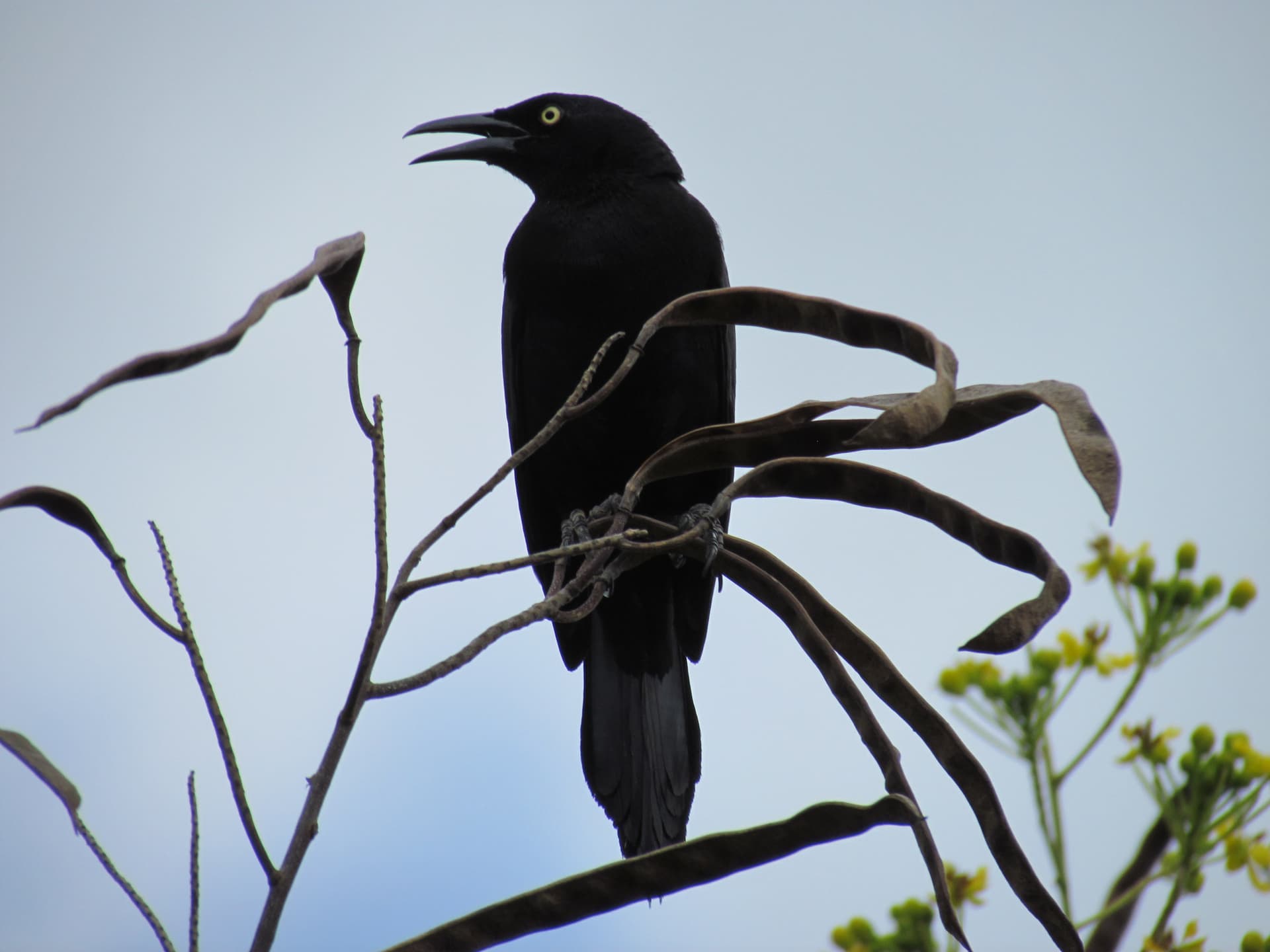
The Carib Grackle is one of the most familiar and abundant birds in Trinidad and Tobago, a glossy, intelligent blackbird found wherever humans settle: gardens, markets, roadsides, beach cafes, and city centres. The male is entirely glossy black with a distinct iridescent purple-violet sheen and striking pale yellow eyes, while the female is smaller and duller brown. Highly adaptable and opportunistic, grackles have thrived alongside human development and are among the most observed birds by residents across both islands.
Identification
The Carib Grackle measures 24 to 28 cm in the male and about 22 cm in the female. The male is entirely black with strong iridescent purple-violet gloss on the head, back, and wings, and distinctive pale whitish-yellow eyes. The tail is distinctly V-shaped or keel-shaped, held in a raised V when the bird is displaying. The bill is long, pointed, and slightly decurved. The female is a much smaller, dull dark brown above and paler brown below, also with pale eyes. Juveniles are streaky brown. The call is a loud, harsh chatter, screech, and various mechanical clicking notes.
Ecology
Carib Grackles are highly omnivorous generalists, eating insects, seeds, fruits, scraps, small lizards, eggs of other birds, and virtually anything edible. They are bold and quick-witted, regularly exploiting human food sources at outdoor eating areas and markets. Nesting is colonial, often in dense vegetation near buildings or in planted trees in urban areas. The nest is a bulky open cup; females perform most nest building and incubation while males guard the colony and display. Groups of males perform exaggerated display postures with spread wings and raised tail while calling.
Status in T&T
The Carib Grackle is found throughout Trinidad and Tobago in virtually all human-modified habitats. It is a year-round resident and one of the most numerous birds on both islands. The species is fully protected under the Conservation of Wild Life Act and is not a game species. Its association with human habitation and food sources has allowed it to expand alongside urbanisation, and it is considered a synanthropic species benefiting strongly from human presence.
Threats
- Pesticide contamination of food sources
- Reduced by habitat competition in some agricultural contexts