Bird
Bird
Black-crowned Night Heron
Nycticorax nycticorax
The Black-crowned Night Heron is the most widespread heron in the world and one of T&T's characteristic wetland birds, a stocky, short-necked heron with a jet-black crown and back contrasting with pale grey wings and white underparts that is most active at dusk and through the night.
The Black-crowned Night Heron is the most widespread heron in the world and one of T&T's characteristic wetland birds, a stocky, short-necked heron with a jet-black crown and back contrasting with pale grey wings and white underparts that is most active at dusk and through the night. Its loud, barking "kwok" call is one of the most familiar sounds of T&T's wetland edges after dark, as birds fly out from daytime roosts in mangroves to feed at water margins. The species is found on both islands and uses a wide range of wetland habitats from coastal mangroves to freshwater swamps and urban water bodies.
Identification
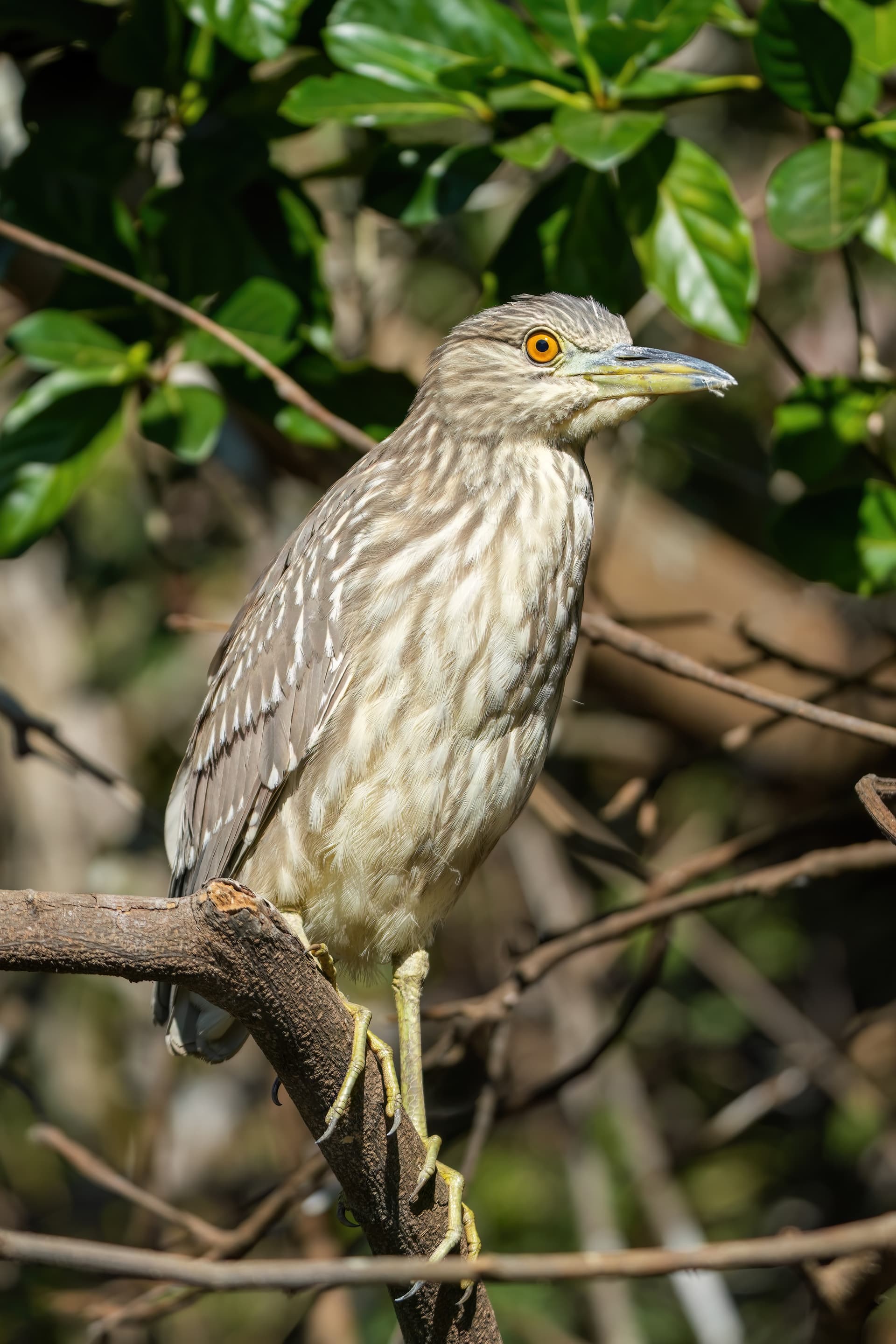
The Black-crowned Night Heron measures 58 to 66 cm, stocky with a relatively large head, short neck, and compact body. Adults have a glossy black crown and back, pale grey wings and tail, and white underparts. Two or three white plumes trail from the back of the head in breeding adults. The bill is short and stout, black. The eyes are large and red. The legs are yellow, becoming pink-red in the breeding season. Juveniles are streaky brown with white spots on the wings and a yellow bill, resembling the Yellow-crowned Night-Heron but with a narrower, more streaked appearance. In flight the feet project well beyond the short tail.
Ecology
Black-crowned Night Herons are primarily crepuscular and nocturnal foragers, becoming active at dusk and feeding through the night on fish, frogs, crustaceans, small mammals, insects, and the eggs and chicks of other colonial waterbirds. By day they roost quietly in dense mangroves or other waterside trees, often in groups of dozens. They nest colonially, usually in mixed heronries in mangroves or trees over water. The large red eyes are an adaptation to low-light foraging. The loud "kwok" flight call is frequently heard overhead at night along wetland and urban waterway margins.
Status in T&T
The Black-crowned Night Heron is found on both Trinidad and Tobago in mangroves, freshwater swamps, coastal lagoons, and urban waterways. It is a year-round resident and among the most commonly encountered herons at dusk in wetland areas. The species is fully protected under the Conservation of Wild Life Act and is not a game species. Despite being globally abundant, local populations are sensitive to mangrove clearance and disturbance of colonial roost and nesting sites.
Threats
- Mangrove clearance destroying roost and nesting sites
- Wetland drainage reducing foraging habitat
- Colonial nesting site disturbance