Bird
Bird
Yellow-rumped Cacique
Cacicus cela
The Yellow-rumped Cacique is a noisy, highly social forest bird of Trinidad, nesting in dense colonies of long, woven, hanging nests suspended from a single tree, often positioned near active wasp nests for protection against predators.
The Yellow-rumped Cacique is a noisy, highly social forest bird of Trinidad, nesting in dense colonies of long, woven, hanging nests suspended from a single tree, often positioned near active wasp nests for protection against predators.
Identification
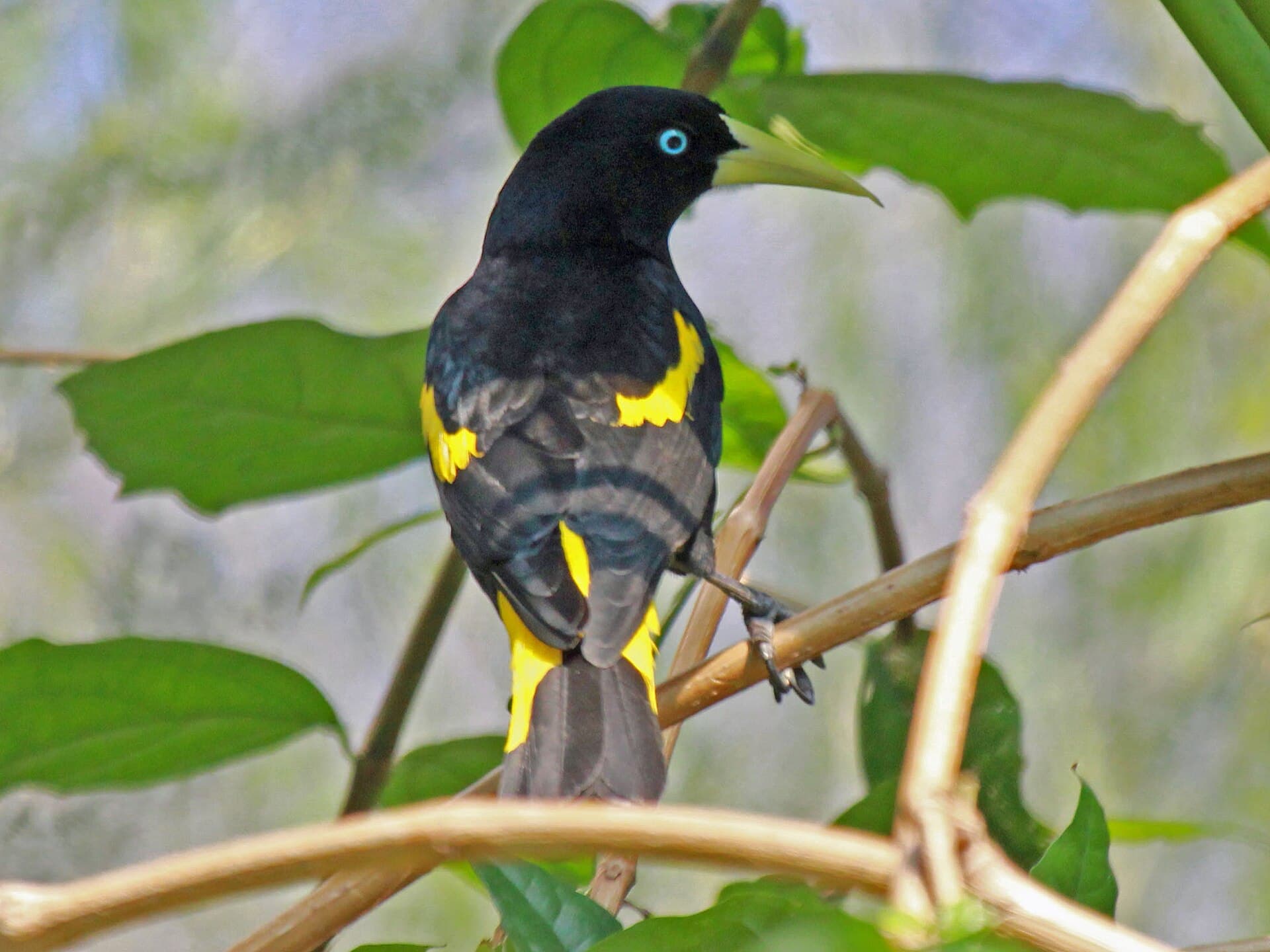
A medium-sized bird around 24 to 28 cm long, mostly glossy black with a bright yellow rump, lower back, and patches at the base of the tail and on the wing, conspicuous both perched and in flight. The bill is pale ivory to yellowish and sharply pointed, and the eyes are pale blue, standing out against the black plumage.
Ecology
The Yellow-rumped Cacique feeds on fruit, nectar, and insects, foraging actively and often noisily in the forest canopy, frequently in small groups. It is strongly colonial, with dozens of pairs building long, woven, sock-like hanging nests clustered together in a single emergent tree, often deliberately near an active wasp or bee nest, whose defensive stinging insects are thought to help deter nest predators such as monkeys and snakes. Colonies are notably noisy, with a wide repertoire of whistles, gurgles, and mimicked sounds.
Status in T&T
Found in forest and forest edge across Trinidad, with conspicuous breeding colonies visible in emergent trees at established sites. It is not threatened. It is protected under the Conservation of Wildlife Act and is not a game species.
Threats
- Loss of large emergent trees used for colonial nest sites
- Forest clearance and fragmentation