Bird
Bird
White-cheeked Pintail
Anas bahamensis
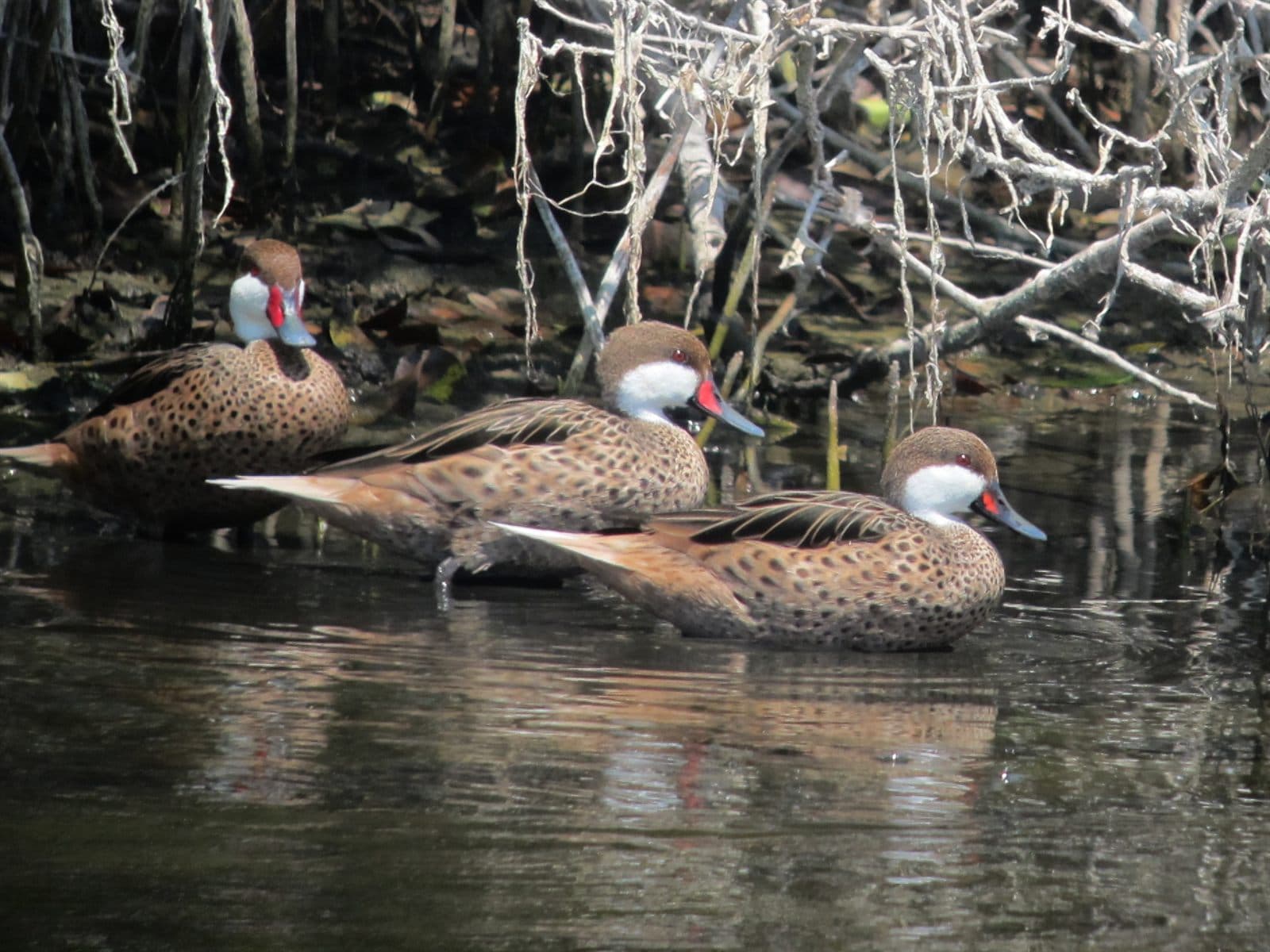
The White-cheeked Pintail is a distinctive, sharp-tailed duck of coastal lagoons and freshwater wetlands across Trinidad and Tobago, its bright white cheek and throat patch and vivid orange-red bill spot making it one of the more readily identified waterfowl of the region.
The White-cheeked Pintail is a distinctive, sharp-tailed duck of coastal lagoons and freshwater wetlands across Trinidad and Tobago, its bright white cheek and throat patch and vivid orange-red bill spot making it one of the more readily identified waterfowl of the region.
Identification
A medium-sized duck around 38 to 51 cm long, warm buff-brown overall with fine dark speckling on the body, a striking white face, cheek, and throat that contrasts sharply with the darker crown, and a slender pointed tail giving it a pintail-like silhouette. The bill is blue-grey with a distinctive bright orange-red spot at the base, and a green speculum is visible on the folded and spread wing.
Ecology
The White-cheeked Pintail dabbles and up-ends in shallow fresh, brackish, and saline waters, feeding on aquatic plants, seeds, and small invertebrates. It favours coastal lagoons, salt pans, mangrove-fringed wetlands, and freshwater marshes, often in pairs or small groups, and readily tolerates brackish and hypersaline conditions unsuited to many other dabbling ducks. Nests are built on the ground, well concealed in dense marsh or lagoon-edge vegetation.
Status in T&T
Found on coastal and freshwater wetlands across both Trinidad and Tobago, including salt pans and lagoon systems. It is not threatened, though regional Caribbean populations are considered locally vulnerable to habitat loss on some smaller islands. It is one of the very few ducks explicitly excluded from the Second Schedule game list of the Conservation of Wildlife Act, which names "Ducks, Wild (except Bahama Pintails)" as game; the White-cheeked Pintail is the Bahama Pintail meant by that exclusion, so it has never been a legal game species.
Threats
- Wetland and salt pan habitat loss
- Nest predation in coastal marsh habitat