Invertebrate
Invertebrate
Trinidad Thick-tailed Scorpion
Tityus trinitatis
The Trinidad Thick-tailed Scorpion (Tityus trinitatis) is the most medically important scorpion in Trinidad.
The Trinidad Thick-tailed Scorpion (Tityus trinitatis) is the most medically important scorpion in Trinidad. A member of the family Buthidae, it is a nocturnal forest and plantation dweller best known to science because its sting can trigger acute pancreatitis. It is recorded chiefly from Trinidad, with reports from Venezuela leaving its true endemism uncertain, so it is best treated as near-endemic.
Identification
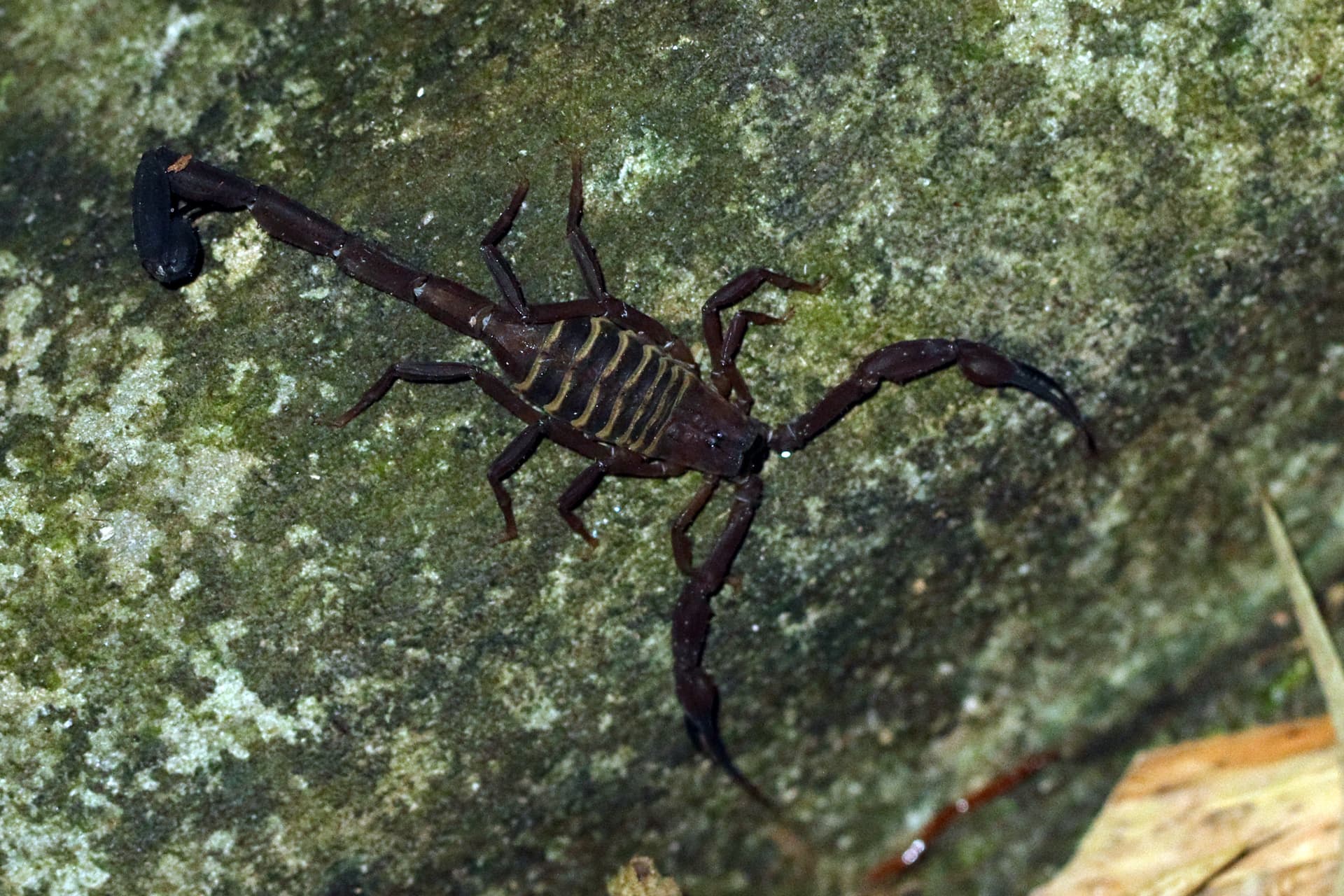
This is a robust buthid scorpion with the thickened tail (metasoma) that gives the group its common name; the venom is delivered from the bulbous telson at the tip. Males are a bright brown with the distal end of the tail black, while females are very dark brown, almost black. White spots mark the mesosoma and legs, and the legs themselves appear lighter and yellowish.
Both sexes carry roughly 18 to 19 pectinal teeth on the comb-like pectines beneath the body, a feature used to separate it from Trinidad's other scorpions such as the slender-tailed Tityus tenuicauda.
Ecology
Tityus trinitatis is nocturnal and semi-arboreal, climbing into trees at times but most often found near the ground among forest debris, logs and discarded coconut husks. It is strongly associated with cultivated land, being common on sugar cane, banana, coconut and cocoa plantations as well as in natural forest.
Like other scorpions it is a sit-and-wait predator of insects and other small invertebrates, seizing prey with its pincers and subduing it with venom. Its frequent presence around plantations and homes explains why human stings are comparatively common.
Status in T&T
This species is reported mainly from Trinidad; records from Venezuela mean its endemism is unconfirmed, so it is treated here as near-endemic rather than strictly endemic to Trinidad. It has not been assessed by the IUCN Red List.
It is the most medically significant scorpion in Trinidad. Hospital studies at the University of the West Indies documented that its venom can cause acute, occasionally fatal pancreatitis as well as cardiac complications; the venom stimulates the pancreas through a cholinergic, muscarinic mechanism. Most envenomed patients nonetheless recover, and the venom is now also studied as a source of useful antimicrobial peptides.