Invertebrate
Invertebrate
Trinidad Chevron Tarantula
Psalmopoeus cambridgei
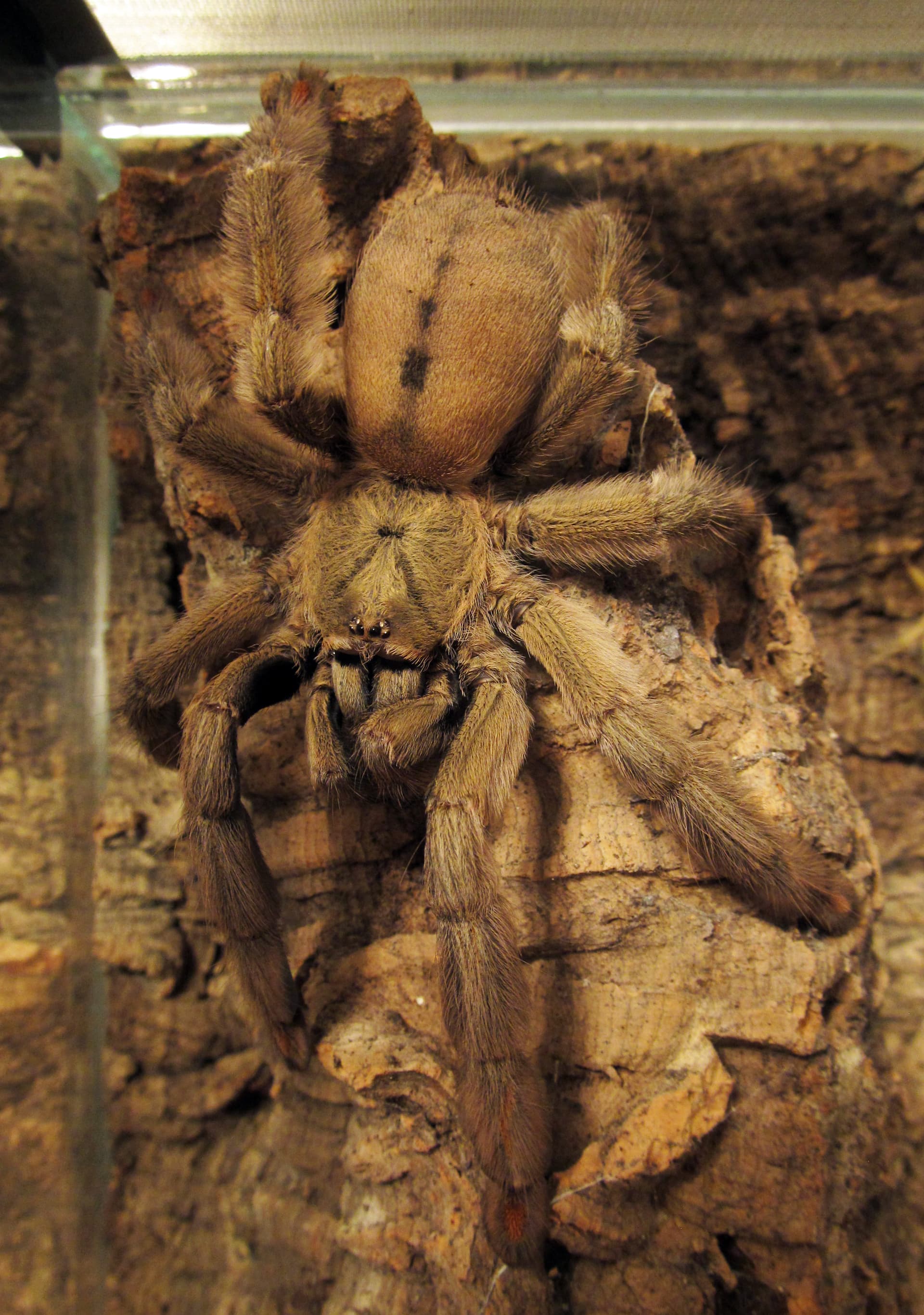
The Trinidad Chevron Tarantula is a large arboreal spider endemic to the island of Trinidad, named for the dark V-shaped chevron markings on its abdomen.
The Trinidad Chevron Tarantula is a large arboreal spider endemic to the island of Trinidad, named for the dark V-shaped chevron markings on its abdomen. Fast-moving and adaptable, it lives behind loose bark and in rot holes of rainforest trees and is one of the most familiar T&T tarantulas in the international pet trade.
Identification
A robust tarantula reaching 11 to 14cm across the legs, with V-shaped chevron marks on the abdomen. Females range from green to brown with red or orange markings on the legs, while mature males are a more uniform grey or brown with proportionally longer legs.
The body is divided into a cephalothorax and abdomen joined by a narrow pedicel, and the eight small eyes provide poor vision, so the animal relies mainly on touch, smell, and vibration. Unlike many New World tarantulas, it lacks urticating (irritating) defensive hairs.
Ecology
This is a nocturnal, arboreal ambush predator. It builds silken tube-web retreats behind loose tree bark, in epiphytic plant growth, and in rot holes, and will also colonise undisturbed walls and road banks rather than open foliage.
It does not use silk to trap prey; instead it leaves the retreat at night to hunt, taking insects such as crickets and grasshoppers as well as small vertebrates including frogs, lizards, mice, and even bats. Venom injected through the fangs subdues prey and contains enzymes that help liquefy tissue for feeding.
Status in T&T
The Trinidad Chevron Tarantula is endemic to Trinidad and is not known from Tobago or the South American mainland. It tolerates disturbed and even urban settings, and it is bred readily in captivity, making it common in the exotic pet trade.
Like all tarantulas it is venomous, but its bite is medically minor to humans, causing localised pain rather than serious harm. The species has not been formally evaluated by the IUCN, so it carries no global conservation category.