Invertebrate
Invertebrate
Blue Land Crab
Cardisoma guanhumi
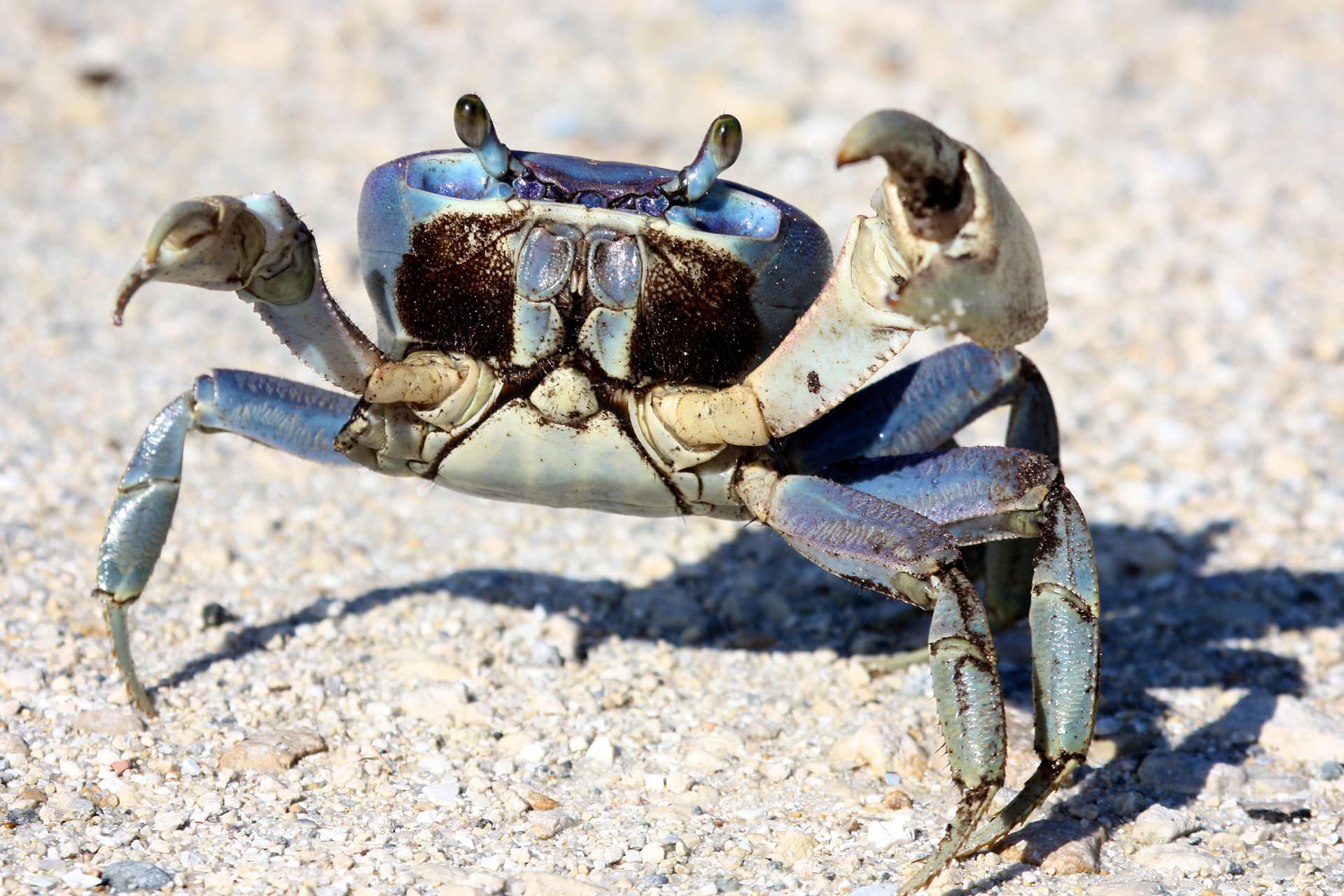
The Blue Land Crab is a large, burrowing land crab of Caribbean coasts, named for the slate-blue to grey-blue colour of mature males.
The Blue Land Crab is a large, burrowing land crab of Caribbean coasts, named for the slate-blue to grey-blue colour of mature males. In Trinidad and Tobago it is a celebrated catch, the crab in the classic dish 'crab and dumpling', and one of the most conspicuous animals of mangrove fringes and low-lying coastal land.
Appearance
It is a heavy-bodied crab whose carapace can exceed 10 to 15 cm across, making it one of the largest land crabs in the region. Adult males are typically blue to blue-grey, while females and juveniles tend toward grey, brown or pale violet. One claw is markedly larger than the other, especially in males, and the stout legs are built for digging and overland walking rather than swimming.
Behaviour
Although it breathes with modified gills, the Blue Land Crab is essentially terrestrial and must keep its gill chamber moist, which it does by living in deep burrows. These burrows spiral down to the water table, sometimes a metre or more, and provide humidity and refuge from heat and predators. It is mainly nocturnal, emerging at night to feed, and is famous for mass overland movements toward the sea during the breeding season.
Burrows are clustered in soft soils near wetlands, and an active colony can riddle the ground with openings.
Diet and breeding
It is largely herbivorous and detritivorous, feeding on leaves, fruit and seedlings, especially of mangroves such as red and white mangrove and buttonwood, along with grasses and the occasional bit of carrion. Breeding peaks in the wet season: after mating, the female carries a large egg mass beneath her abdomen for about two weeks, then migrates to the shore to release the eggs into the sea. A single female may carry 300,000 to 700,000 eggs, the larvae developing in the plankton before tiny crabs return to land, though very few survive. It is slow-growing and long-lived, taking several years to reach maturity.
In Trinidad and Tobago
The Blue Land Crab is common along low coasts, mangrove margins and swampy ground on both Trinidad and Tobago, and it is heavily harvested as food, most famously in crab and dumpling. As an abundant herbivore and burrower it recycles leaf litter and aerates coastal soils. Globally the IUCN lists it as Near Threatened, and in T&T it is subject to a closed hunting season to protect it during breeding migrations.