Bird
Bird
Spectacled Owl
Pulsatrix perspicillata
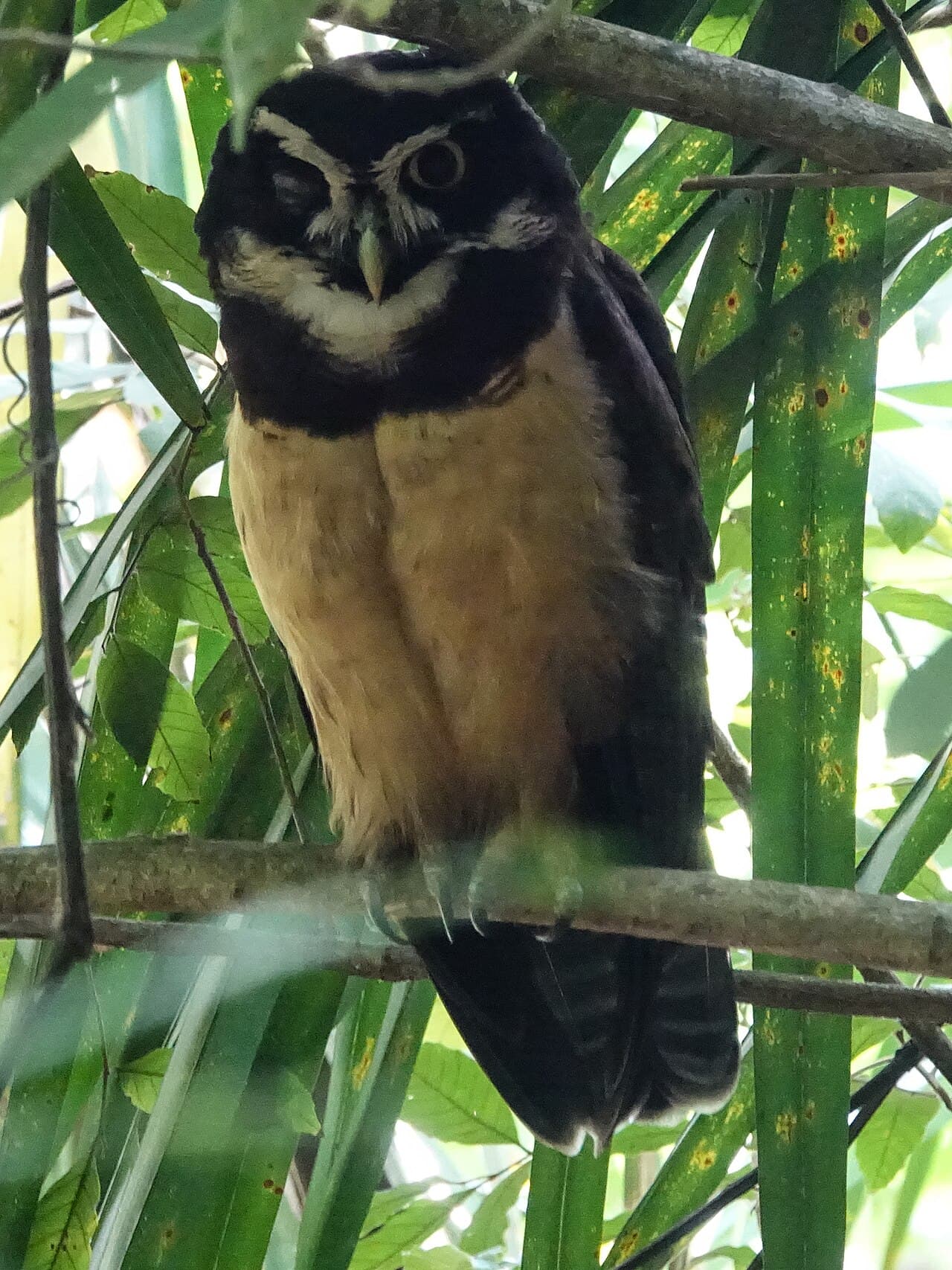
The Spectacled Owl is a large, powerful forest owl of Trinidad, named for the bold white markings encircling its dark facial disc that resemble a pair of spectacles, and one of the more formidable nocturnal predators of the island's forest interior.
The Spectacled Owl is a large, powerful forest owl of Trinidad, named for the bold white markings encircling its dark facial disc that resemble a pair of spectacles, and one of the more formidable nocturnal predators of the island's forest interior.
Identification
A large owl around 43 to 52 cm long, dark brown above and on the upper breast, with a bold, contrasting white eyebrow, throat, and upper breast band that frames the dark brown facial disc, giving the appearance of white spectacles against the dark face. The eyes are bright yellow. Juveniles look markedly different, being mostly white with a dark brown mask, and take several years to reach adult plumage.
Ecology
A powerful nocturnal predator, the Spectacled Owl hunts small to medium-sized mammals, birds, reptiles, amphibians, and large insects, taking prey considerably larger than that of the smaller owls sharing its habitat. It hunts from a perch within mature forest, dropping onto prey detected by sound in the darkness below, and roosts in dense canopy foliage by day. Its call is a distinctive, deep, accelerating series of knocking notes, quite different from typical owl hooting.
Status in T&T
Found in mature forest on Trinidad, generally requiring extensive, relatively undisturbed forest for hunting territory. It is not threatened. It is protected under the Conservation of Wildlife Act and is not a game species; forest clearance and persecution linked to superstition are the main local pressures.
Threats
- Mature forest clearance and fragmentation
- Persecution driven by superstition in some rural communities