Bird
Bird
Scarlet Tanager
Piranga olivacea
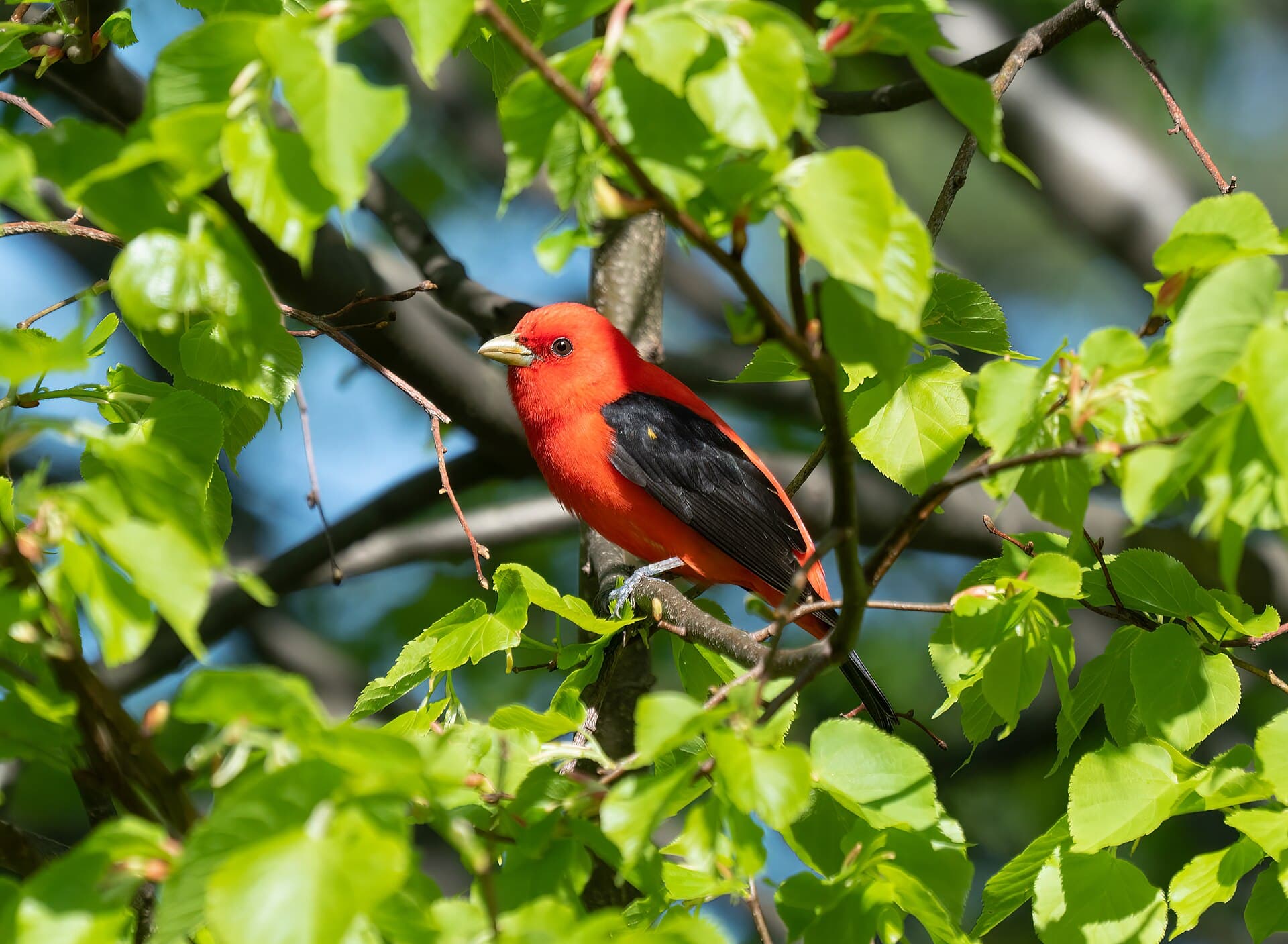
The Scarlet Tanager is a vivid North American songbird that passes through or winters in Trinidad and Tobago on migration, the breeding male's brilliant red body and jet-black wings among the most striking plumages of any bird recorded in T&T, though it does not breed here.
The Scarlet Tanager is a vivid North American songbird that passes through or winters in Trinidad and Tobago on migration, the breeding male's brilliant red body and jet-black wings among the most striking plumages of any bird recorded in T&T, though it does not breed here.
Identification
A medium-sized songbird around 16 to 19 cm long. The breeding male is unmistakable, with an intensely vivid scarlet-red body contrasting sharply against jet-black wings and tail. Outside the breeding season, males moult into a yellowish-olive plumage similar to the female, retaining only the black wings, meaning most birds seen in T&T, given the timing of the species' presence, show this duller non-breeding plumage rather than full breeding red.
Ecology
The Scarlet Tanager feeds on insects, spiders, and fruit, foraging in the forest canopy, gleaning prey from foliage and occasionally catching insects in flight. It breeds in deciduous and mixed forest across eastern North America and undertakes a long-distance migration to winter in the forests of northern and western South America, with Trinidad and Tobago lying within the broader range through which migrants pass or occasionally overwinter.
Migration
The Scarlet Tanager does not breed in T&T; birds recorded here are non-breeding migrants or winter visitors from North American breeding populations, generally present from the northern autumn through spring before returning north to breed. Records in T&T are irregular compared to more consistently recorded North American migrants such as the Barn Swallow.
Threats
- Habitat loss along the migratory range and at wintering grounds
- Collision mortality during migration