Bird
Bird
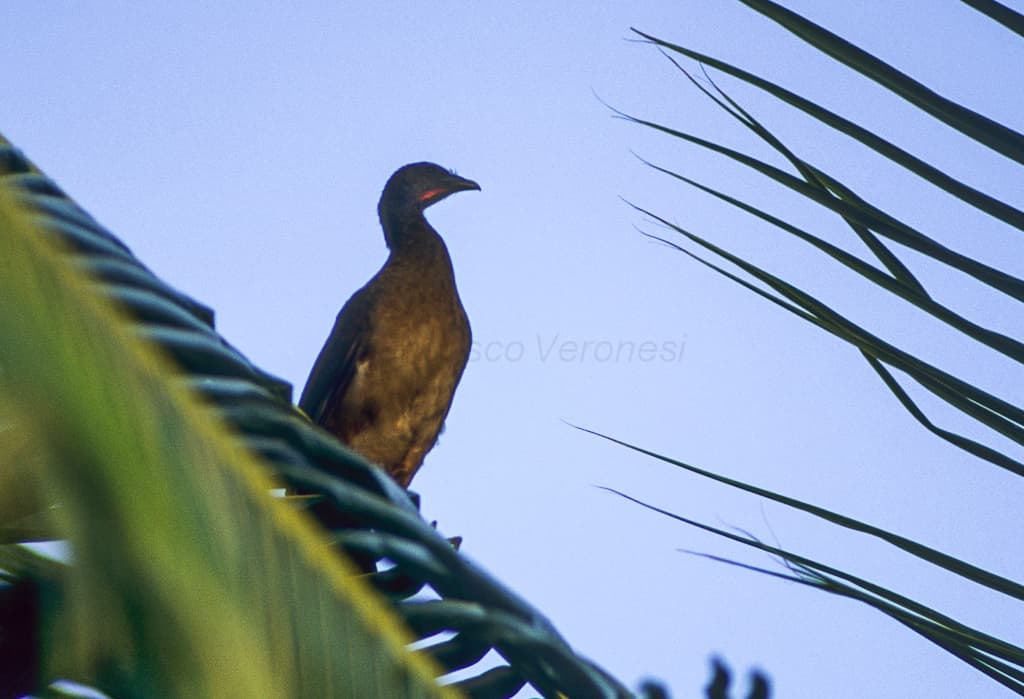
Rufous-vented Chachalaca (Cocrico)
Ortalis ruficauda
The Rufous-vented Chachalaca, known throughout Tobago as the Cocrico, is one of the island's most recognisable birds and shares the honour of being a national symbol of Trinidad and Tobago alongside the Scarlet Ibis.
The Rufous-vented Chachalaca, known throughout Tobago as the Cocrico, is one of the island's most recognisable birds and shares the honour of being a national symbol of Trinidad and Tobago alongside the Scarlet Ibis. Found only on Tobago within T&T, the Cocrico fills the forest edge and scrub with its raucous, chorus-call at dawn that gave the island itself one of its enduring informal names.
Identification
The Cocrico is a medium-to-large bird measuring approximately 50 to 56 cm, with olive-brown upperparts, a slightly paler breast, and a long, graduated tail that ends in chestnut-tipped feathers most visible in flight. The face is bare with reddish skin around the eye. The bill is strong and slightly curved. Birds are usually encountered in small, noisy groups moving through the understorey and lower canopy, often running along branches rather than flying. The call is a loud, rolling "co-co-ri-co" that carries far through forest and is often given in coordinated group choruses.
Ecology
Rufous-vented Chachalacas are primarily frugivores, feeding on a wide range of wild fruits, berries, flowers, and leaves. They are well adapted to forest edges, secondary scrub, gardens, and disturbed woodland, making them conspicuous even in settled areas of Tobago. The species is monogamous and builds a simple platform nest of twigs and leaves in a tree or shrub, typically producing two to three eggs. Chicks are precocial and leave the nest quickly. Like all cracids, they play an important role as seed dispersers for forest tree species.
Legal Protection
As the national bird of Tobago, the Cocrico is a protected animal under the Conservation of Wild Life Act (COWA): it is not among the game species listed in the Act's Second Schedule, so it may not be legally hunted at any time. It is nonetheless sometimes shot illegally, particularly by farmers seeking to protect crops, which is a criminal offence. The species is also one of the flagships of Tobago's ecotourism profile and is featured prominently in national wildlife education.
Threats
- Illegal hunting and shooting, often by farmers protecting crops
- Habitat loss from agricultural expansion
- Forest fragmentation