Bird
Bird
Red-billed Tropicbird
Phaethon aethereus
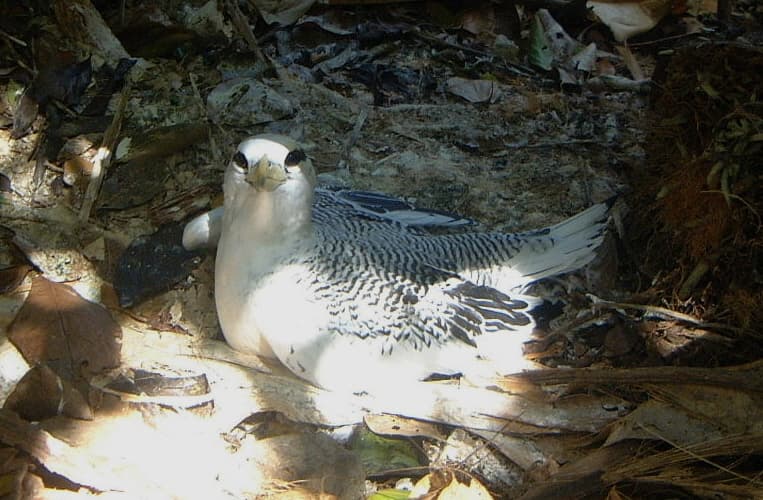
The Red-billed Tropicbird is one of the most elegant seabirds to be found in T&T waters, a brilliantly white bird with a vivid red bill, black wing markings, and extraordinary elongated central tail feathers (streamers) that trail behind in flight like white ribbons.
The Red-billed Tropicbird is one of the most elegant seabirds to be found in T&T waters, a brilliantly white bird with a vivid red bill, black wing markings, and extraordinary elongated central tail feathers (streamers) that trail behind in flight like white ribbons. In T&T it is primarily associated with Tobago, where it nests on rocky offshore islets and sea cliffs and is a regular sight for visitors to the island's northern and eastern coasts. Its buoyant, tern-like flight and the long tail streamers make it instantly identifiable even at a distance over open sea.
Identification
The Red-billed Tropicbird measures 46 to 56 cm body length with elongated central tail streamers adding a further 46 to 56 cm in adults. The plumage is largely white with fine black barring on the back and black wing-tip markings. The bill is vivid coral red. The eyes are dark with a black stripe through the eye. The tail streamers are white and extremely elongated in adults, shorter or absent in juveniles. Juveniles have a yellow-orange bill and lack the long tail feathers. The similar White-tailed Tropicbird has a yellow bill and white (not red) tail streamers.
Ecology
Red-billed Tropicbirds are pelagic plunge-divers, hunting flying fish, squid, and other surface prey over open tropical seas by diving steeply from height like a gannet. They are otherwise almost entirely oceanic, coming to land only to nest on rocky cliffs, sea caves, and offshore islands. Nesting is colonial; a single egg is laid in a rock crevice or cave with no nest material. Both parents share incubation and chick-rearing. Outside the nesting season they disperse widely over tropical Atlantic and Indo-Pacific waters. Their flight is buoyant and graceful, with rapid wingbeats interspersed with glides.
Status in T&T
The Red-billed Tropicbird nests in small numbers on rocky islets and sea cliffs around Tobago, particularly on the St. Giles Islands off the north-east coast, which also support other seabird colonies. It is not known to breed on Trinidad. The species is fully protected under the Conservation of Wild Life Act and is not a game species. Disturbance of nesting colonies and predation by introduced rats at nest sites are the primary threats to its breeding population in T&T.
Threats
- Introduced rat predation at nest sites
- Human disturbance of nesting colonies
- Marine plastic and pollution affecting prey