Mammal
Mammal
Red-tailed Squirrel
Sciurus granatensis
The Red-tailed Squirrel is a medium-sized tree squirrel of northern South America and the southern Caribbean, and it is the only native tree squirrel found in Trinidad.
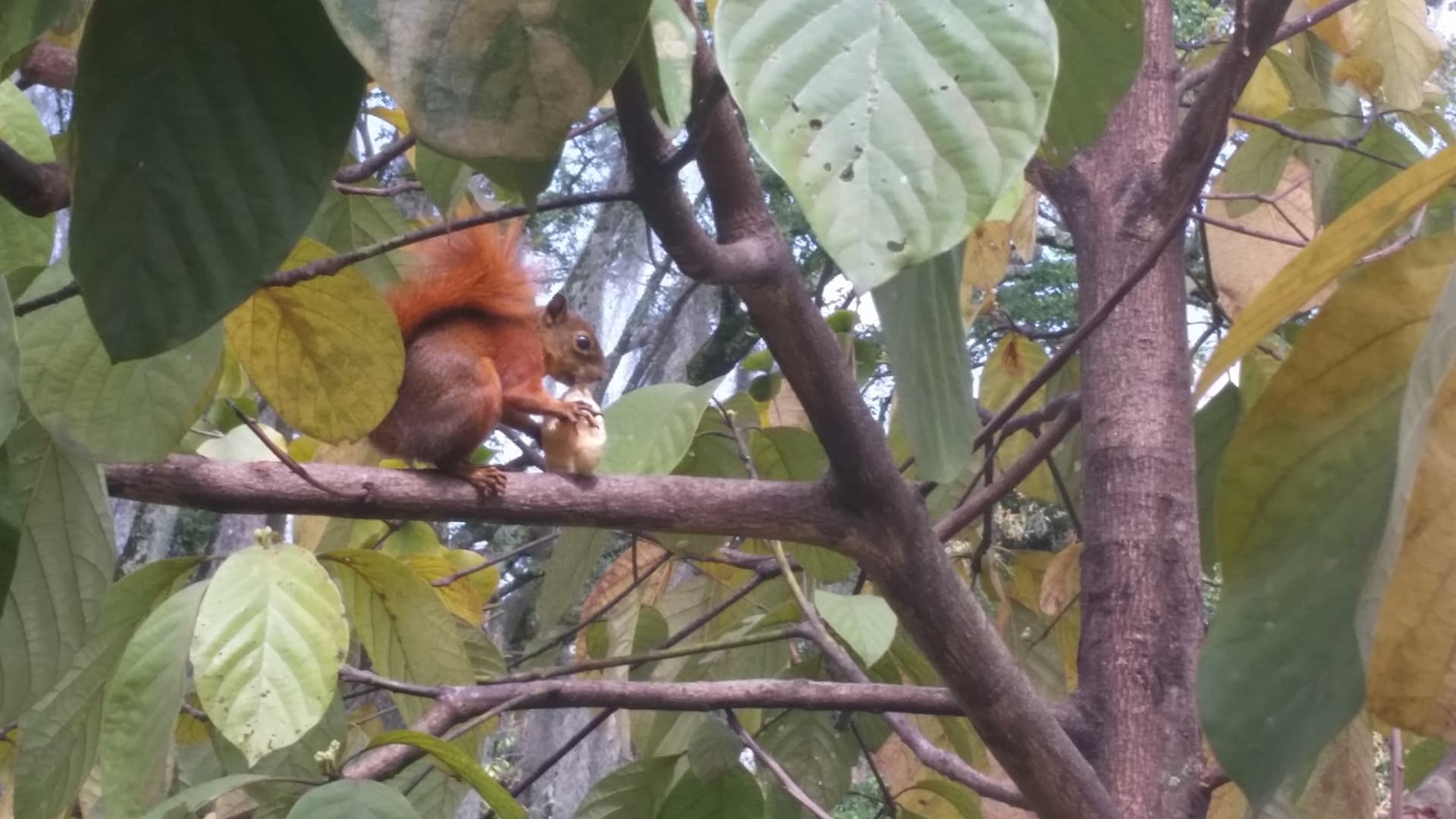
The Red-tailed Squirrel is a medium-sized tree squirrel of northern South America and the southern Caribbean, and it is the only native tree squirrel found in Trinidad. Agile and alert, it spends most of its life in the canopy, where its rusty-coloured tail and quick darting movements give it away.
Appearance
Body colour is highly variable across its range, but animals typically have grizzled brown or grey upperparts and paler, often reddish to orange underparts, with the long bushy tail frequently washed in rich rust-red. The head and body measure roughly 20 to 28 cm, with a tail almost as long again. The Trinidad and Tobago population belongs to the subspecies chapmani, shared with the neighbouring Venezuelan coast.
Behaviour
The Red-tailed Squirrel is diurnal and arboreal, foraging through the trees by day and resting in nests or tree hollows. It is mostly solitary outside the breeding season and uses sharp chattering and tail-flicking signals to warn of danger.
It is an excellent climber and jumper, moving confidently along branches and trunks. Individuals defend favoured feeding areas and will cache food, helping to disperse the seeds of the trees they feed on.
Diet and breeding
The diet centres on fruits, nuts and seeds, with palm fruits often important, supplemented by flowers, fungi and occasionally insects. By carrying off and burying seeds, the squirrel plays a useful ecological role as a seed disperser and predator. Females build leaf-and-twig nests, sometimes in tree cavities, and give birth to small litters of young that are reared in the nest until they are ready to climb.
In Trinidad and Tobago
In Trinidad the Red-tailed Squirrel is the island's only native tree squirrel, found in forests, plantations and wooded areas, including habitats influenced by people. It is widespread and adaptable, and across its large range it is listed as Least Concern with a stable population. Its presence in cocoa estates and forest patches makes it one of the more commonly encountered native mammals.