Reptile
Reptile
Red-footed Tortoise
Chelonoidis carbonarius
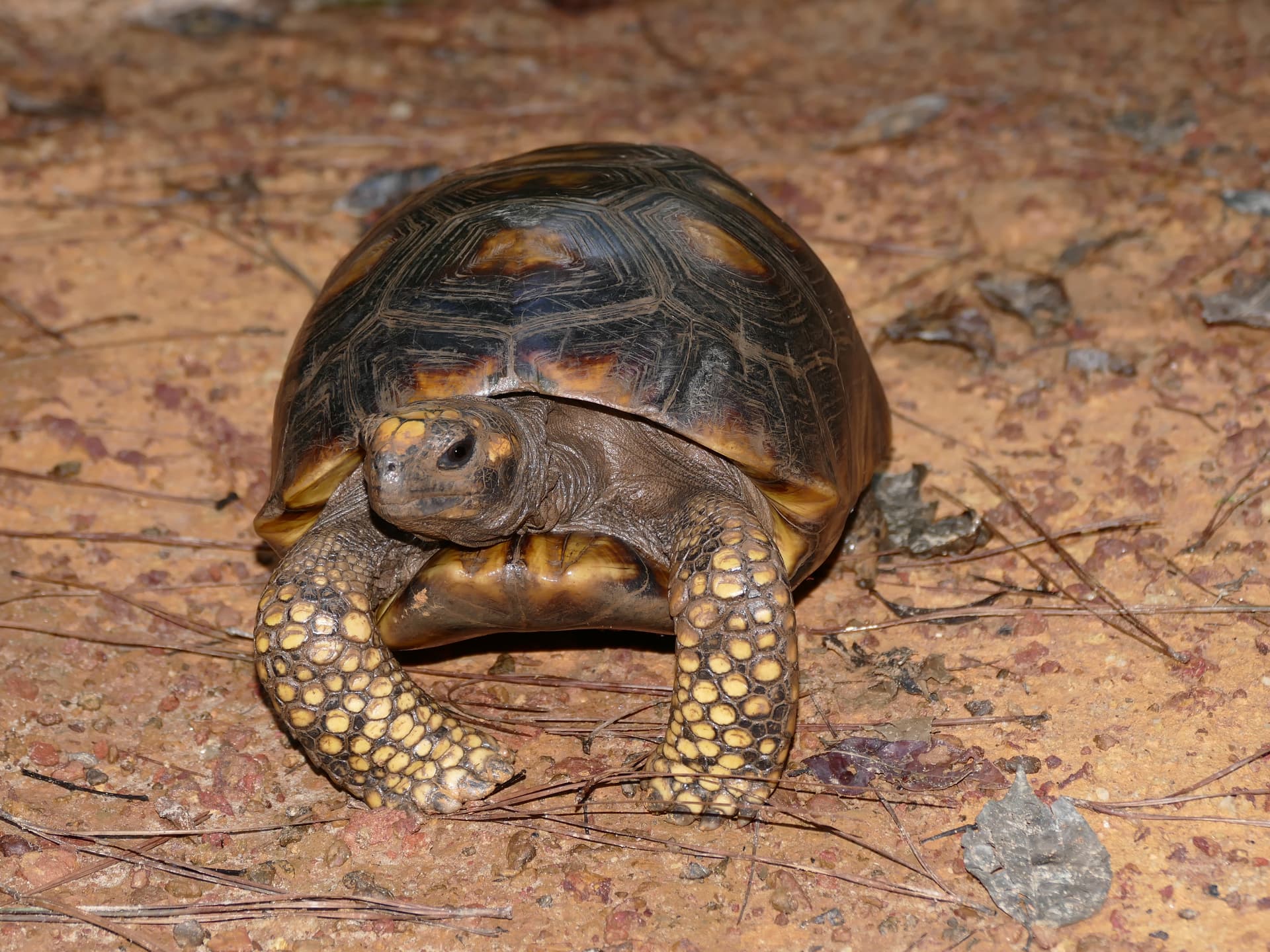
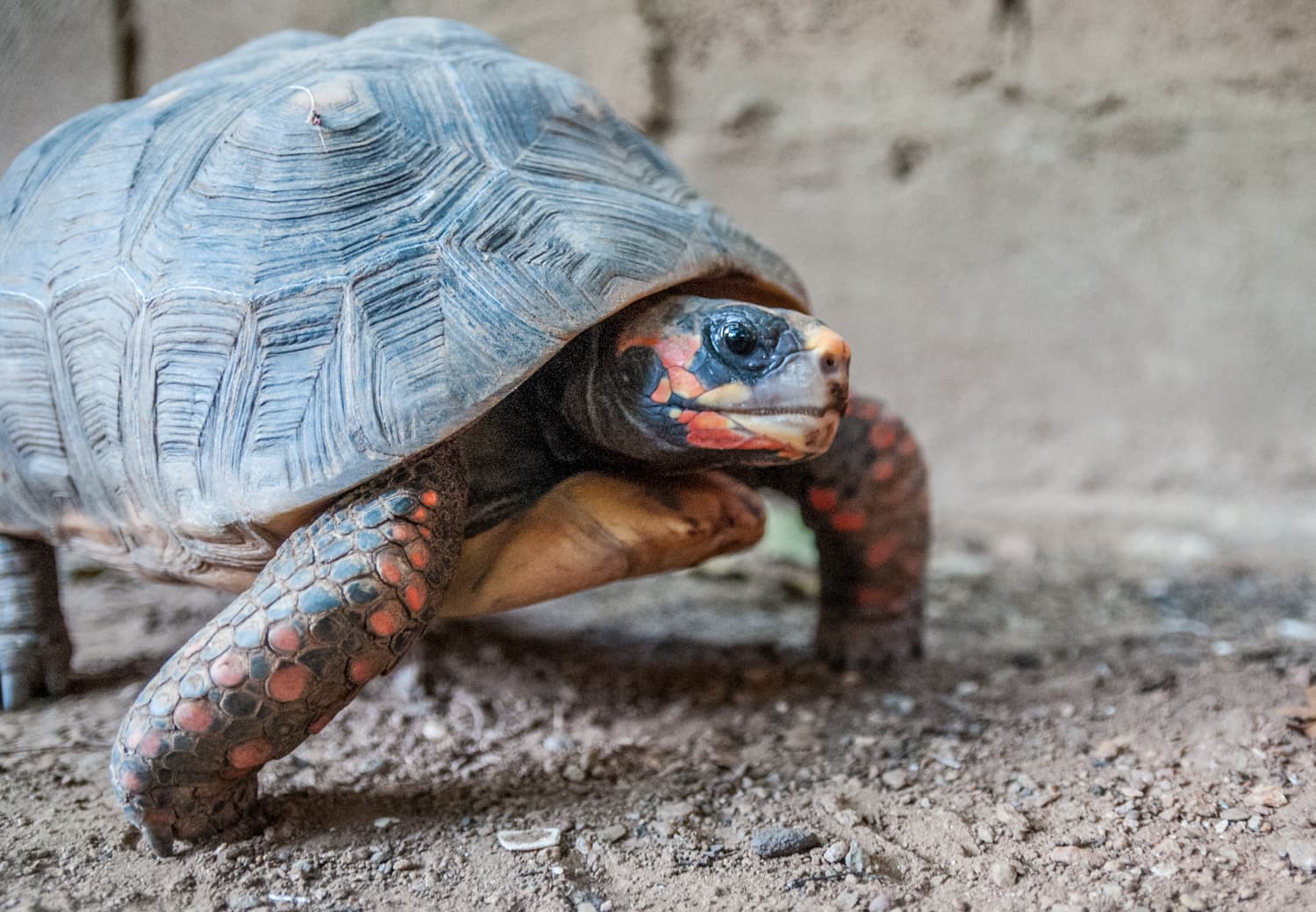
Known locally as the morrocoy, the Red-footed Tortoise is a medium-sized land tortoise of Trinidad and Tobago's forests and savannas, recognised by the brick-red to yellow scales on its head and limbs.
Known locally as the morrocoy, the Red-footed Tortoise is a medium-sized land tortoise of Trinidad and Tobago's forests and savannas, recognised by the brick-red to yellow scales on its head and limbs. It is heavily collected for the local pet trade and for food, and is listed on CITES Appendix II to regulate international trade.
Identification
Adults have an elongated, highly domed carapace with almost parallel sides, typically 30 to 35 cm long, that is dark brown to black with a yellowish patch (aureole) in the centre of each scute. The most distinctive feature is the irregular scaling on the head and limbs, coloured from brick red through orange to pale yellow.
Males are larger and more colourful than females, with a longer, more muscular tail and a concave plastron; females have a short conical tail and a flat plastron. Juveniles are rounder, flatter and paler, and are often more brightly coloured than adults.
Ecology
The Red-footed Tortoise is omnivorous, feeding on fruits, flowers, grasses, fungi, small invertebrates and carrion, and tends to forage around fruiting trees during the cooler parts of the day. It occupies transitional ground between forest (rainforest, dry forest) and savanna, including forest clearings, woodland edges and areas along waterways, favouring warm, humid conditions near 30 degrees Celsius.
It shelters in tree falls, hollow logs, burrows and dense vegetation, and may become inactive (aestivate) when conditions are too hot, too cold, or food is scarce. Breeding peaks in the April to May wet season, with females laying clutches of 2 to 7 spherical eggs that incubate for roughly 150 days.
Status in T&T
The Red-footed Tortoise occurs on both Trinidad and Tobago and may have been introduced to the islands; it is widespread across the Caribbean and northern South America. Locally it is under sustained pressure from collection for the pet trade and for use as food, and adults face few natural predators apart from humans.
The species is listed on CITES Appendix II, meaning international trade is regulated. Its global IUCN status is uncertain: an older Red List assessment of 'Vulnerable' (1996, as Geochelone carbonaria) is still widely cited but is outdated, and the species lacks a current, agreed reassessment. This status should be treated as provisional pending an up-to-date evaluation.