Bird
Bird
Osprey
Pandion haliaetus
The osprey, often called the fish hawk, is a large, fish-eating bird of prey found on every continent except Antarctica.
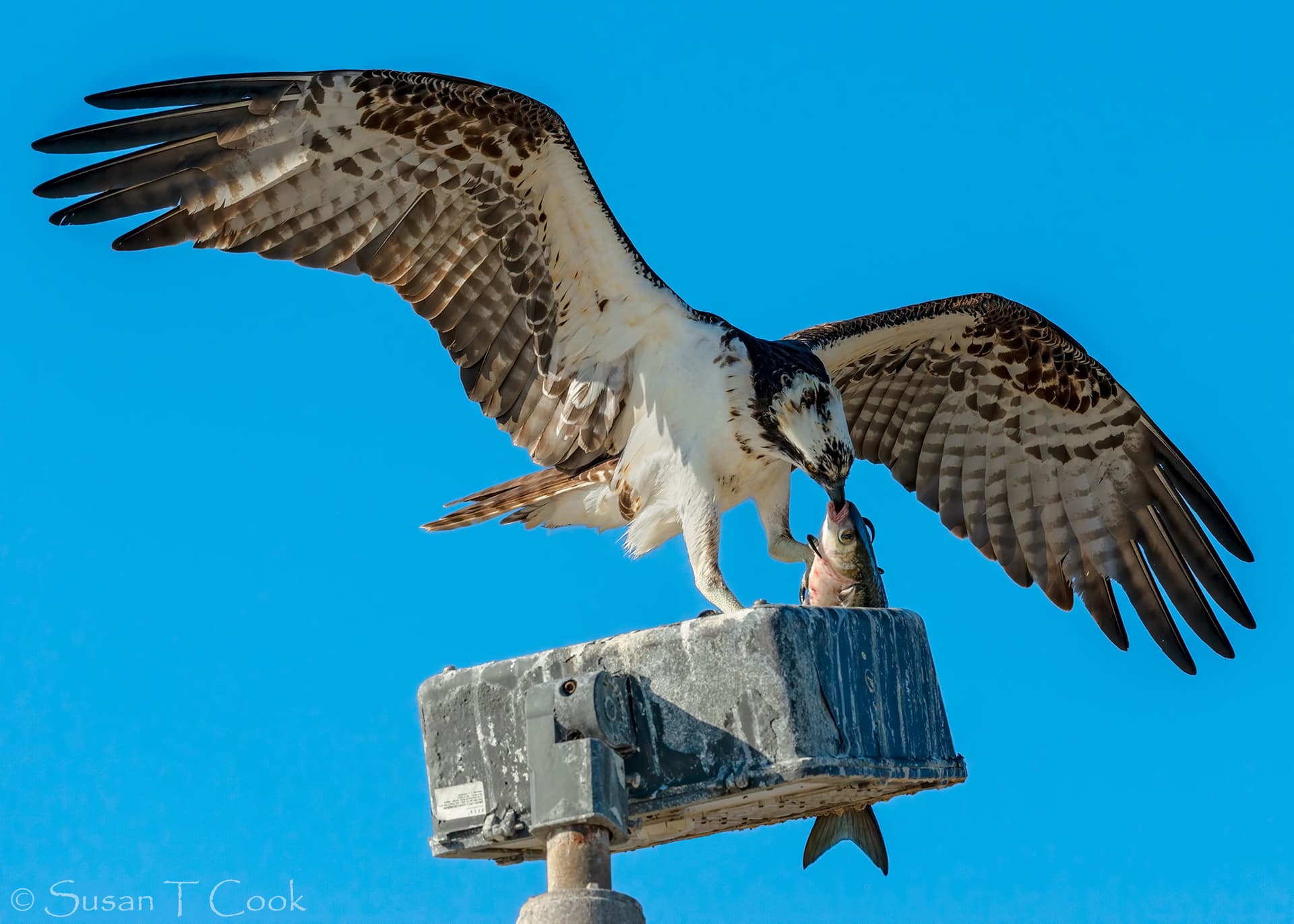
The osprey, often called the fish hawk, is a large, fish-eating bird of prey found on every continent except Antarctica. Built entirely around catching fish, it is a regular seasonal visitor to the coasts and wetlands of Trinidad and Tobago, arriving each October as northern breeding seasons end and departing by April, where it hunts in spectacular plunging dives.
Appearance
The osprey is a large raptor about 55 to 58 cm long with a wingspan of 145 to 170 cm. It is dark brown above and white below, with a white head crossed by a bold dark stripe through the eye. In flight the long wings are held with a distinctive kink at the wrist, showing dark carpal patches. Its feet are specialised for fishing, with a reversible outer toe, sharply curved talons, and rough, spiny pads that grip slippery prey.
Behaviour
Ospreys hunt almost exclusively on the wing, hovering or circling over water before plunging feet-first from as high as 20 m to seize fish near the surface. They carry their catch head-forward to reduce drag and often shake water from their plumage in flight. Largely solitary outside the breeding season, ospreys migrate alone rather than in flocks, and individuals frequently return to favour the same wintering shorelines year after year.
Diet and breeding
Fish make up almost the entire diet, and around Trinidad and Tobago ospreys take coastal and estuarine species such as cutlass fish, mullet, and catfish. On their breeding grounds in the Northern Hemisphere they build bulky stick nests on tall trees, cliffs, and structures, laying two to four eggs incubated for about five weeks; chicks fledge in roughly two months. Ospreys are long-lived, regularly reaching 15 to 20 years or more in the wild.
In Trinidad and Tobago
In Trinidad and Tobago the osprey is a non-breeding visitor, present mainly from around October to April along coasts, mangroves, lagoons, and inland reservoirs after migrating south from North America. It does not nest locally, occurring only as a passage and wintering migrant. The species is globally widespread and listed by the IUCN as Least Concern.