Bird
Bird
King Vulture
Sarcoramphus papa
The King Vulture is the most spectacular raptor in Trinidad, a large, commanding bird whose striking black-and-white plumage, brightly coloured bare head, and deliberate soaring flight over the Northern Range canopy make it one of the most sought-after sightings for naturalists on the island.
The King Vulture is the most spectacular raptor in Trinidad, a large, commanding bird whose striking black-and-white plumage, brightly coloured bare head, and deliberate soaring flight over the Northern Range canopy make it one of the most sought-after sightings for naturalists on the island. The dominant scavenger of T&T's primary forests, the King Vulture's presence is a reliable indicator of intact, undisturbed lowland and montane forest.
Identification
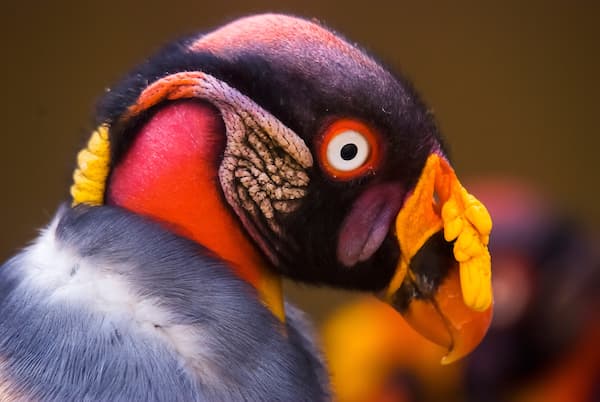
The King Vulture is a large bird measuring 71 to 81 cm with a wingspan reaching 170 to 200 cm. Adults are unmistakable: the body is creamy white, the flight feathers and broad ruff around the neck are jet black, and the head is entirely bare with a mosaic of orange, yellow, red, purple, and grey skin, plus a prominent orange fleshy caruncle above the bill. The eye is white with a red ring. Immature birds are entirely black and pass through several intermediate plumages before reaching adult colouring at around four years of age. In flight, the broad, flat wings held horizontally and the short tail are distinctive.
Ecology
King Vultures are obligate scavengers, feeding almost entirely on carrion discovered by soaring high above the forest canopy. They locate carcasses primarily by following Turkey Vultures and Black Vultures, which find food by smell; the King Vulture then displaces smaller species and uses its powerful bill to open tough hides that smaller vultures cannot penetrate. This dominant feeding role gives the species its name. It requires large expanses of primary or mature secondary forest and is thus absent from highly deforested landscapes. In Trinidad, sightings are concentrated over the Northern Range, the Trinity Hills, and the Nariva area.
Legal Protection
The King Vulture is fully protected under the Conservation of Wild Life Act and is not a game species. Under CITES it carries only an Appendix III listing (entered by Honduras, not a global Appendix I/II listing), so its international trade protection is far weaker than for most other T&T raptors; its main safeguard in T&T is national legislation. As a forest-dependent species sensitive to habitat fragmentation, its conservation in T&T depends principally on protecting the remaining primary and mature secondary forest on Trinidad. Its low reproductive rate (one egg per year; slow maturation) means populations recover very slowly from any losses.
Threats
- Primary forest loss
- Forest fragmentation reducing foraging range
- Low reproductive rate slowing recovery
- Illegal shooting