Reptile
Reptile
Green Iguana
Iguana iguana
The Green Iguana (Iguana iguana) is the largest lizard native to Trinidad and Tobago and one of the most familiar reptiles on the islands, often seen basking high in trees along rivers, swamps and coastlines.
The Green Iguana (Iguana iguana) is the largest lizard native to Trinidad and Tobago and one of the most familiar reptiles on the islands, often seen basking high in trees along rivers, swamps and coastlines. A large arboreal herbivore that can exceed 1.5 metres including the tail, it is widespread across the Neotropics from Mexico to South America and is common in both Trinidad and Tobago. Locally it occupies an unusual place: it is prized as bush meat ('iguana' is a traditional dish) and is one of the few reptiles classed as a game animal under the Conservation of Wild Life Act, hunted legally during a defined open season.
Identification
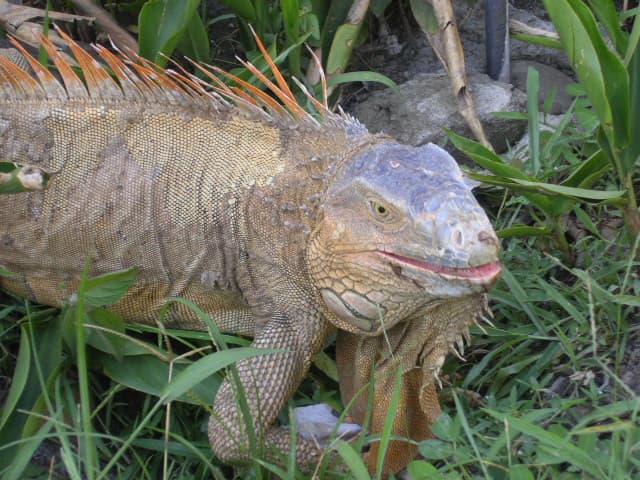
The Green Iguana is easily recognised by its large body, a prominent crest of enlarged scales running along the neck and back, a hanging dewlap under the throat, and a long banded tail. A large circular scale (the subtympanic plate) sits below each ear opening. Despite the name, colour varies widely: females and smaller males range from bright to dull green, while large mature males turn grey, gold or tan. Males have bigger heads, larger femoral pores and longer dorsal spines than females.
Ecology
Green Iguanas are arboreal and diurnal, typically living near water in well-foliaged trees and often remaining in the same tree for days or weeks, descending mainly to bask or move between trees. They are strong swimmers and will drop into water to escape predators.
The species is essentially an opportunistic vegetarian, feeding on leaves, flowers and fruits, supplemented occasionally by beach-washed vegetation and the odd bird egg. Females lay large clutches of eggs in burrows dug in sandy soil, and the nesting season is the reason hunting is restricted at certain times of year.
Status in T&T
Globally the Green Iguana is listed as Least Concern by the IUCN, and it remains common in Trinidad and Tobago. It is, however, in CITES Appendix II, so international trade is regulated. In T&T it is one of the named game animals under the Conservation of Wild Life Act (Chapter 67:01) and may be taken only by licensed hunters during the open season.
Iguana hunting closes earlier than other game: it must end by midnight on December 31, with possession prohibited in January, February and March to protect the nesting season, and offences carry fines. Hunting lizards is also banned within the municipal boundaries of Port of Spain.