Bird
Bird
Green Hermit
Phaethornis guy
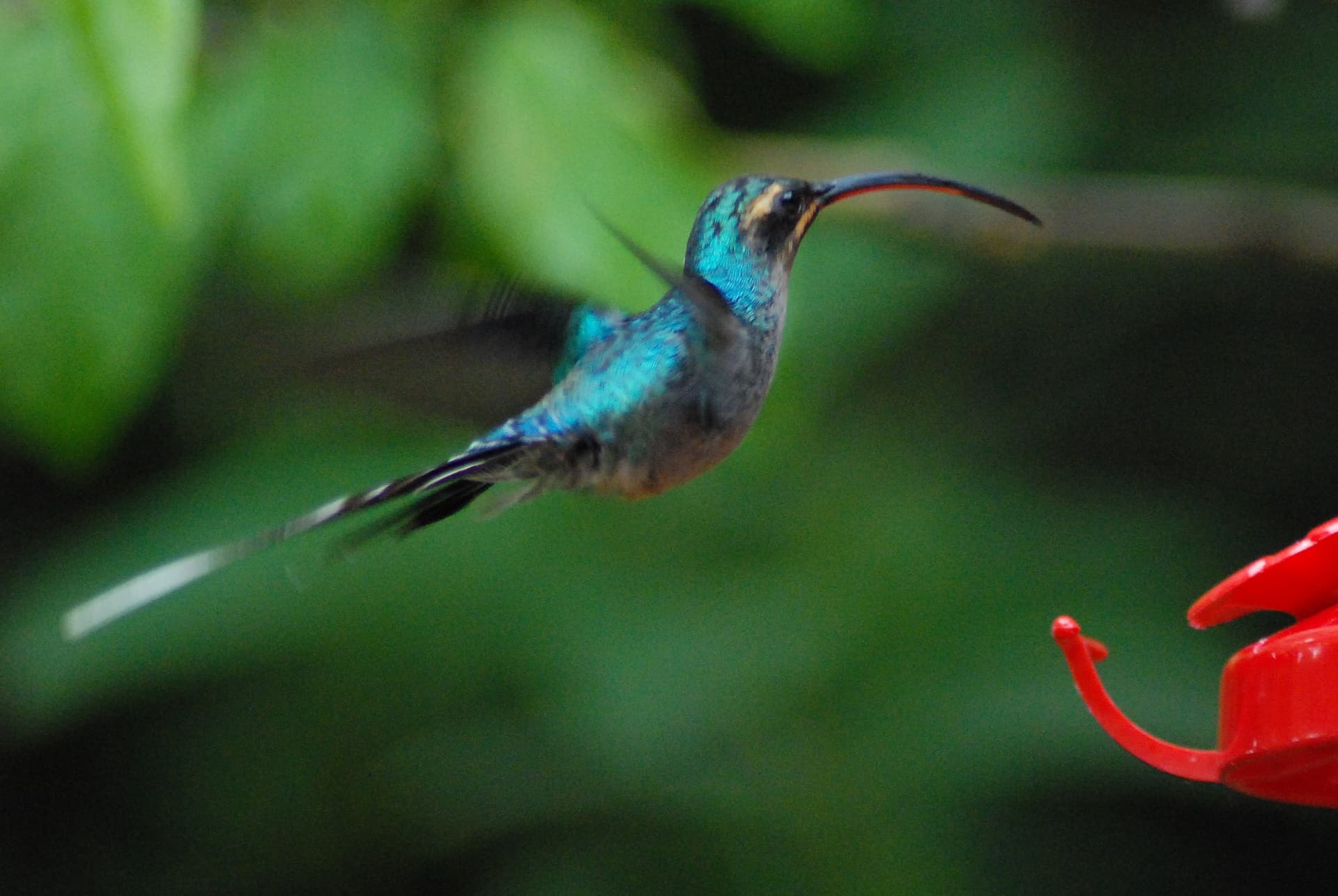
The Green Hermit is a large, long-tailed hummingbird of Trinidad's forest interior, best known for its participation in communal display grounds, or leks, where males gather to sing and compete for the attention of visiting females deep in the forest understorey.
The Green Hermit is a large, long-tailed hummingbird of Trinidad's forest interior, best known for its participation in communal display grounds, or leks, where males gather to sing and compete for the attention of visiting females deep in the forest understorey.
Identification
One of the larger hermit hummingbirds, around 14 to 16 cm including its notably long, white-tipped, central tail streamers, which extend well beyond the rest of the tail. Plumage is bronze-green above with duller, greyish-green underparts, and the long, decurved bill is typical of the hermit group. The combination of large size, long curved bill, and elongated tail streamers distinguishes it from smaller hermits sharing its forest habitat.
Ecology
The Green Hermit feeds on nectar from a range of forest understorey flowers via traplining, and also takes small insects. Males gather at traditional lek sites in the forest understorey, where they sing repetitive, insect-like songs from favoured perches for extended periods to attract females, a mating system shared by several hermit species. Females build a cone-shaped nest attached to the underside of a broad leaf, generally away from the lek site.
Status in T&T
Found in forest interior and understorey across Trinidad's forested areas, particularly the Northern Range, where its lekking behaviour has been well documented at established sites. It is not threatened, though its dependence on intact forest understorey makes it sensitive to habitat degradation. It is protected under the Conservation of Wildlife Act and is not a game species.
Threats
- Forest clearance and understorey degradation, particularly at lek sites