Bird
Bird
Fork-tailed Flycatcher
Tyrannus savana
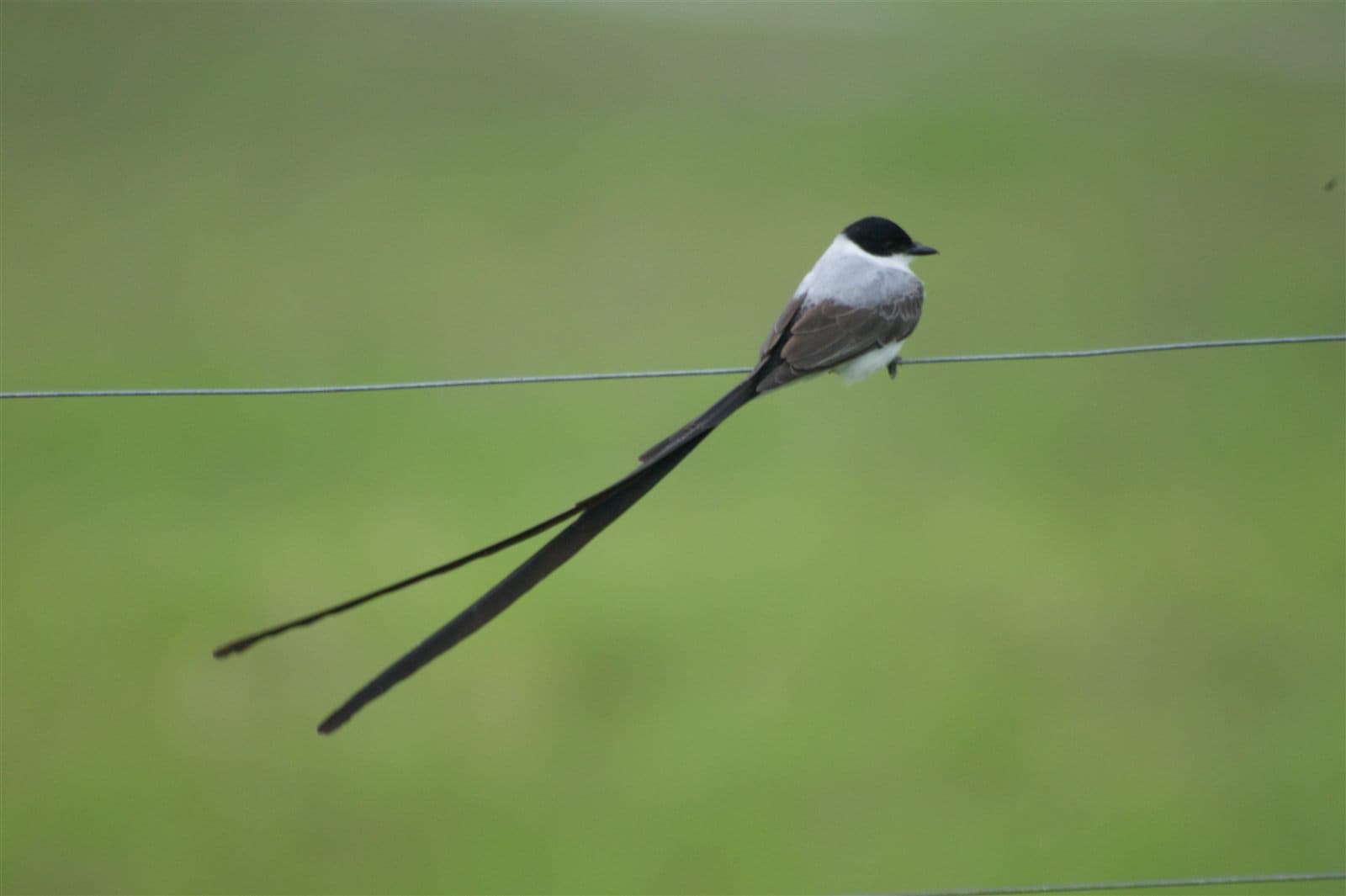
The Fork-tailed Flycatcher is one of the most visually striking birds recorded in Trinidad, its extraordinarily long, deeply forked black tail streaming behind it in flight, well over twice the length of its small, pale body.
The Fork-tailed Flycatcher is one of the most visually striking birds recorded in Trinidad, its extraordinarily long, deeply forked black tail streaming behind it in flight, well over twice the length of its small, pale body.
Identification
A small-bodied flycatcher around 20 cm long excluding the tail, but with adult males possessing an extraordinarily elongated, deeply forked black tail that can more than double the total length of the bird, sometimes exceeding 25 cm on its own. The head and back are black, the underparts pale grey-white, and a partially concealed yellow crown patch is present but rarely visible. Females and immatures have proportionally shorter tails than adult males.
Ecology
The Fork-tailed Flycatcher hunts flying insects by sallying from an exposed perch in open savanna, grassland, and agricultural land, and its long tail streams dramatically behind it during flight and aerial manoeuvres. Some populations are strongly migratory within South America, moving seasonally between breeding and non-breeding ranges, and birds recorded in Trinidad may include both local breeders and austral migrants moving north from temperate South American breeding grounds during the southern winter.
Status in T&T
Recorded in open savanna and grassland on Trinidad, generally in lower numbers than the common resident kingbirds, with some records likely representing austral migrants from temperate South America rather than local breeders. It is not threatened. It is protected under the Conservation of Wildlife Act and is not a game species.
Threats
- Loss of open savanna and grassland habitat