Bird
Bird
Black Vulture
Coragyps atratus
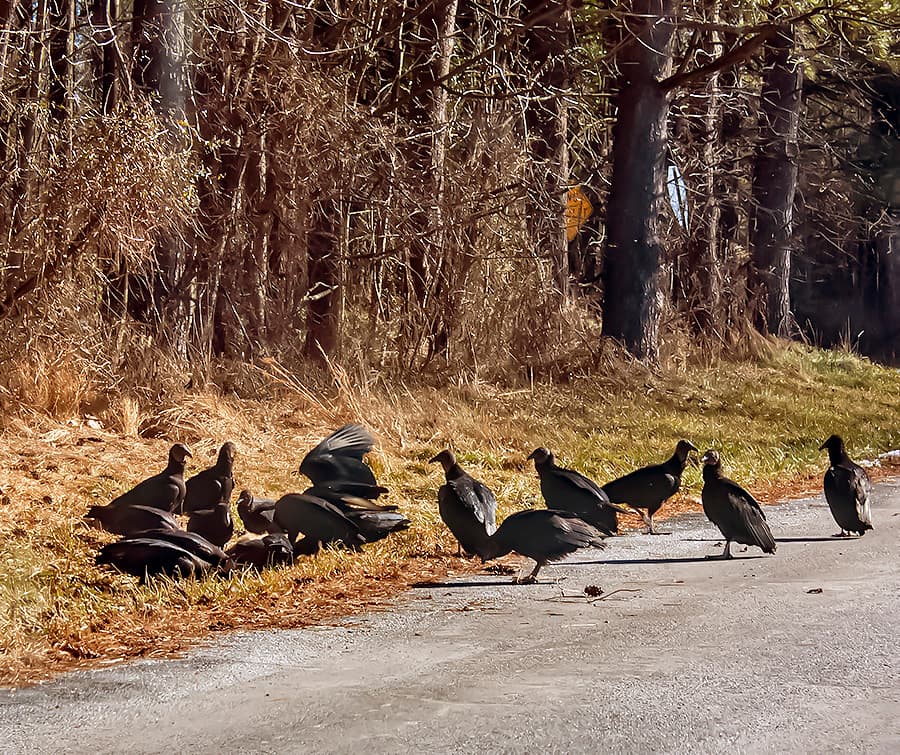
The Black Vulture is the most abundant vulture in the Americas and one of the most familiar large birds of T&T's open country, commonly seen soaring on flat wings over urban outskirts, agricultural land, and rubbish tips, or perched in hunched groups on telephone poles and trees near carrion.
The Black Vulture is the most abundant vulture in the Americas and one of the most familiar large birds of T&T's open country, commonly seen soaring on flat wings over urban outskirts, agricultural land, and rubbish tips, or perched in hunched groups on telephone poles and trees near carrion. Entirely black with a bare grey-black wrinkled head, it is distinguished from the Turkey Vulture by its shorter tail, white wing-tip patches visible in flight, and the flat rather than V-shaped wing posture when soaring. Unlike the Turkey Vulture it finds food primarily by sight rather than smell, and frequently follows turkey vultures to carcasses it could not locate independently.
Identification
The Black Vulture measures 56 to 74 cm with a wingspan of 132 to 167 cm. The entire plumage is black. The head and upper neck are bare with grey-black, heavily wrinkled skin. The tail is short and squared. In flight the wings are broad and relatively short, held flat (not in a V-dihedral), and the wingtips show distinctive silvery-white patches on the underside of the primary feathers, contrasting with otherwise black wings. The wingbeat is rapid and interspersed with glides. The bill is hooked and pale ivory. Juveniles have smoother, darker facial skin that wrinkles and lightens with age.
Ecology
Black Vultures are obligate scavengers, feeding almost exclusively on carrion. They locate food primarily by sight, scanning from high altitude and watching for other scavengers descending to a carcass. They often displace smaller Turkey Vultures at carcasses through numerical dominance and aggressive behaviour, despite having a weaker sense of smell. They are highly gregarious, roosting communally in groups of dozens to hundreds and foraging in loose flocks. Pairs are monogamous and long-lasting; nests are simple scrapes in caves, hollow logs, or on the ground, with 1 to 3 eggs.
Status in T&T
The Black Vulture is a common year-round resident on both Trinidad and Tobago, often outnumbering the Turkey Vulture in and around urban and agricultural areas. Both species are ecologically essential for disease prevention and carcass removal. The Black Vulture is fully protected under the Conservation of Wild Life Act and is not a game species. Despite cultural associations that sometimes lead to persecution, it performs a critical sanitation role in T&T's ecosystems.
Threats
- Secondary poisoning from lead shot in carcasses
- Illegal shooting and persecution
- Vehicle collision while feeding on road kills