Bird
Bird
Eared Dove
Zenaida auriculata
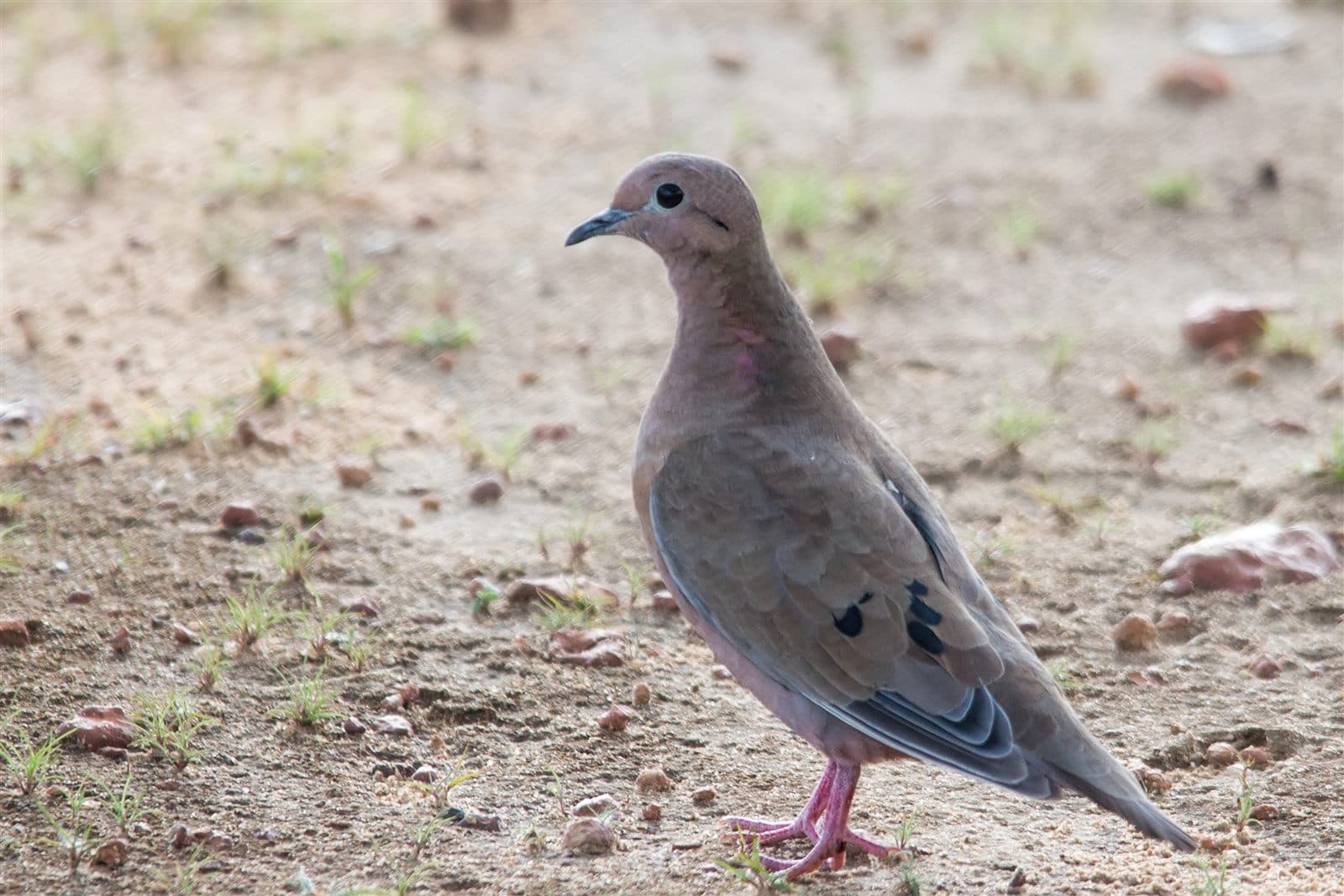
The Eared Dove is a widespread, adaptable dove of open country and agricultural land across Trinidad and Tobago, named for a small dark crescent mark below the eye resembling an ear, and closely related to game doves hunted seasonally elsewhere in its South American range.
The Eared Dove is a widespread, adaptable dove of open country and agricultural land across Trinidad and Tobago, named for a small dark crescent mark below the eye resembling an ear, and closely related to game doves hunted seasonally elsewhere in its South American range.
Identification
A medium-sized dove around 22 to 25 cm long, greyish-brown above with a pinkish tinge on the breast, and a small, distinctive black crescent-shaped mark on the side of the face below the eye, from which the common name derives. A few scattered black spots mark the upper wing coverts, and the tail is squared with pale grey-brown outer feathers, unlike the pointed tail of the closely related Mourning Dove found elsewhere.
Ecology
The Eared Dove feeds primarily on seeds and grains, foraging on open ground in agricultural fields, savanna, and roadside verges, frequently in small to large flocks outside the breeding season. It is a highly adaptable species capable of exploiting cultivated cropland, and in parts of its mainland South American range large flocks are considered an agricultural pest and legally hunted; in T&T it occurs at lower densities and is not associated with the same conflict. Its cooing call is a soft, repeated series of low notes.
Status in T&T
Found in open savanna, agricultural land, and grassland on both Trinidad and Tobago, generally less common and more locally distributed than the Ruddy Ground Dove or White-tipped Dove. It is not threatened. It is protected under the Conservation of Wildlife Act as native wildlife.
Threats
- Habitat loss from conversion of open savanna to intensive agriculture or development