Bird
Bird
Crimson-crested Woodpecker
Campephilus melanoleucos
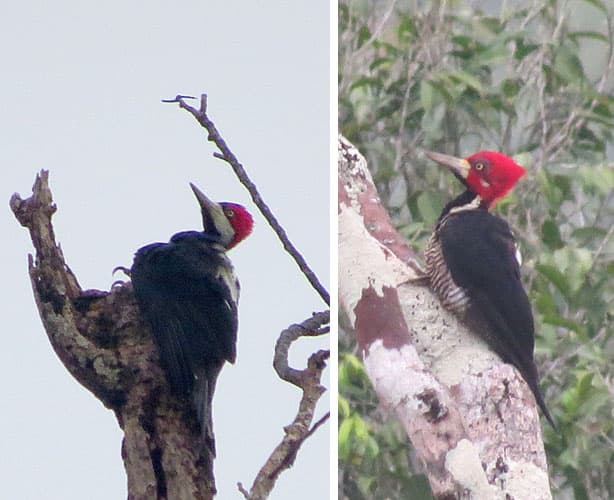
The Crimson-crested Woodpecker is one of the largest and most striking woodpeckers found in Trinidad, instantly recognisable by its flaming red head and crest set against a black-and-white body.
The Crimson-crested Woodpecker is one of the largest and most striking woodpeckers found in Trinidad, instantly recognisable by its flaming red head and crest set against a black-and-white body. It belongs to the genus Campephilus, the powerful woodpeckers that hammer with such force their double-knock drumming echoes through the forest.
Appearance
This is a big woodpecker, 33 to 36 cm long and weighing 225 to 281 g, with a heavy chisel-tipped bill. The entire head and prominent pointed crest are bright crimson, broken only by a black-and-white patch at the base of the bill. The back is black with a bold white V formed by stripes running down each side, and the belly is barred buff and black. Males show an all-red face while females have a black-and-white bar across the cheek, an easy way to tell the sexes apart.
Behaviour
Pairs work their way up tree trunks and large limbs, bracing on stiff tail feathers as they chisel into bark and wood. Their loud, ringing calls and characteristic double-knock drumming carry a long way and often announce the bird before it is seen.
They are usually found in pairs or family groups and range widely through their territory, favouring tall trees and dead snags where wood-boring insects are abundant.
Diet and breeding
The diet is built around wood-boring beetle larvae, ants, termites and other insects prised from beneath bark, supplemented at times with fruit and berries. The powerful bill lets the bird excavate deep into living and dead timber that smaller species cannot reach. Both sexes excavate a nest cavity high in a tree, and both share incubation of the two to four white eggs and the feeding of the young. The abandoned cavities they leave behind become valuable nest sites for other forest birds and mammals.
In Trinidad and Tobago
The nominate subspecies occurs on Trinidad, where it is a fairly common resident of forested areas, forest edges and wooded estates, though it is absent from Tobago. It depends on mature trees and standing dead wood, so it benefits from the protection of forested habitat. Globally the species is listed as Least Concern.