Bird
Bird
Chestnut Woodpecker
Celeus elegans
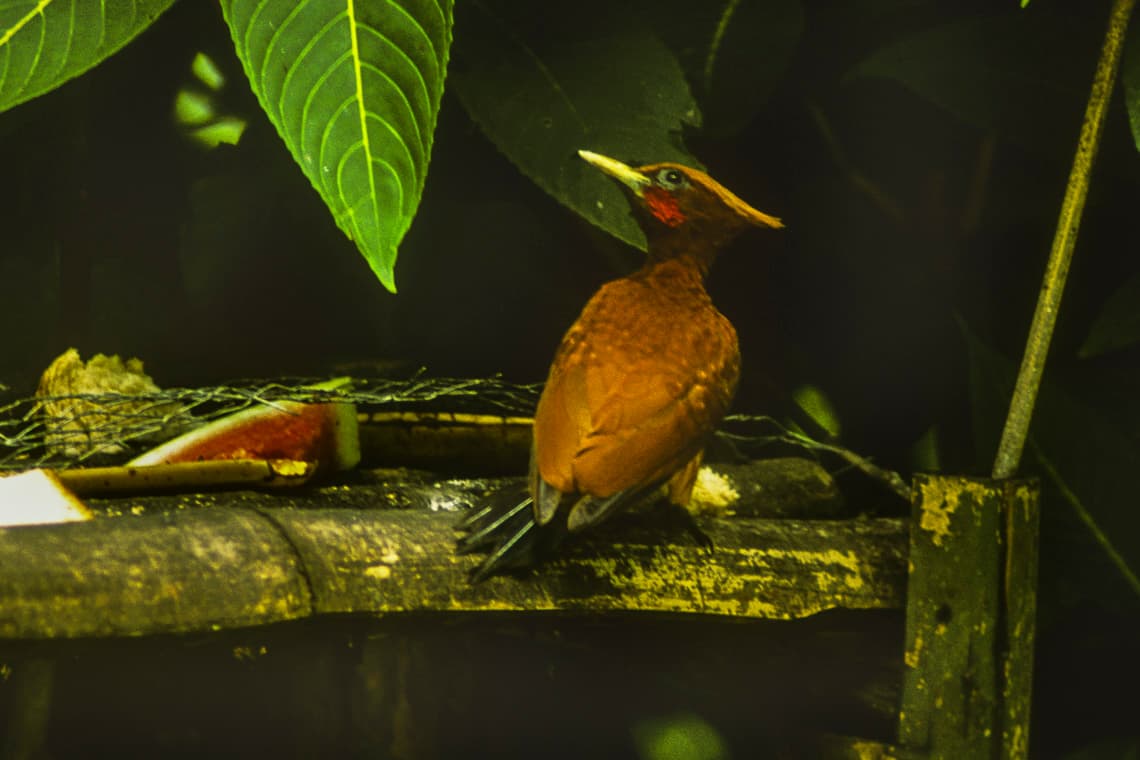
The Chestnut Woodpecker is a warm rufous-brown woodpecker of Trinidad's forest interior, distinguished by its shaggy, often erected crest and a distinctive pale, curved bill, moving methodically along trunks and branches in search of wood-boring insects.
The Chestnut Woodpecker is a warm rufous-brown woodpecker of Trinidad's forest interior, distinguished by its shaggy, often erected crest and a distinctive pale, curved bill, moving methodically along trunks and branches in search of wood-boring insects.
Identification
A medium-sized woodpecker around 24 to 28 cm long, rich chestnut to rufous-brown overall with fine darker barring on the wings and back, and a shaggy, pointed crest frequently raised when the bird is alert or calling. The bill is pale, ivory to horn-coloured, and gently curved rather than the straight chisel-bill typical of most woodpeckers. Males typically show a red malar stripe absent in females.
Ecology
The Chestnut Woodpecker forages by climbing and probing tree trunks and branches for wood-boring beetle larvae, ants, and other invertebrates, occasionally supplementing its diet with fruit. It excavates its own nest cavity in a dead or decaying tree trunk, and is generally encountered singly or in pairs moving through the mid-storey and canopy of mature forest, sometimes joining mixed-species foraging flocks.
Status in T&T
Found in mature forest and forest edge across Trinidad, generally favouring less disturbed woodland with sufficient standing dead wood for foraging and nesting. It is not threatened. It is protected under the Conservation of Wildlife Act and is not a game species.
Threats
- Loss of mature forest and standing dead wood for nesting