Bird
Bird
Channel-billed Toucan
Ramphastos vitellinus
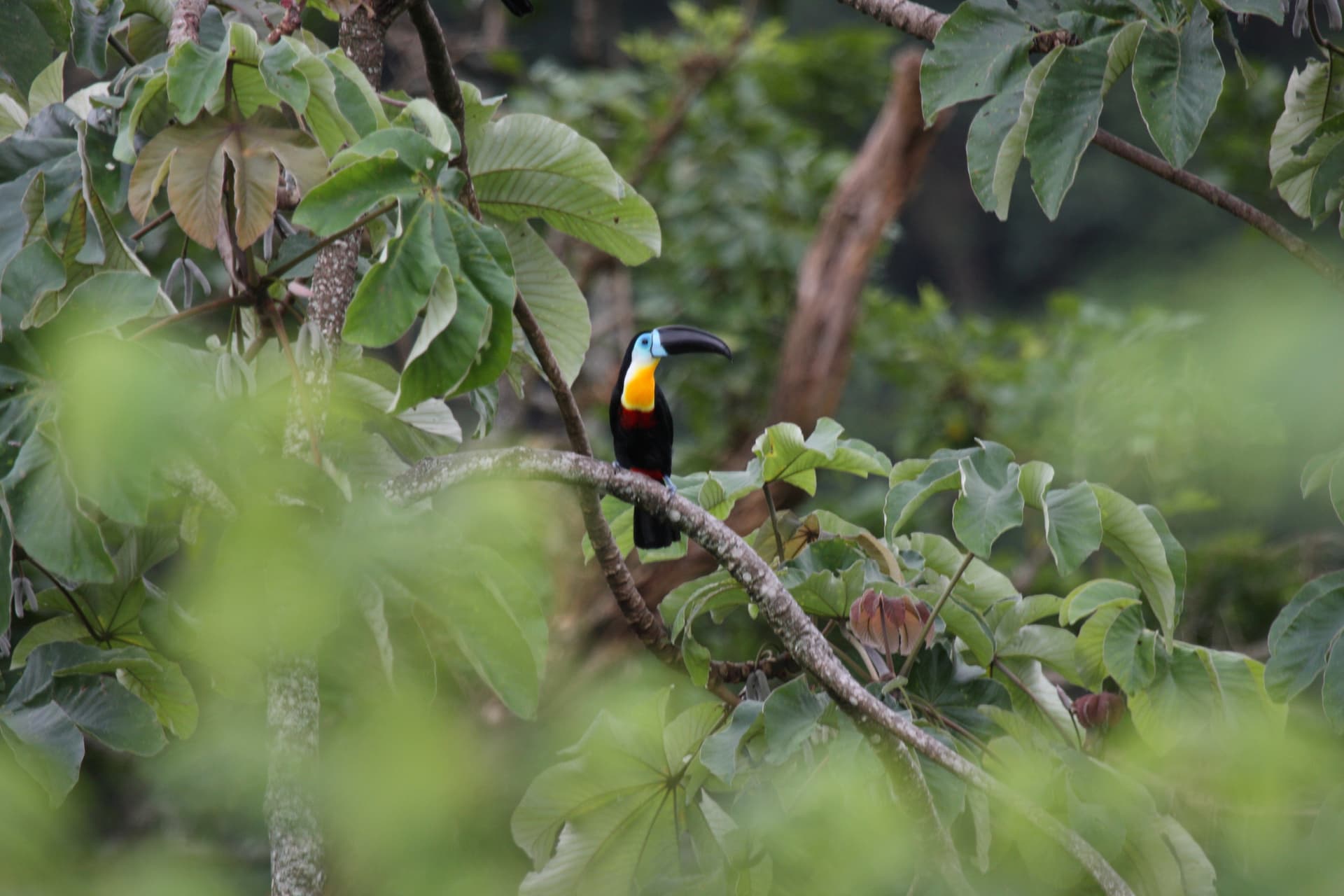
The Channel-billed Toucan is the resident toucan of Trinidad's forests, an unmistakable black bird with a vivid orange-yellow throat and a huge ridged bill.
The Channel-billed Toucan is the resident toucan of Trinidad's forests, an unmistakable black bird with a vivid orange-yellow throat and a huge ridged bill. It occurs on Trinidad but not on Tobago, and is most readily found in the forests of the Northern Range.
Identification
A large, glossy black toucan reaching roughly 48 cm in length, with a bill of about 9 to 14 cm. The throat and upper breast are bright orange-yellow, bordered below by a narrow red band, and there is a patch of bare blue skin around the eye. The enormous, ridged bill is mostly black with a paler base, and the bird typically weighs between 300 and 430 grams.
Ecology
This is primarily a fruit-eating bird, taking lipid-rich fruits of Virola and Euterpe palms along with Cecropia, Ficus and Nectandra; it also takes insects, eggs, and small vertebrates. Toucans move through the forest canopy in pairs or small groups and nest in tree cavities, where both parents share incubation of the eggs.
As a wide-ranging frugivore that swallows fruit whole and passes the seeds, it is an important seed disperser in forest ecosystems. Its call is a repeated, high-pitched croaking or yelping note.
Status in T&T
In Trinidad the Channel-billed Toucan is a fairly common resident of forested areas, especially in the Northern Range, and it is absent from Tobago. Globally the species is currently assessed as Least Concern on the IUCN Red List, though older BirdLife assessments of the broader complex classified it as Vulnerable on the basis of projected Amazonian deforestation and hunting pressure. Like all toucans it is listed on CITES Appendix II, regulating international trade.