Bird
Bird
Boat-billed Flycatcher
Megarynchus pitangua
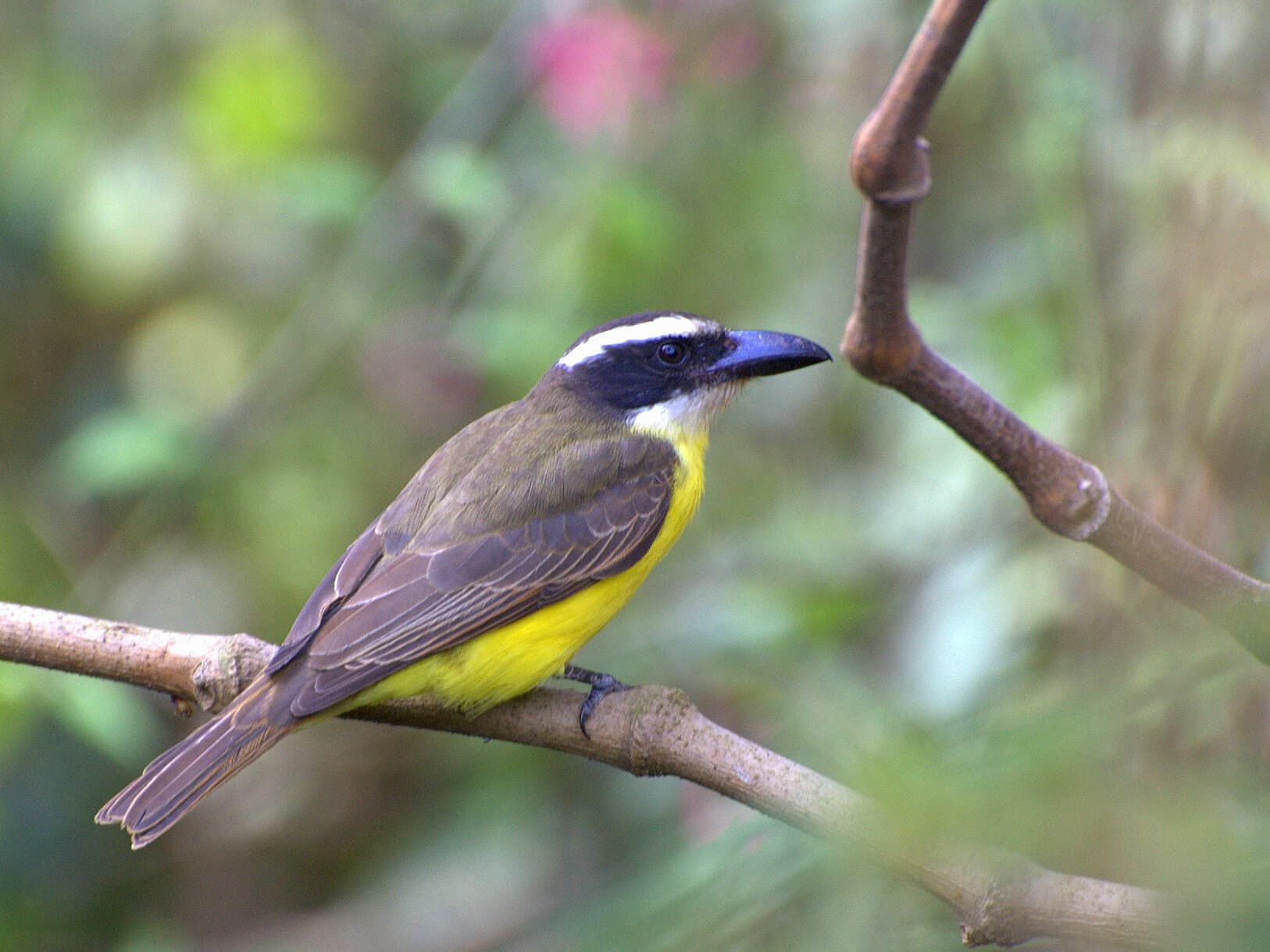
The Boat-billed Flycatcher closely resembles the familiar Great Kiskadee but is distinguished by its notably heavier, broader bill and quieter, more subdued habits, favouring the forest canopy rather than the open, conspicuous perches typical of its more common relative.
The Boat-billed Flycatcher closely resembles the familiar Great Kiskadee but is distinguished by its notably heavier, broader bill and quieter, more subdued habits, favouring the forest canopy rather than the open, conspicuous perches typical of its more common relative.
Identification
A large flycatcher around 22 to 23 cm long, with a black head marked by a bold white eyebrow and a partially concealed yellow crown patch, an olive-brown back, and bright yellow underparts, a pattern closely resembling the Great Kiskadee. It is best distinguished by its noticeably heavier, broader, boat-shaped bill, giving the species its common name, and by its quieter, less conspicuous behaviour, generally remaining in the canopy rather than perching in the open.
Ecology
The Boat-billed Flycatcher feeds on large insects, small vertebrates, and fruit, foraging in the forest canopy and at forest edge, often more secretively than the bolder, more visible Great Kiskadee. It builds a bulky, domed nest with a side entrance, typically placed high in a tree, and is generally encountered singly or in pairs rather than in the loose family groups typical of kiskadees.
Status in T&T
Found in forest and forest edge across Trinidad, generally less numerous and less conspicuous than the very common Great Kiskadee. It is not threatened. It is protected under the Conservation of Wildlife Act and is not a game species.
Threats
- Forest clearance and fragmentation