Invertebrate
Invertebrate
Caribbean Spiny Lobster
Panulirus argus
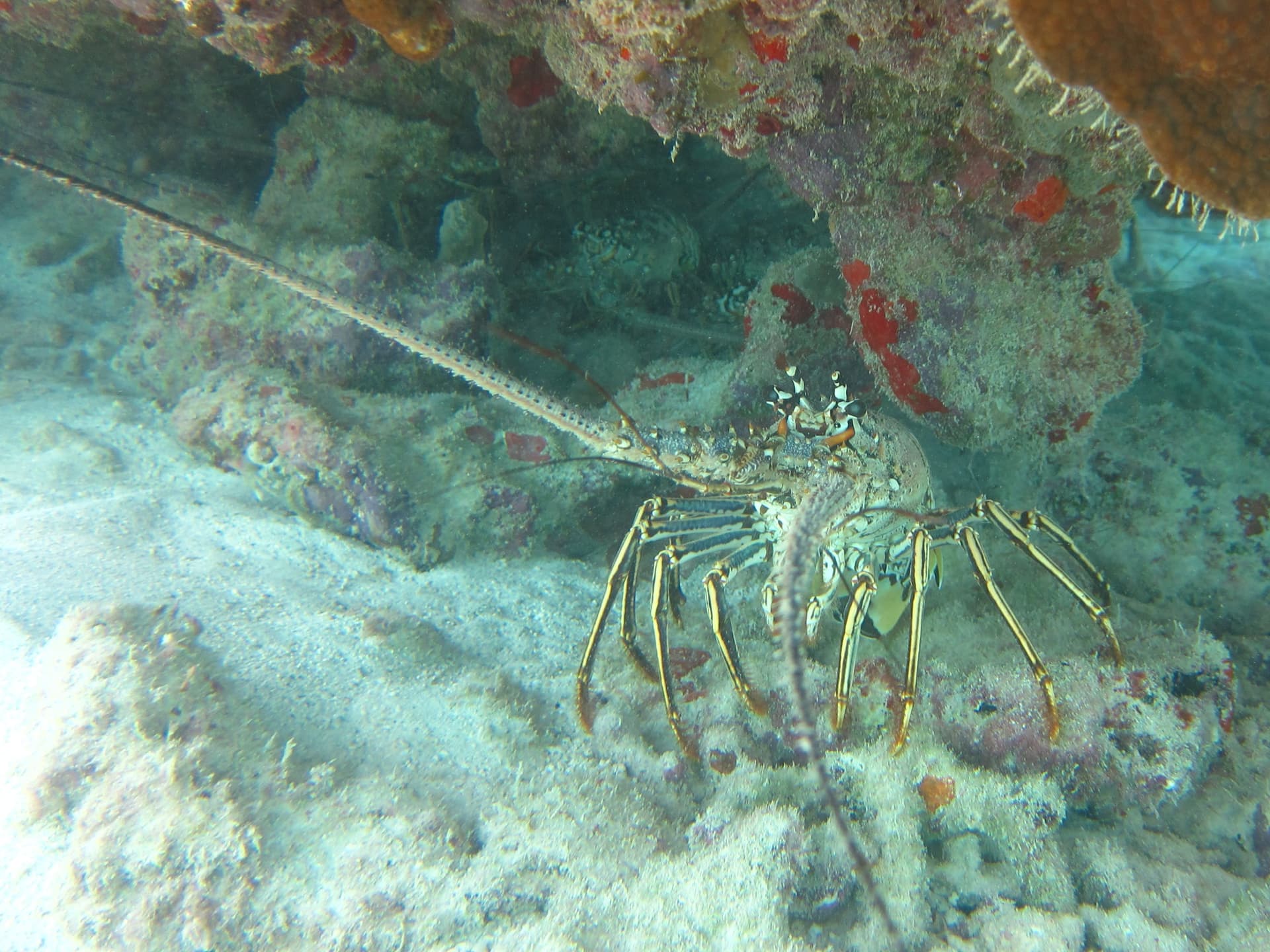
The Caribbean spiny lobster is the familiar reef lobster of the warm western Atlantic, instantly recognised by its long, whip-like antennae and the lack of the large front claws that crayfish-style lobsters carry.
The Caribbean spiny lobster is the familiar reef lobster of the warm western Atlantic, instantly recognised by its long, whip-like antennae and the lack of the large front claws that crayfish-style lobsters carry. Its tan to reddish shell is dotted with pale spots and armoured with forward-pointing spines for defence. It is a cornerstone of Caribbean reef ecosystems and one of the region's most valuable fisheries.
Appearance
Instead of large pincers it has two enormously long, spiny antennae used to fend off predators, plus a pair of smaller antennules that sense the water. The carapace and tail are tan, olive or reddish-brown studded with characteristic pale yellow and dark spots, and the body is covered in sharp forward-curving spines. Adults commonly reach 20 to 40 cm in body length.
Behaviour
Spiny lobsters are nocturnal, sheltering by day in reef crevices and under ledges and emerging after dark to forage across the seabed. When threatened they rasp the antennae against a file-like structure near the eyes to produce a defensive screech, and they back into crevices presenting their spiny defences.
They are famous for spectacular single-file mass migrations, when long queues of lobsters march across open bottom in autumn, each maintaining contact with the one ahead.
Diet and breeding
The diet consists mainly of snails, clams, crabs and other small invertebrates, along with carrion, crushed by strong mouthparts. Females carry tens of thousands to over a million bright orange eggs cemented beneath the tail until they hatch. A notable feature is the long planktonic larval phase: the flattened, transparent phyllosoma larvae drift in ocean currents for months before settling, which links lobster populations across the wider Caribbean.
In Trinidad and Tobago
In Trinidad and Tobago the spiny lobster is found chiefly on the coral reefs and rocky bottoms around Tobago, where it is targeted by divers and artisanal fishers as a high-value catch. The fishery is managed through a closed season and rules protecting undersized and egg-bearing females, intended to safeguard breeding stock. The species is assessed as Least Concern by the IUCN but is sensitive to local overfishing.