Bird
Bird
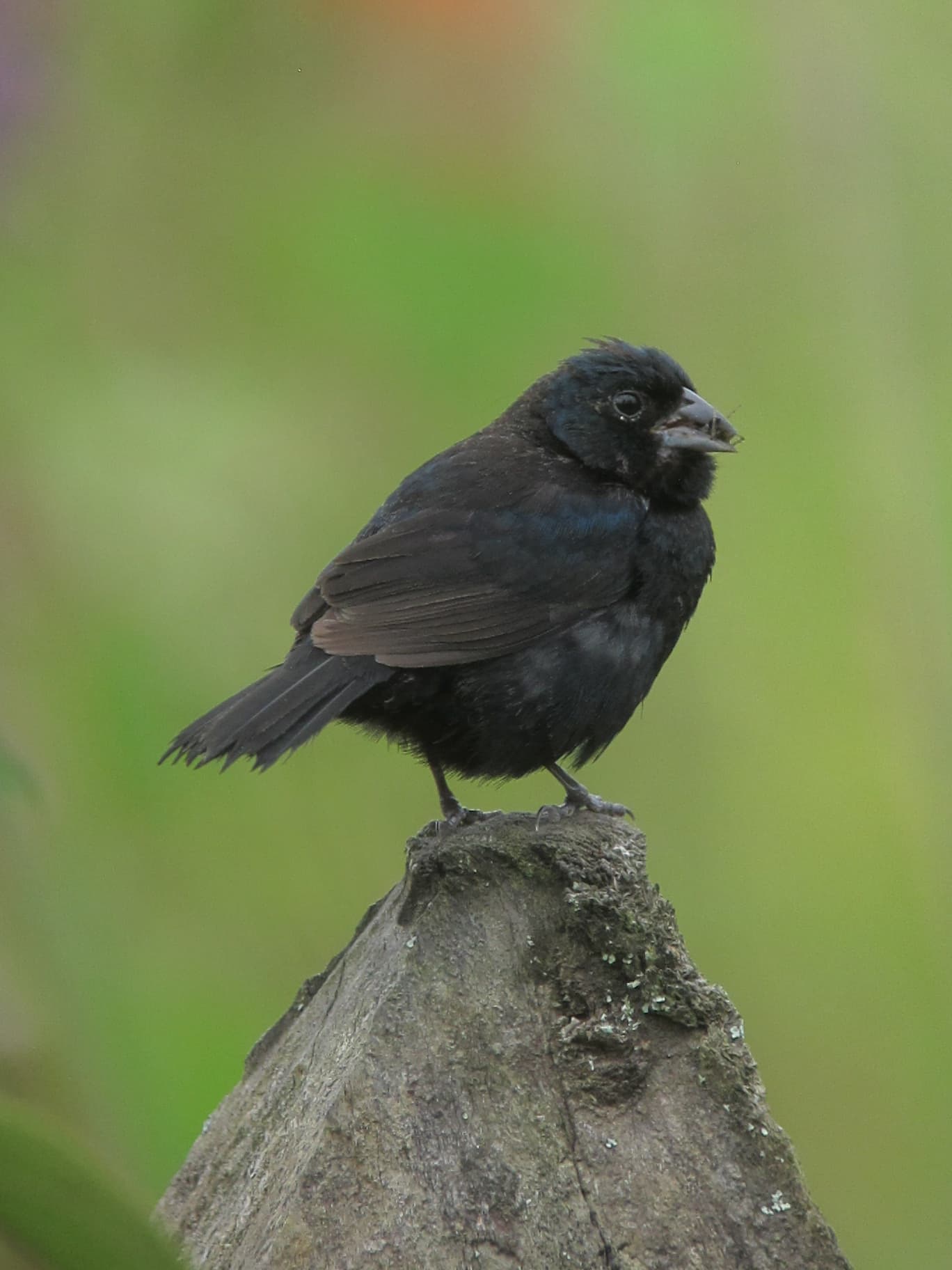
Blue-black Grassquit
Volatinia jacarina
The Blue-black Grassquit is a tiny, glossy songbird of open grassland across Trinidad and Tobago, the male famous for a distinctive, repeated "jump display", leaping vertically from a low perch while giving a buzzing call, over and over through the breeding season.
The Blue-black Grassquit is a tiny, glossy songbird of open grassland across Trinidad and Tobago, the male famous for a distinctive, repeated "jump display", leaping vertically from a low perch while giving a buzzing call, over and over through the breeding season.
Identification
A very small finch around 10 to 11.5 cm long. The breeding male is glossy blue-black overall, appearing almost entirely dark at a distance but showing an iridescent sheen in good light. The female and non-breeding male are streaked brown above and buffy below, resembling a small sparrow and providing effective camouflage in grass.
Ecology
The Blue-black Grassquit feeds on small grass seeds, foraging low in open grassland, savanna, and roadside verges, often in small flocks outside the breeding season. During the breeding season, males perform a distinctive repeated jump display from a low grass stem or fence wire, leaping a short distance into the air while giving a buzzy call before dropping back to the same perch, repeated many times to advertise territory and attract females.
Status in T&T
Common in open grassland and savanna across both Trinidad and Tobago. It is not threatened. It is protected under the Conservation of Wildlife Act; small seed-eating finches including this species are sometimes illegally captured for the cage bird trade.
Threats
- Illegal capture for the cage bird trade
- Loss of open grassland habitat