Trees
Trees
Trinidad Podocarpus (Yew Plum Pine)
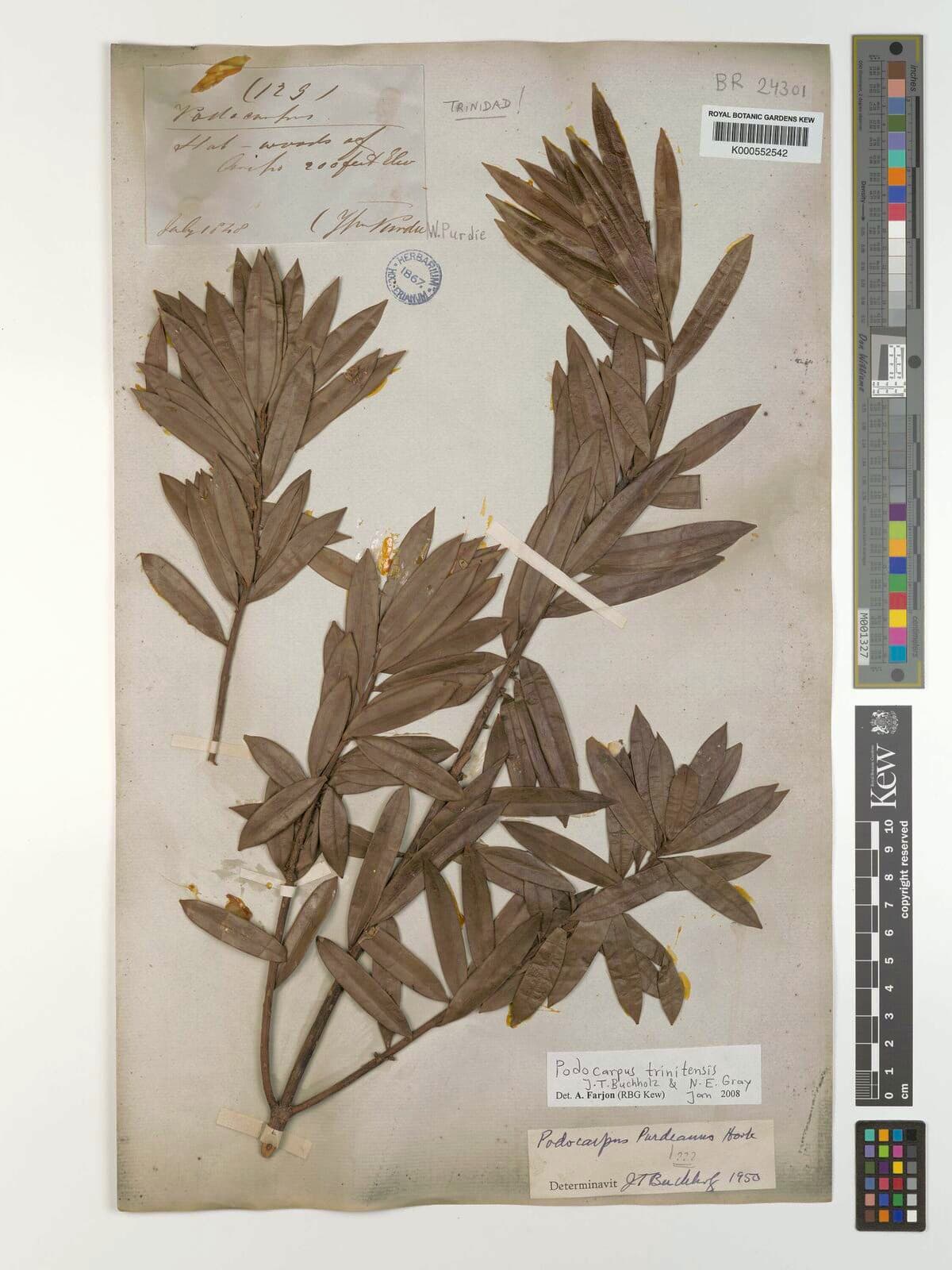
Podocarpus trinitensis
Photo: Royal Botanic Gardens, Kew · Kew Herbarium (CC BY 4.0)
Podocarpus trinitensis is Trinidad's only native conifer and one of the rarest trees in the Caribbean.
Podocarpus trinitensis is Trinidad's only native conifer and one of the rarest trees in the Caribbean. Confined to 13 known localities across the Northern and Central Ranges, with a single historical Tobago record, this ancient gymnosperm lineage clings to lower montane rainforest on shallow, nutrient-poor soils where few broadleaved trees can compete. It is assessed as Near Threatened by the IUCN and faces growing pressure from climate change that may push temperatures beyond its thermal tolerance.
Description
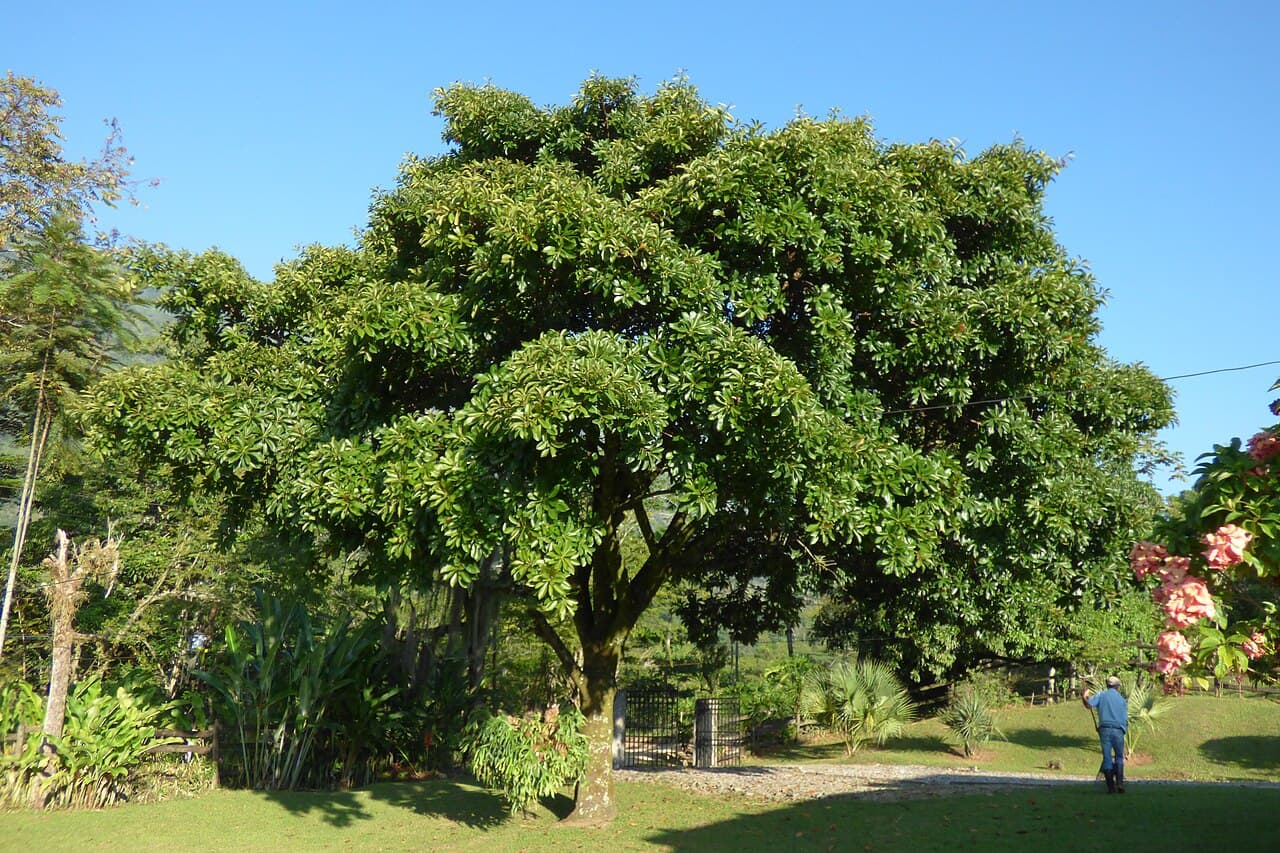
A dioecious evergreen tree reaching 20 m in height with a trunk diameter of up to 80 cm. The bole is typically single and often fluted at the base, with bark that exfoliates in small strips: dark brown on the surface weathering to grey, with pinkish-red beneath. Leaves are polymorphic: shade foliage 60 to 100 mm long and 10 to 15 mm wide; sun foliage 40 to 60 mm long and 6 to 12 mm wide. All leaves are elliptic to oblanceolate, leathery, dark green above and pale green below, superficially resembling a yew (Taxus), hence the common name Yew Plum Pine. The seed structure bears two fused unequal bracts; at maturity the receptacle is 7 to 8 mm wide, succulent, and bright red, resembling a small berry; the seed itself is ovoid and 7 to 8 mm long.
Habitat and Ecology
The species occurs in lower montane rainforest (Trinidad and Tobago Moist Forest) at elevations of 50 to 600 m. It gains a competitive advantage on shallow, nutrient-poor soils where most angiosperms struggle. Seedlings show high shade tolerance, establishing under a closed canopy. The primary population is centred on El Tucuche, the second-highest peak in Trinidad; 11 additional localities have been recorded across the Northern and Central Ranges, and one historical site exists at Mount St. George-Castara Trace in Tobago. An isolated low-elevation population grows in Aripo Savanna Marsh Forest. Pollination is by wind. The bright red succulent receptacle strongly suggests bird-mediated seed dispersal, though specific disperser species have not been formally documented.
Conservation and Climate Vulnerability
The IUCN Red List (Gardner 2013, updated 2021) classifies Podocarpus trinitensis as Near Threatened globally. It occurs within several State Forests and protected areas governed by the Forests Act (Chap. 66:01); however, a species-specific Schedule listing under the Forests Act or the Environmentally Sensitive Species Rules 2001 has not been confirmed in publicly accessible sources. Conservation effectiveness is limited by inadequate staffing and low enforcement capacity in protected areas. Critically, tropical forests are projected to warm more than 3 degrees C by end of century; leaf death in P. trinitensis occurs at 47 to 48 degrees C and physiological performance declines above a 30 degrees C mean, placing this species at acute risk from warming temperatures alone.
Significance
As the only native conifer in Trinidad, Podocarpus trinitensis represents an entire plant division (Pinophyta) that would otherwise be absent from the island's flora. Molecular phylogenetic analysis places the species within a clade including Caribbean and Central/South American podocarp species, suggesting Quaternary-era dispersal events rather than strict Gondwanan relict status. Its restriction to 13 known localities, combined with illegal timber extraction, human-set fires, and projected climate warming beyond its thermal threshold, make it a priority for active monitoring, population surveys, and seed-banking.
Threats
- Illegal logging
- Human-set fires
- Climate warming
- Low enforcement
- Restricted range