Ferns
Ferns
Golden Leather Fern (Mangrove Fern)
Acrostichum aureum
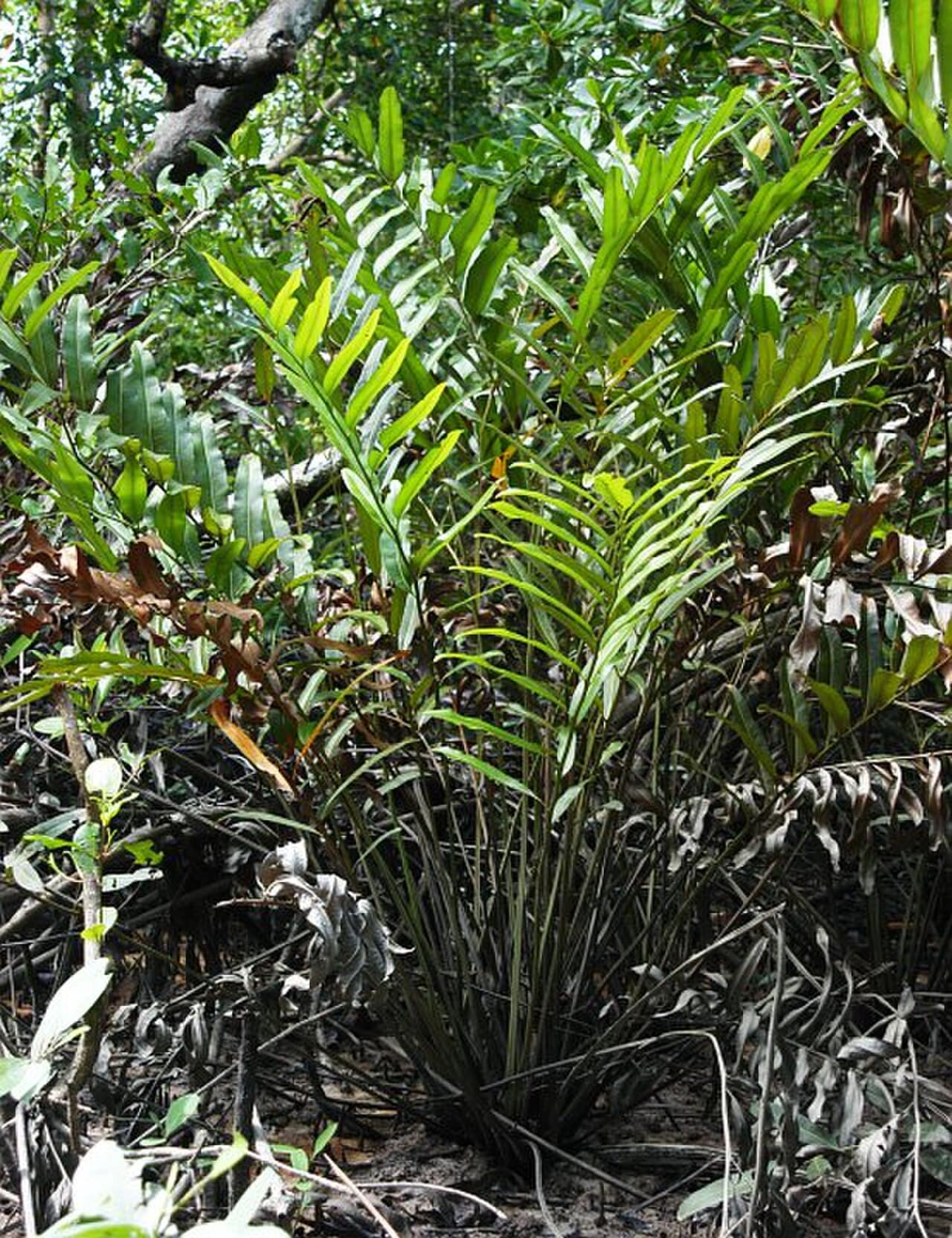
Photo: Wikimedia Commons contributor (CC BY-SA 2.5)
The Golden Leather Fern is one of the largest ferns on Earth and the only fern capable of surviving periodic seawater flooding.
The Golden Leather Fern is one of the largest ferns on Earth and the only fern capable of surviving periodic seawater flooding. It grows at the landward edge of mangrove forests across Trinidad and Tobago's coastal wetlands, forming a distinctive golden-brown fringe where mangrove meets dry land. The "golden" in its name comes from the dense, rust-coloured sporangia that coat the entire underside of fertile fronds.
Description
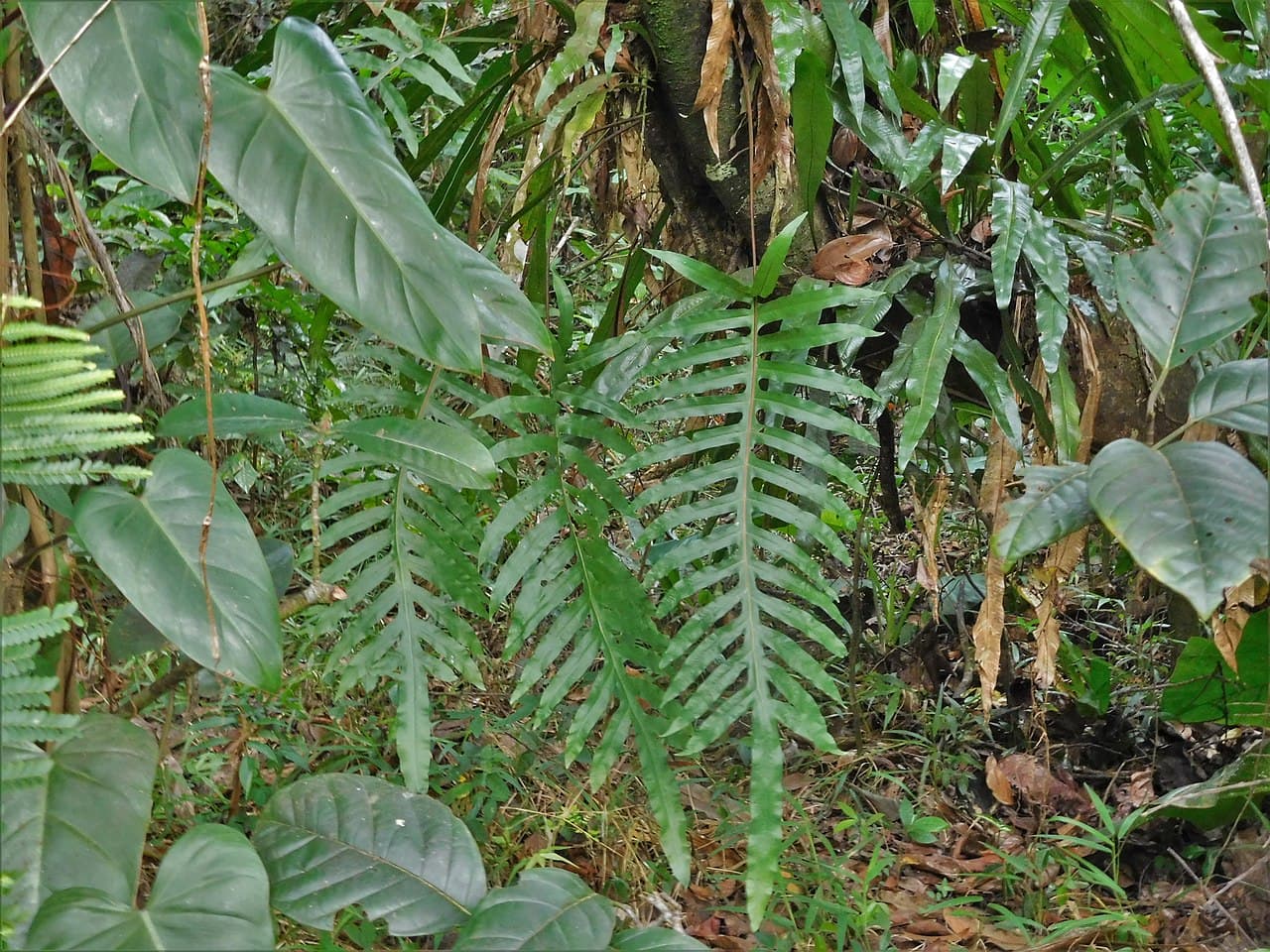
A massive evergreen fern forming dense crowns of once-pinnate (single-divided) fronds that can reach 3 metres in length. The fronds are leathery and dark glossy green, with large, elliptic pinnae arranged alternately along the rachis. On mature plants, the upper five to eight pairs of pinnae are fertile: their entire undersurface is coated with confluent sporangia that ripen to a distinctive brick-red to golden-brown. This acrostichoid arrangement, in which sporangia cover the whole frond surface rather than forming discrete clusters, is diagnostic for the genus. The rhizome is short, stout, and erect, with fronds arranged in a crown.
Habitat and Ecology
Acrostichum aureum occupies the transition zone between mangrove forest and drier land behind it. It is uniquely tolerant of periodic seawater inundation among ferns. It grows at mangrove margins, tidal channel edges, and brackish coastal wetlands, favouring open or semi-open positions rather than deep shade. In Trinidad and Tobago it is present at the landward fringes of the Caroni Swamp and the Nariva Swamp, both internationally recognised Ramsar Wetlands. Its robust rhizome and dense frond canopy stabilise mangrove margins and provide structural microhabitat for invertebrates and small vertebrates at the mangrove-land interface. It is also a pioneer coloniser of disturbed mangrove gaps and cleared coastal margins.
Conservation Status
Globally the species is Least Concern on the IUCN Red List, reflecting its wide pantropical distribution (West Africa, South and Southeast Asia, Pacific islands, and throughout the Neotropics) and vigorous regeneration. There is no species-specific legal protection in Trinidad and Tobago; the primary protection is habitat-level, through the Ramsar designations of Caroni Swamp and Nariva Swamp, and through the Environmental Management Authority Act. The greatest local threat is the ongoing loss and degradation of coastal mangrove habitat through development, altered hydrology, and pollution.
Threats
- Mangrove clearance
- Coastal development
- Sea-level rise
- Pollution and runoff