Bird
Bird
Savanna Hawk
Buteogallus meridionalis
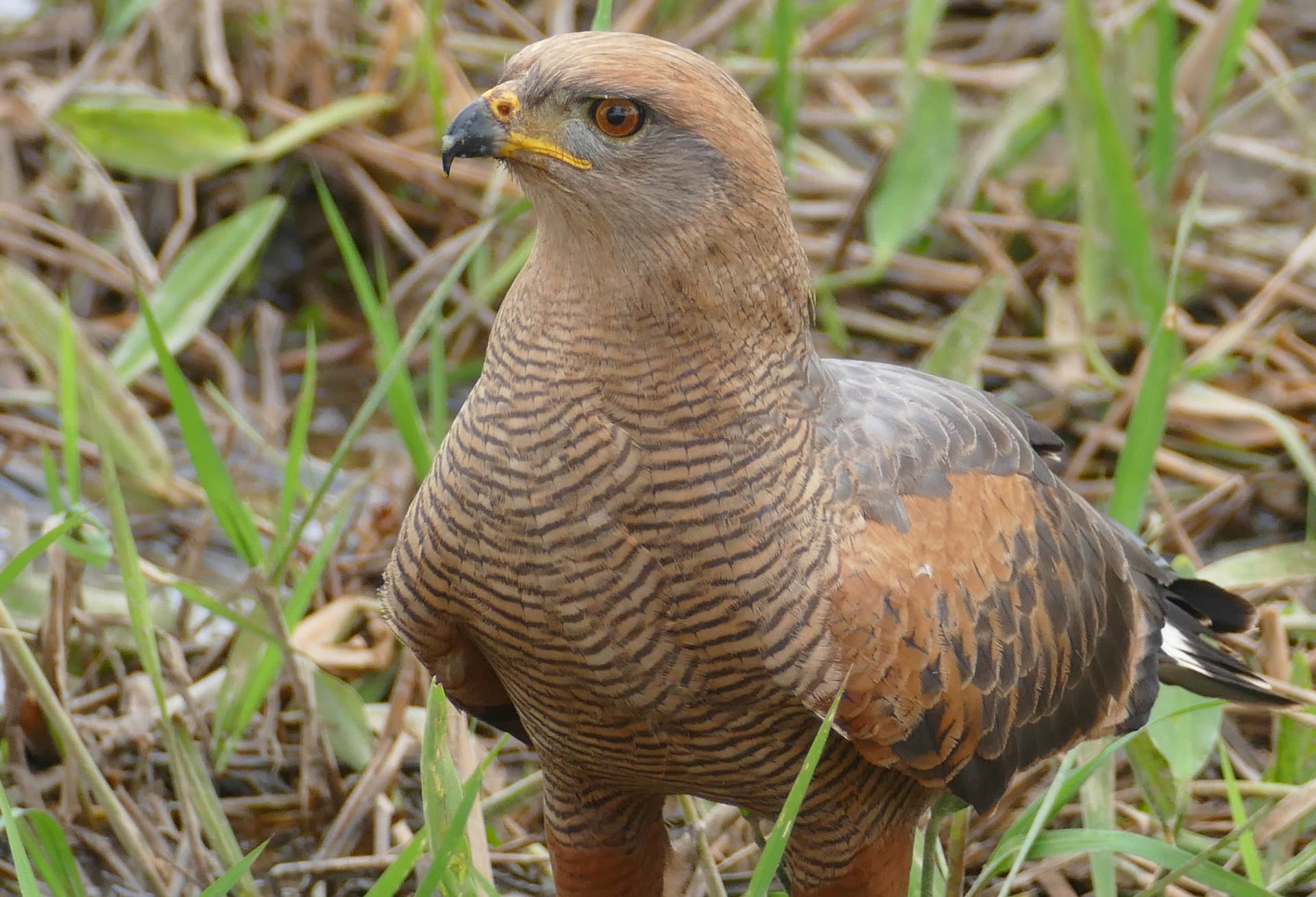
The Savanna Hawk is a tall, long-legged raptor of open country, a warm rufous bird often seen perched on a fence post or stalking through grass on foot.
The Savanna Hawk is a tall, long-legged raptor of open country, a warm rufous bird often seen perched on a fence post or stalking through grass on foot. Adapted to wet savannas and field edges, it is one of the most distinctive birds of prey in Trinidad's lowlands.
Appearance
It is a large hawk, 46 to 61 cm long and weighing 825 to 1070 g, with broad rounded wings, long legs and a relatively short tail. Adults are mostly rich cinnamon-rufous, finely barred below, with a grey-and-black banded tail and a black trailing edge to the wing that shows in flight. The long legs give it an upright, leggy stance well suited to hunting on the ground.
Behaviour
The Savanna Hawk hunts in several ways, taking prey on the wing, dropping from a perch, or stalking through grass on foot with long strides. It readily follows grass fires and farm machinery to snatch animals flushed into the open.
It is often seen soaring on broad wings over savanna or perched conspicuously on a post, lone tree or termite mound surveying open ground.
Diet and breeding
The diet is broad and opportunistic, including small mammals, birds, snakes, lizards, frogs, toads, crabs and large insects, with crabs and amphibians especially important in wet habitats. This flexibility lets it thrive in disturbed and farmed landscapes. The pair builds a large stick nest in a tree, where the female usually lays a single white egg, and the chick is cared for by both parents. Their habit of following fires and machinery makes them a familiar sight to farmers.
In Trinidad and Tobago
The Savanna Hawk is a resident of Trinidad, where it frequents savannas, marsh edges, rice fields, mangrove fringes and other open low-lying country, but it is not found on Tobago. It adapts well to agricultural land, which helps keep its numbers stable. The species is listed as Least Concern.