Bird
Bird
Common Black Hawk
Buteogallus anthracinus
The Common Black Hawk is a broad-winged, coastal raptor of Trinidad's mangroves and estuaries, where it has a striking specialty: it feeds heavily on land crabs.
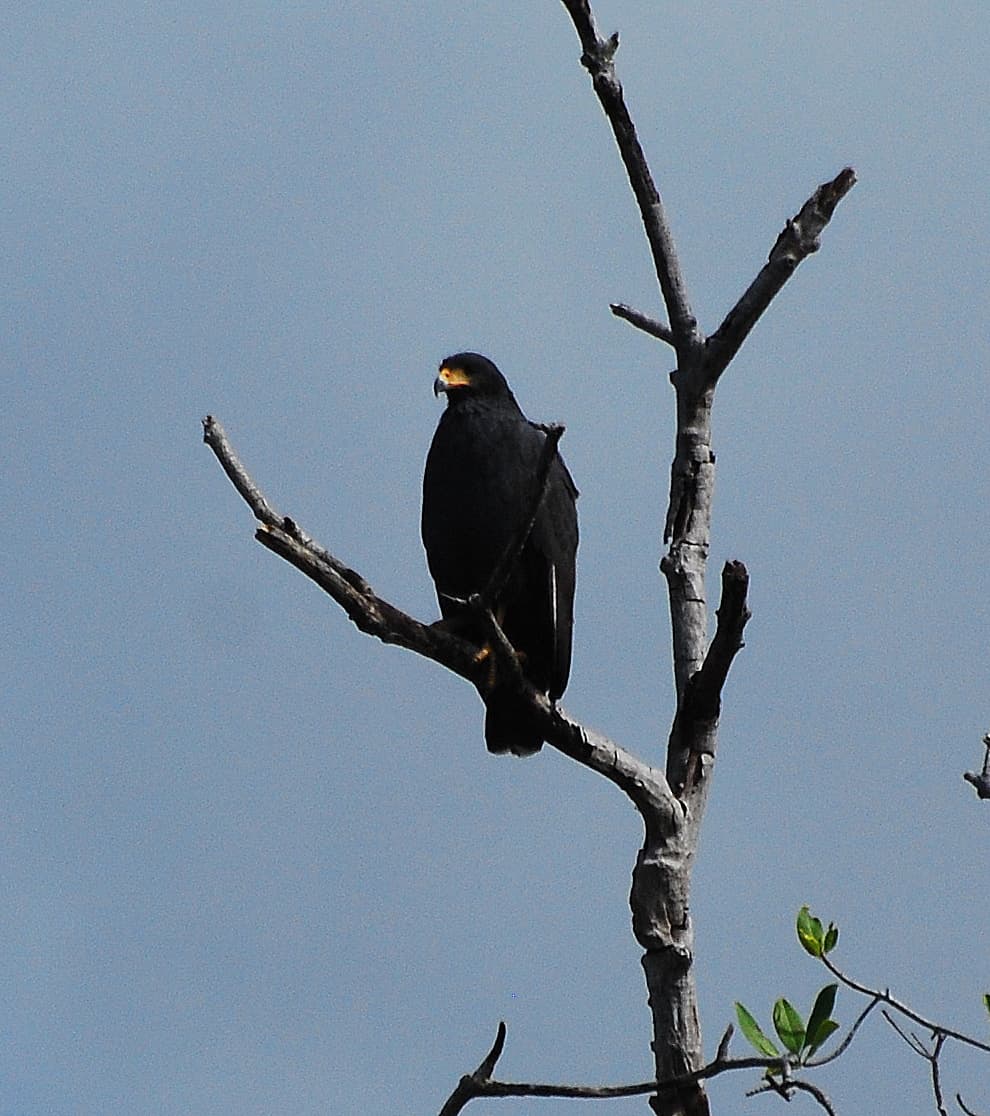
The Common Black Hawk is a broad-winged, coastal raptor of Trinidad's mangroves and estuaries, where it has a striking specialty: it feeds heavily on land crabs. Almost entirely sooty black, it is most often seen perched low over mudflats or soaring on broad wings near the shore.
Appearance
This is a stocky, medium-large hawk with very broad, rounded wings and a short tail, giving it a bulky silhouette in flight. Adults are almost uniformly sooty black, with a single broad white band across the tail, bright yellow legs, and a yellow cere at the base of the bill. The wings are so broad and the tail so short that soaring birds look almost batlike from below.
Behaviour
It is a mainly coastal, resident bird of mangrove swamps, estuaries, mudflats, and adjacent open woodland. It hunts by perching low and watching the ground, then dropping or making a short swooping flight to seize prey on the mud or in shallow water. It also soars over the shoreline, particularly in the warmth of midday, and gives a distinctive series of high whistled calls.
Diet and breeding
Land crabs are a favourite prey, and birds living in mangroves may feed on them almost exclusively, though the diet also includes fish, frogs, snakes, young birds, and large insects such as grasshoppers. It builds a bulky platform nest of sticks high in a tree, very often a mangrove, and reuses the nest year after year so that it grows steadily larger. The clutch is usually one egg, occasionally up to three, whitish with brown markings.
In Trinidad and Tobago
The Common Black Hawk is a resident breeder closely tied to Trinidad's coastal mangroves and estuaries, where intact crab populations and mature shoreline trees are essential to it. Because it depends on these habitats, local conservation of mangrove systems matters for its future. The species is classified as Least Concern across its wide American range.