Invertebrate
Pink-toed Tarantula
Avicularia avicularia
The Pink-toed Tarantula is one of Trinidad's most striking invertebrates: a large, arboreal spider that spends its entire life in the forest canopy, building funnel-shaped silk retreats in tree hollows and bromeliads. Gentle and fast-moving compared to terrestrial tarantulas, it is an icon of neotropical rainforest biodiversity.
Identification
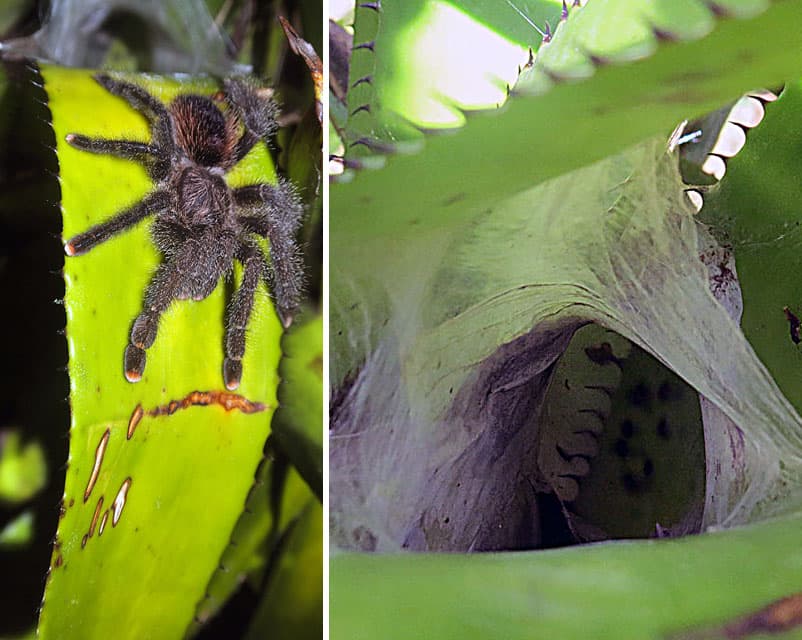
Adults have a body length of 5 to 7 cm with a leg span of up to 12 to 14 cm. The body and legs are covered in dark, velvety hairs with a characteristic iridescent blue sheen in good light. The tips of all eight legs are pink to orange, giving the species its common name. Juveniles show a reverse pattern: pink body with dark feet, which shifts to the adult colouring over successive moults.
Arboreal Lifestyle
Unlike most tarantulas, which are terrestrial and burrow, the Pink-toed Tarantula is an obligate canopy dweller. It constructs a tubular silk retreat, often in a tree hollow or behind loose bark, from which it ambushes insects, small frogs, and lizards. The species is capable of rapid movement and can leap short distances between branches. It is primarily nocturnal.
Ecology
Pink-toed Tarantulas are significant predators of forest insects and play a role in regulating invertebrate populations in the canopy. They are themselves prey for birds, snakes, and parasitoid wasps, including the large tarantula hawk wasps that paralyse them as living larval food stores.
Trade and Protection
The species is extremely popular in the international exotic pet trade due to its attractive appearance and relatively docile temperament. All Theraphosidae (tarantulas) are listed on CITES Appendix II, meaning international commercial trade requires permits and documentation. Wild collection is a significant pressure across South America; Trinidad's forest protection provides indirect safeguarding of local populations.
Threats
- Wild collection for the international exotic pet trade
- Habitat loss from deforestation and agricultural expansion
- Pesticide use reducing invertebrate prey populations