Reptile
Reptile
Lora (Parrot Snake)
Leptophis ahaetulla coeruleodorsus
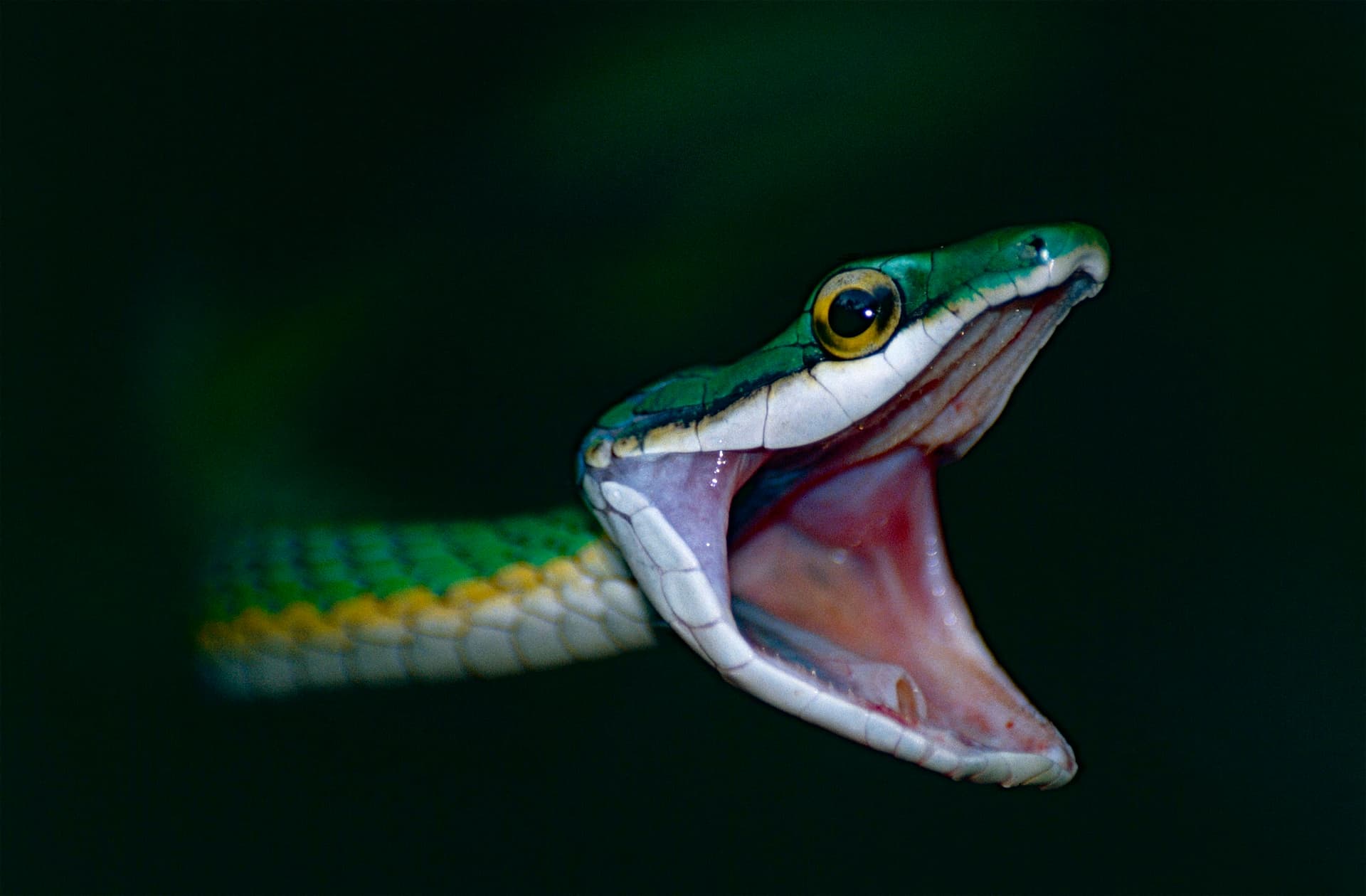
The Lora, or Parrot Snake, is one of the most vividly coloured snakes in T&T, its emerald green scales flashing with iridescent blue and bronze in sunlight.
The Lora, or Parrot Snake, is one of the most vividly coloured snakes in T&T, its emerald green scales flashing with iridescent blue and bronze in sunlight. Found on both Trinidad and Tobago, it is a fast, diurnal, arboreal species that hunts frogs and lizards in low forest vegetation and along waterways. Mildly rear-fanged, it poses no medical risk to humans and is fully protected by law.
Description
Leptophis ahaetulla coeruleodorsus is a slender, elegant snake reaching approximately 1 to 1.5 m. The dorsal surface is vivid emerald green, each scale with a structural iridescence that shifts through blue, bronze, and gold in direct light, giving the snake its parrot-like brilliance. A bold black stripe runs from the tip of the snout through the eye and along the temporal region on each side, contrasting with the green. The belly is pale yellowish-white. The head is elongated and narrow; the eyes are large with a striking bright copper or orange iris; and the tail is very long and thinly tapered.
Ecology
Active during the day, the Lora is a fast-moving arboreal predator hunting frogs, tree frogs, and lizards in low forest vegetation, secondary growth, and along streams. It will climb into low shrubs and along fence lines and is equally comfortable foraging at ground level or 2 to 3 m above it. When threatened it inflates the neck, gapes widely to reveal the dark blue-black interior of the mouth, a threatening display used by several arboreal colubrids, and may strike repeatedly. The rear-fanged venom causes local swelling and redness in some individuals but is not classified as medically significant.
Conservation
The subspecies coeruleodorsus is the form found in Trinidad, Tobago, and Venezuela; the name refers to the blue dorsal iridescence. The Lora is oviparous and lays eggs in leaf litter or rotting vegetation. The related Gray Lora (Leptophis stimsoni) is also recorded from Trinidad but is much rarer. The Lora is fully protected under the Conservation of Wildlife Act. Despite its harmless nature, it is occasionally killed by people who cannot reconcile its vibrant appearance with safety.
Threats
- Persecution: occasionally killed despite harmless nature
- Habitat loss and removal of streamside vegetation