Reptile
Reptile
False Coral
Oxyrhopus petola petola
The False Coral is a nocturnal, rear-fanged colubrid found on both Trinidad and Tobago.
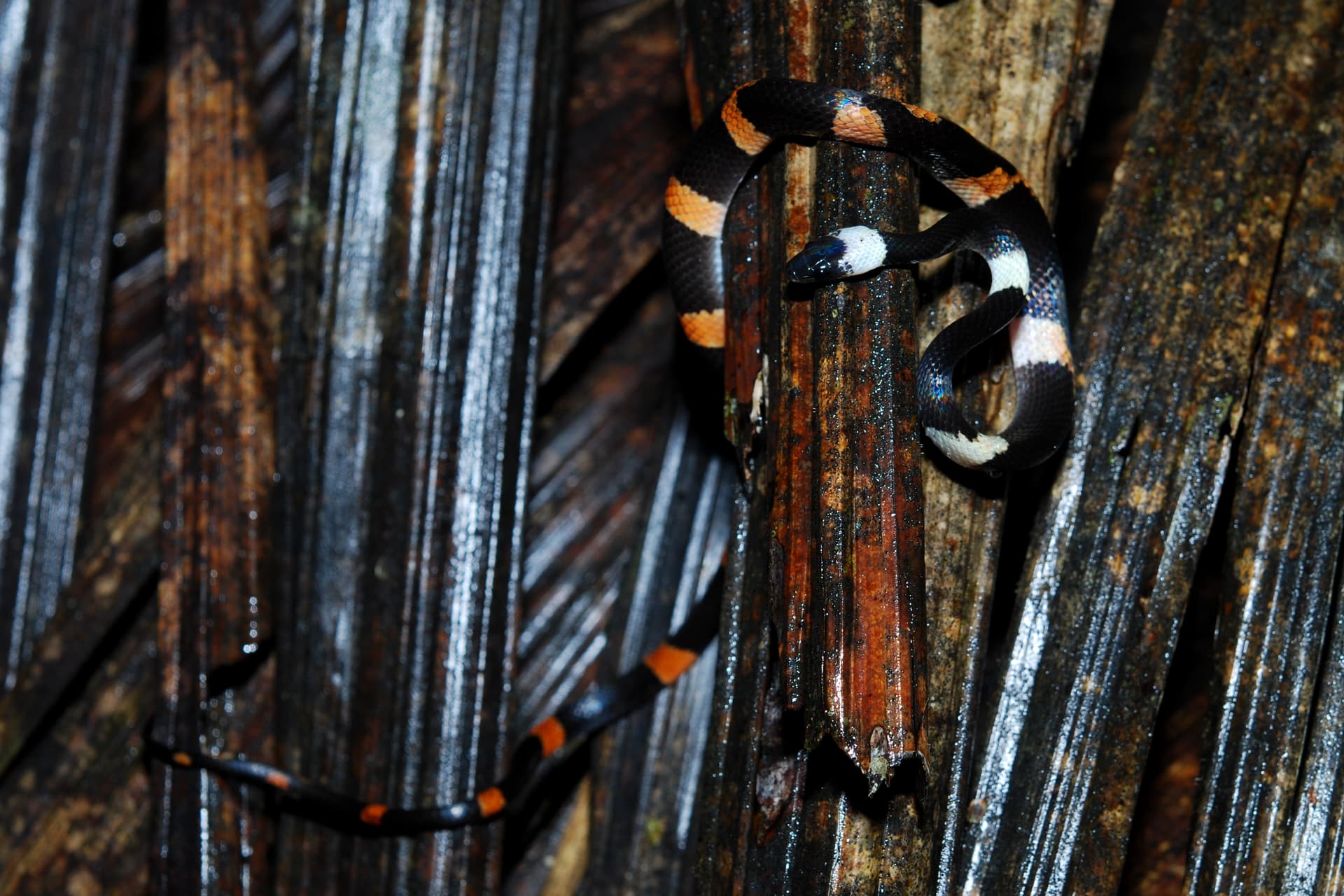
The False Coral is a nocturnal, rear-fanged colubrid found on both Trinidad and Tobago. Its vivid red, black, and white banding mimics the pattern of true coral snakes (Micrurus spp.), gaining protection from predators through Batesian mimicry. It is non-venomous to humans and one of the more frequently encountered brightly patterned snakes in T&T forests, though it remains far more often killed than admired.
Description
Oxyrhopus petola petola is a medium to moderately large snake typically reaching 70 to 100 cm, though specimens over 1.2 m are documented. The body is banded in vivid red, black, and white or pale yellow; the rings encircle the entire body and belly. The head is dark or black. The subspecies petola is the form found across Trinidad, Tobago, and much of northern South America. This pattern, combined with its nocturnal habits and the fact that it is often encountered at ground level in forest, means it is the colubrid most commonly mistaken for a true coral snake in T&T.
Ecology
Strictly nocturnal and primarily terrestrial, the False Coral is an active hunter on the forest floor and in low vegetation. It feeds mainly on lizards, particularly geckos and other nocturnal species, as well as small frogs and occasionally small mammals and other snakes. It is a rear-fanged species: enlarged grooved teeth at the back of the upper jaw deliver Duvernoy's gland secretions to immobilise prey, but the venom is specific to small ectotherms and is not medically significant to humans.
Conservation
The Batesian mimicry system involving the False Coral and the Common Coral Snake (Micrurus circinalis) is a textbook example of the phenomenon: the harmless mimic gains predator avoidance by resembling the dangerous model. However, this protection comes at a cost: humans, who do not rely on the same predator-avoidance instinct, kill the mimic because they cannot distinguish it from the real thing. On Tobago there are no true coral snakes at all, so the banding pattern on Tobago's False Coral population maintains itself without a local model. It is fully protected under the Conservation of Wildlife Act on both islands.
Threats
- Persecution: killed in large numbers by people who cannot distinguish it from venomous coral snakes
- Habitat loss and forest fragmentation