Reptile
Reptile
Black and White Worm Lizard
Amphisbaena fuliginosa
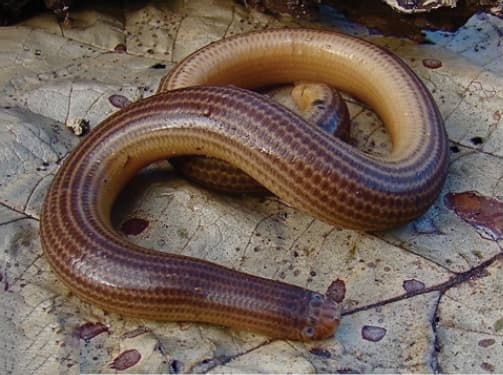
The Black and White Worm Lizard is a burrowing reptile that looks more like a giant earthworm or a snake than a lizard.
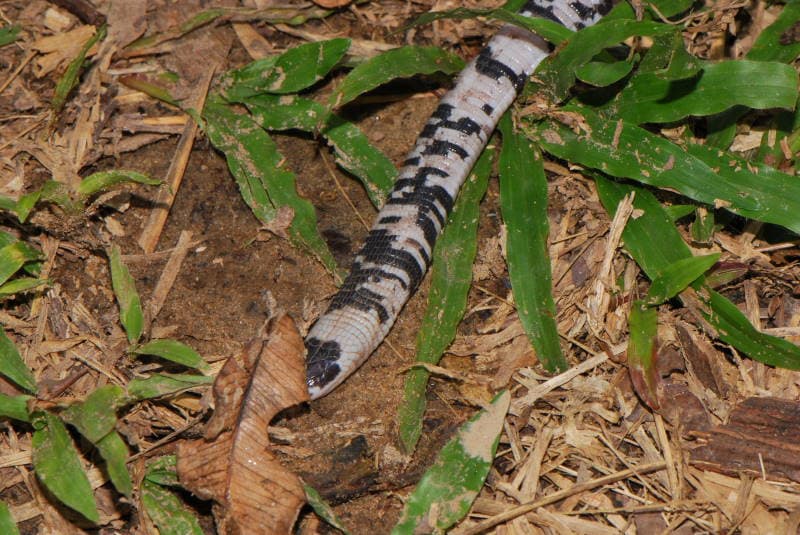
The Black and White Worm Lizard is a burrowing reptile that looks more like a giant earthworm or a snake than a lizard. It belongs to the amphisbaenians, a specialised group of legless, fossorial reptiles, and is instantly recognisable by its bold mosaic of black and white blotches.
Appearance
It is a slender, cylindrical animal usually 30 to 50 cm long, with no limbs and a body that looks the same diameter from head to blunt tail, an arrangement that gives the family its 'two-headed' reputation. The skin is divided into rings of rectangular scales arranged in regular grooves, and the striking pattern is a chequerboard of dark brown to black and white. The eyes are tiny and hidden beneath the skin, and the skull is heavily reinforced for digging.
Behaviour
This is a nocturnal, almost wholly subterranean reptile that spends nearly all its life underground, tunnelling head-first through soil and leaf litter using a concertina, worm-like motion. Its ringed skin can move somewhat independently of the body, helping it grip the tunnel walls and reverse direction. Because of these secretive habits it is rarely seen, usually only when heavy rain, ploughing or excavation brings one to the surface, and its ecology remains poorly known.
When handled it may raise both ends of the body to confuse a predator about which end is the head.
Diet and breeding
It is a generalist predator of soil invertebrates, taking ants, termites, beetles, beetle larvae, spiders, centipedes and other arthropods encountered while burrowing, and occasionally small vertebrates. Strong jaws and interlocking teeth let it tackle prey larger than expected for its size, biting off chunks. Like most amphisbaenians it lays eggs, with a small clutch deposited in moist soil or inside ant and termite nests, and there is no parental care.
In Trinidad and Tobago
The species occurs naturally in Trinidad and across northern South America, inhabiting forest soils, gardens and disturbed ground; it is not recorded from Tobago. By preying on ants, termites and other invertebrates it helps regulate soil communities. It is not assessed as threatened, and its main interaction with people is being mistaken for a snake or worm and killed needlessly.