Bird
White-tailed Sabrewing
Campylopterus ensipennis
The White-tailed Sabrewing is one of the largest and most spectacular hummingbirds in the Caribbean, and a flagship species for conservation in Tobago.
The White-tailed Sabrewing is one of the largest and most spectacular hummingbirds in the Caribbean, and a flagship species for conservation in Tobago. Restricted almost entirely to the Main Ridge Forest Reserve, this near-endemic bird is a star attraction for birdwatchers and a vital pollinator of the forest plants it feeds upon. Its near-extinction following Hurricane Flora in 1963, and its subsequent slow recovery, makes it a powerful symbol of both natural resilience and fragility.
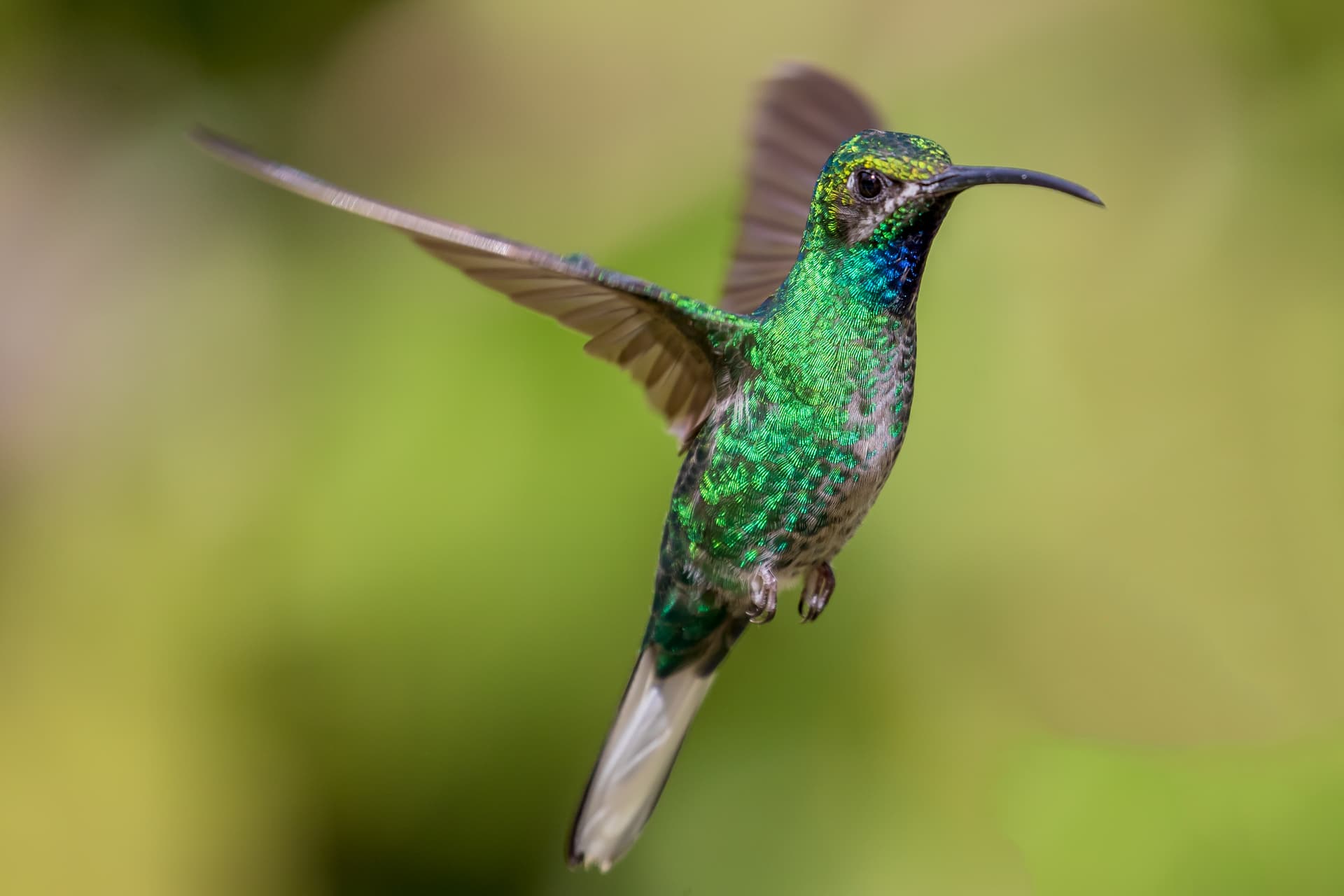
Adults measure approximately 11–12 cm in length and weigh around 8–9 g, making the sabrewing one of the largest hummingbirds in the region. The plumage is striking: the upperparts, head, and breast shine with brilliant iridescent blue-green and violet, while the outer tail feathers are white, the feature that gives the species its common name and makes it instantly identifiable in flight. The curved outer primaries of males form the distinctive "sabre" shape that gives the genus Campylopterus its name. Females are similar but less intensely coloured, with more white below.
The White-tailed Sabrewing is a near-endemic, with its global range essentially confined to the Main Ridge Forest Reserve in Tobago and a very small population in Sucre State, northeastern Venezuela. The Main Ridge was designated a Crown Forest Reserve in 1776, making it one of the oldest protected forests in the Western Hemisphere, a distinction that reflects Tobago's long conservation legacy. Within this forest, the sabrewing feeds on the nectar of a range of flowering plants, with its long, slightly decurved bill well-adapted to accessing tubular flowers, making it an important pollinator for the forest ecosystem.
The species was nearly eliminated from Tobago by Hurricane Flora in September 1963, which destroyed vast tracts of the Main Ridge forest. The population collapsed and the bird was feared lost, but slow recovery was documented over the following decades as the forest regenerated. Today it remains sensitive to major storm events and represents one of the clearest examples in T&T of how a single weather event can devastate a species with such a restricted range. The sabrewing is fully protected under the Conservation of Wildlife Act (COWA), and preservation of the Main Ridge forest is the essential conservation requirement for its survival.
Why This Matters
The White-tailed Sabrewing is not simply an attractive bird; it is a working part of the Main Ridge Forest Reserve's ecological machinery. As one of the largest hummingbirds in the Caribbean, it pollinates flowering plants in the montane forest interior, including species with tubular flowers that smaller pollinators cannot efficiently access. Remove the sabrewing, and a portion of the forest's reproductive web is severed: plants that depend on it for pollination produce fewer seeds, forest regeneration in those areas slows, and the intricate web of species that use those plants begins to unravel.
The near-extinction of this bird following Hurricane Flora in 1963, and its slow recovery over the subsequent decades, is one of the clearest demonstrations in T&T's ecological record that the natural world can bounce back when given protection and time. For eleven years it was believed gone. It was not. That recovery depended entirely on the Main Ridge Forest Reserve remaining intact, on Tobago's long conservation tradition that dates back to the 1776 Crown Forest designation, and on the regeneration of the very forest the hurricane destroyed.
Tobago's identity as a nature destination rests in part on the species that can only be found there. The sabrewing is one of the island's most sought-after birds by visiting naturalists from around the world. Its protection is an act of ecological stewardship and an investment in the natural economy that Tobago has built around its extraordinary biodiversity.
Threats to Survival
- Hurricane events
- Habitat degradation in the Main Ridge
- Restricted range: entire population in one forest reserve
- Tourism disturbance at nesting sites
- Climate change affecting flowering patterns
Seen a White-tailed Sabrewing?
Sighting records help us track population status and distribution. If you observe this species, please report the location, date, time, and any photos to WEPTT.
Report a Sighting