Mammal
Trinidad White-fronted Capuchin
Cebus albifrons trinitatis
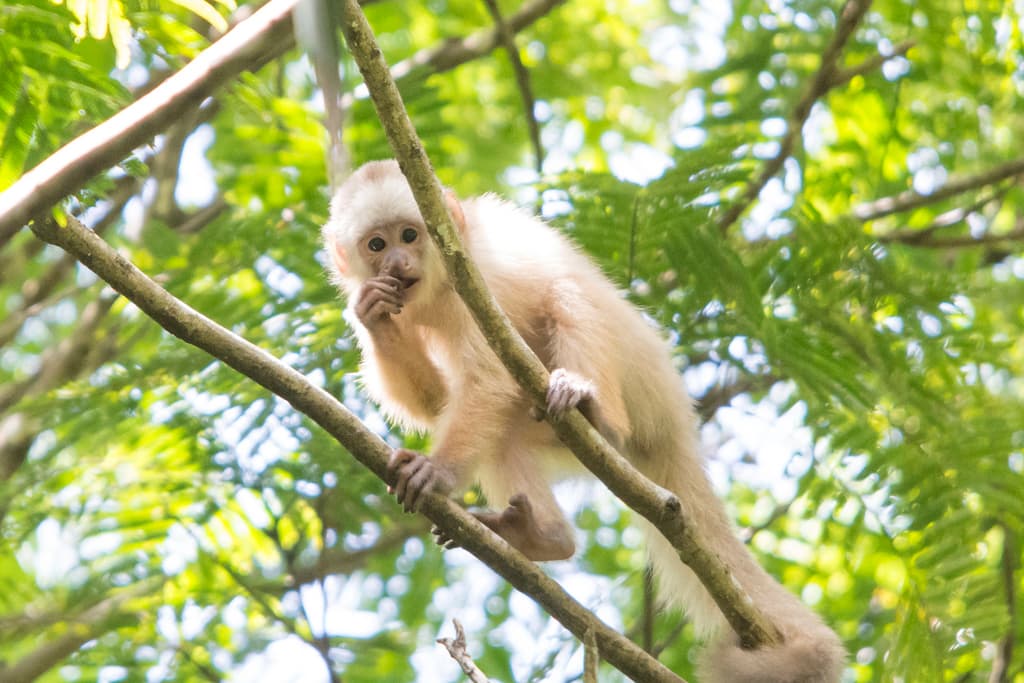
Photo: Jerome Foster (drjayf) · Nariva Swamp, Trinidad (CC BY-NC-ND 4.0)
The Trinidad White-fronted Capuchin is a highly intelligent, socially complex primate found only in Trinidad's forests, the island's sole endemic monkey subspecies.
The Trinidad White-fronted Capuchin is a highly intelligent, socially complex primate found only in Trinidad's forests, the island's sole endemic monkey subspecies. Classified as Endangered, this small capuchin faces mounting pressure from deforestation, forest fragmentation, and illegal capture for the pet trade. Its survival depends on the protection of Trinidad's remaining lowland and submontane forests.
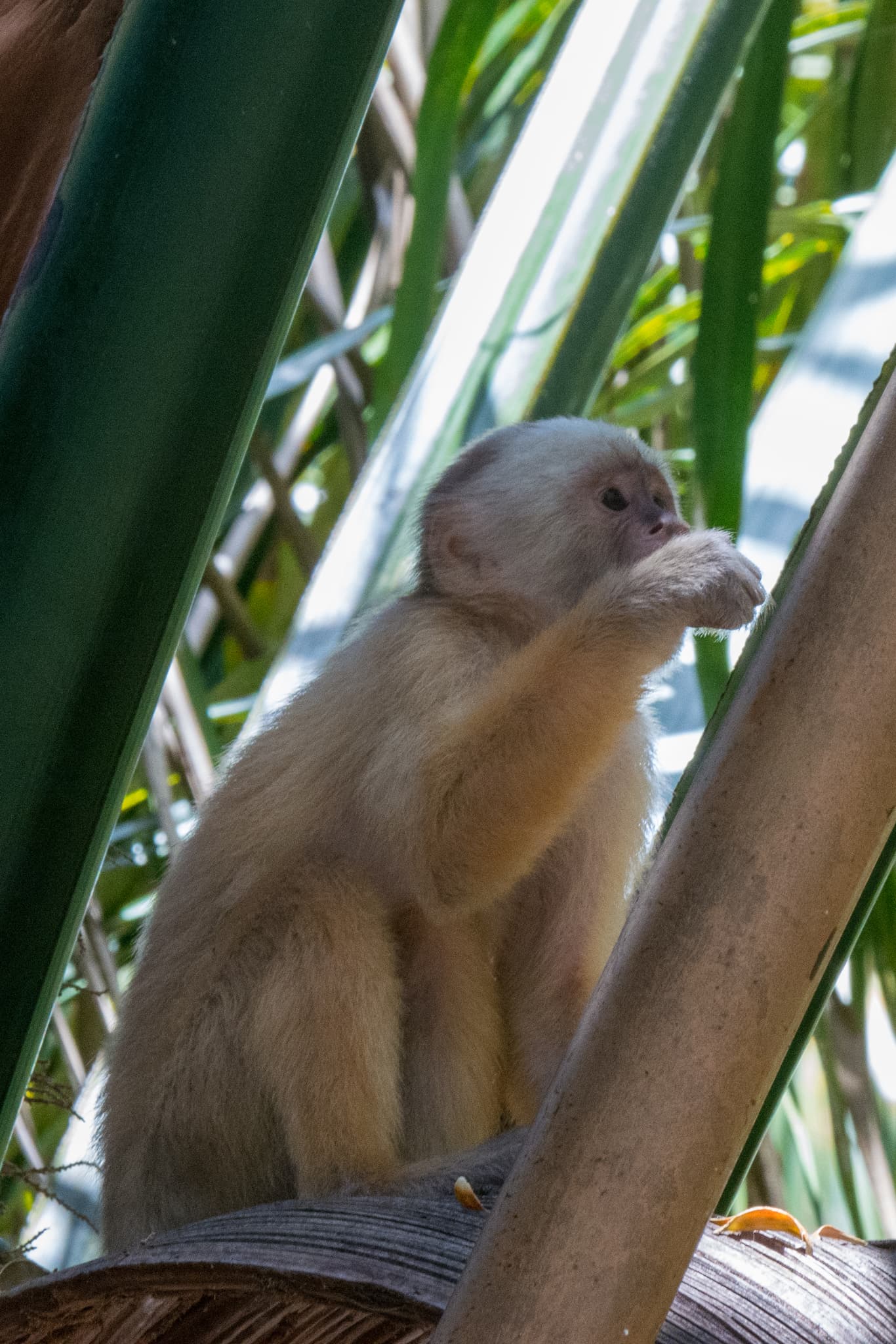
The Trinidad White-fronted Capuchin is a medium-sized New World monkey distinguished by its pale creamy-white forehead and facial cap contrasting with a brown or tawny body. Adults typically weigh between 1.5 and 3 kg, with males somewhat larger than females. The subspecies is endemic to Trinidad and is considered genetically and morphologically distinct from mainland South American populations of Cebus albifrons, reflecting the island's biogeographic isolation. It is the only primate endemic to Trinidad and Tobago.
In Trinidad, this capuchin inhabits lowland tropical forests and submontane forests, with populations concentrated in the Northern Range, the island's primary forested mountain chain, as well as forested areas in the Central Range and Nariva Swamp environs. The species is diurnal and highly arboreal, travelling in cohesive social groups of roughly 6 to 20 individuals. Groups occupy large home ranges and depend on extensive, connected forest for foraging. As omnivores, capuchins consume fruit, seeds, insects, small vertebrates, and plant material, and play an important ecological role as seed dispersers for a range of forest tree species.
The Trinidad White-fronted Capuchin is listed as Critically Endangered at the subspecies level, driven primarily by ongoing habitat loss through agricultural encroachment, logging, and residential development, coupled with severe forest fragmentation that isolates populations and reduces genetic exchange. The illegal pet trade poses a particularly acute threat: infant capuchins are taken from the wild after their mothers are killed. Although the subspecies is fully protected under Trinidad and Tobago's Conservation of Wildlife Act (COWA) and is on CITES Appendix II, enforcement remains a challenge. No large-scale captive breeding or reintroduction programme is currently active, making in-situ forest protection the critical conservation priority.
Why This Matters
The Trinidad White-fronted Capuchin is the only endemic monkey subspecies in Trinidad and Tobago, a primate that has lived on this island long enough to diverge genetically and morphologically from its South American relatives. That evolutionary distinction is irreversible; it cannot be recreated. As diurnal, wide-ranging omnivores, capuchins are among the most effective seed dispersers in Trinidad's forests, consuming fruit and seeds from dozens of plant species and depositing them across home ranges of several square kilometres. Their foraging behaviour actively regenerates the forest around them, planting the trees that future generations of capuchins, and of humans, will depend on.
The loss of 25 percent of the Bush Bush Wildlife Sanctuary population over 25 years, documented by Cambridge researchers in the 1990s, is a concrete measure of what happens when hunting pressure and habitat destruction go unchecked in a restricted range. These animals are not widely distributed across the island; they are concentrated in the Trinity Hills and Bush Bush areas, places where the pressure of human encroachment is constant and the margin for error is small. Adding the threat of invasive exotic capuchin species from the illegal pet trade displacing the endemic subspecies further compresses that margin.
A country's endemic species are its most singular natural heritage, the living products of its specific geography and evolutionary history. The Trinidad White-fronted Capuchin exists because this island has been the right place, for long enough, for a particular lineage of primates to become itself. Protecting it means protecting that evolutionary legacy and the forest ecosystem that makes it possible.
Threats to Survival
- Deforestation
- Forest fragmentation
- Illegal pet trade
- Habitat loss from agricultural encroachment
- Logging and residential development
- Small isolated populations with reduced genetic diversity
Seen a Trinidad White-fronted Capuchin?
Sighting records help us track population status and distribution. If you observe this species, please report the location, date, time, and any photos to WEPTT.
Report a Sighting