Mammal
Ocelot
Leopardus pardalis
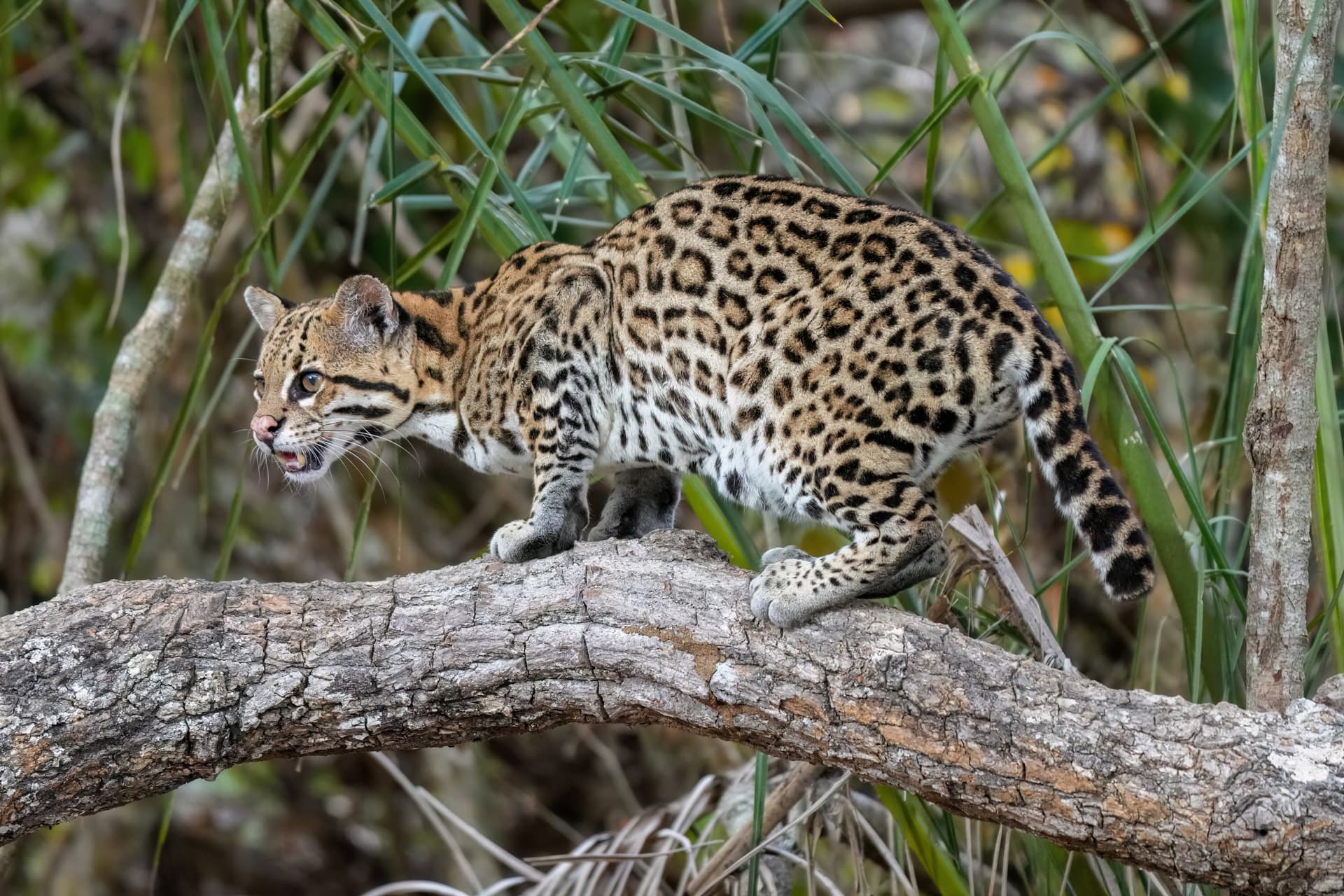
Photo: Giles Laurent · Pantanal, Brazil (CC BY-SA 4.0)
The Ocelot is Trinidad's largest wild cat and one of its most elusive predators, prowling the forests of the Northern Range and lowland woodlands under cover of darkness.
The Ocelot is Trinidad's largest wild cat and one of its most elusive predators, prowling the forests of the Northern Range and lowland woodlands under cover of darkness. Though globally assessed as Least Concern, the species is Endangered in Trinidad and Tobago, a reflection of how drastically its island population has contracted under pressure from roads, deforestation, and human persecution. Protecting the Ocelot means protecting the intact forest corridors it needs to survive.
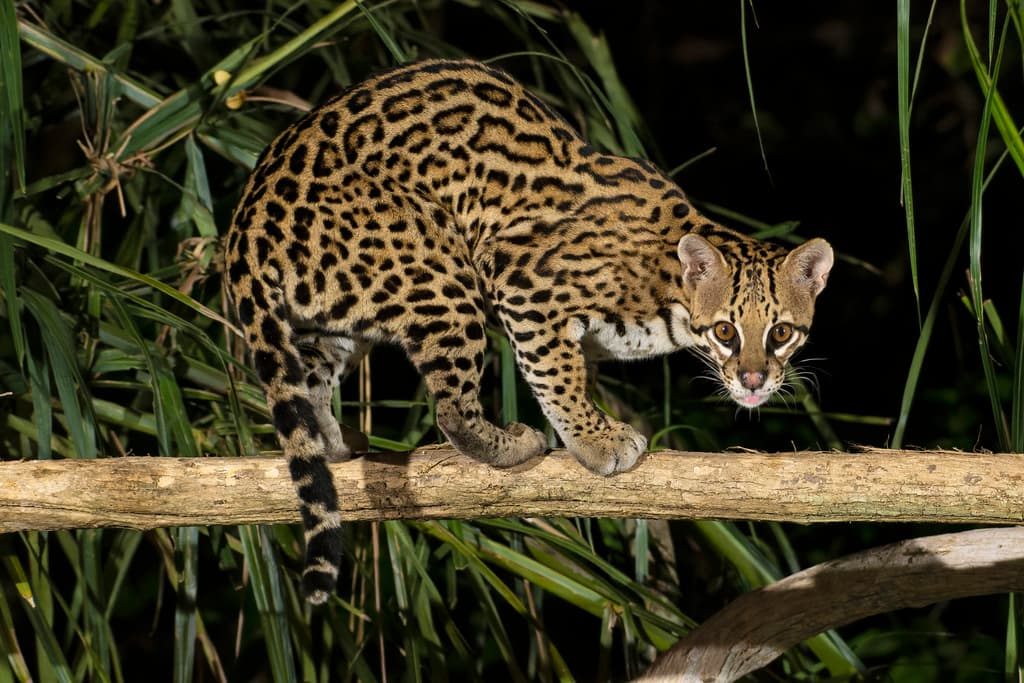
Leopardus pardalis is a medium-sized felid weighing 7–16 kg, instantly recognisable by its richly patterned coat of black-outlined tawny spots and elongated streaks on a cream or ochre background. The face carries bold white markings framing the eyes, and the tail is banded with dark rings. Males are noticeably larger than females. In Trinidad the species is confined to the main island, primarily the Northern Range and its foothills, Nariva Swamp surrounds, and the forests of south and east Trinidad, and has never been recorded in Tobago.
As a generalist carnivore, the Ocelot preys on whatever small vertebrates the forest offers: agoutis, rats, mice, opossums, birds, lizards, frogs, and freshwater crabs. It is predominantly nocturnal and crepuscular, resting in dense vegetation or tree forks by day. Males patrol large territories of roughly 30–46 km², while female ranges are smaller at approximately 8–15 km². These large space requirements make the species acutely vulnerable to the fragmentation of Trinidad's remaining forest cover.
The single greatest documented cause of Ocelot mortality in Trinidad is collision with vehicles. The Beetham Highway/Churchill-Roosevelt Highway corridor and the Eastern Main Road bisect critical habitat between the Northern Range and coastal lowlands, and road-killed Ocelots are reported with troubling regularity. Persecution by poultry and small-livestock farmers adds to the toll. The national population is estimated to number fewer than 250 mature individuals. The Ocelot is fully protected under the Conservation of Wildlife Act (COWA) and is not a game species. It is also listed as an Environmentally Sensitive Species by the EMA, and on CITES Appendix I.
Conservation efforts in Trinidad include camera-trap monitoring programmes by UWI and local NGOs, rehabilitation of injured and orphaned animals at the Emperor Valley Zoo, and public awareness campaigns by the Wildlife Alert Network and the Wildlife Adoption and Orphan Care Organisation. Landscape-level protection of Northern Range forest and the restoration of wildlife crossing points on major highways are considered essential to securing the species' long-term future on the island.
Why This Matters
The Ocelot is the last apex mammalian predator in Trinidad's forests. Jaguars and pumas no longer exist on the island. In their absence, the ocelot alone occupies the ecological role of top feline predator: regulating populations of agoutis, rodents, birds, and reptiles in the forest interior. In any functioning forest ecosystem, apex predators prevent prey populations from becoming so large that they degrade vegetation and destabilise the system beneath them. Without the ocelot, that ecological regulation disappears entirely.
There is also a landscape signal encoded in the ocelot's presence. This is a species that requires large, connected tracts of forest, around 30 to 46 square kilometres of territory for an adult male. Where ocelots persist, the forest is large enough, connected enough, and intact enough to support the full web of life below them. Their disappearance from an area is a leading indicator that the forest itself is too fragmented to sustain complex communities. In that sense, protecting the ocelot is equivalent to protecting the structural integrity of Trinidad's remaining forests.
Trinidad is one of only a handful of Caribbean islands where ocelots still survive, a consequence of geological history: the short time since Trinidad separated from the South American mainland means its fauna has a distinctly continental richness. Letting that go, through indifference to road deaths, through failure to prosecute shootings that happen in plain sight, would be an irreversible loss. This animal is not merely a conservation symbol. It is a working part of a forest system that millions of Trinidadians depend on.
Threats to Survival
- Road mortality
- Habitat fragmentation and loss of forest corridors
- Persecution by farmers protecting poultry and livestock
- Deforestation of Northern Range and lowland forest
- Illegal capture and keeping as exotic pets
Seen a Ocelot?
Sighting records help us track population status and distribution. If you observe this species, please report the location, date, time, and any photos to WEPTT.
Report a Sighting