Amphibian
Golden Tree Frog
Phytotriades auratus
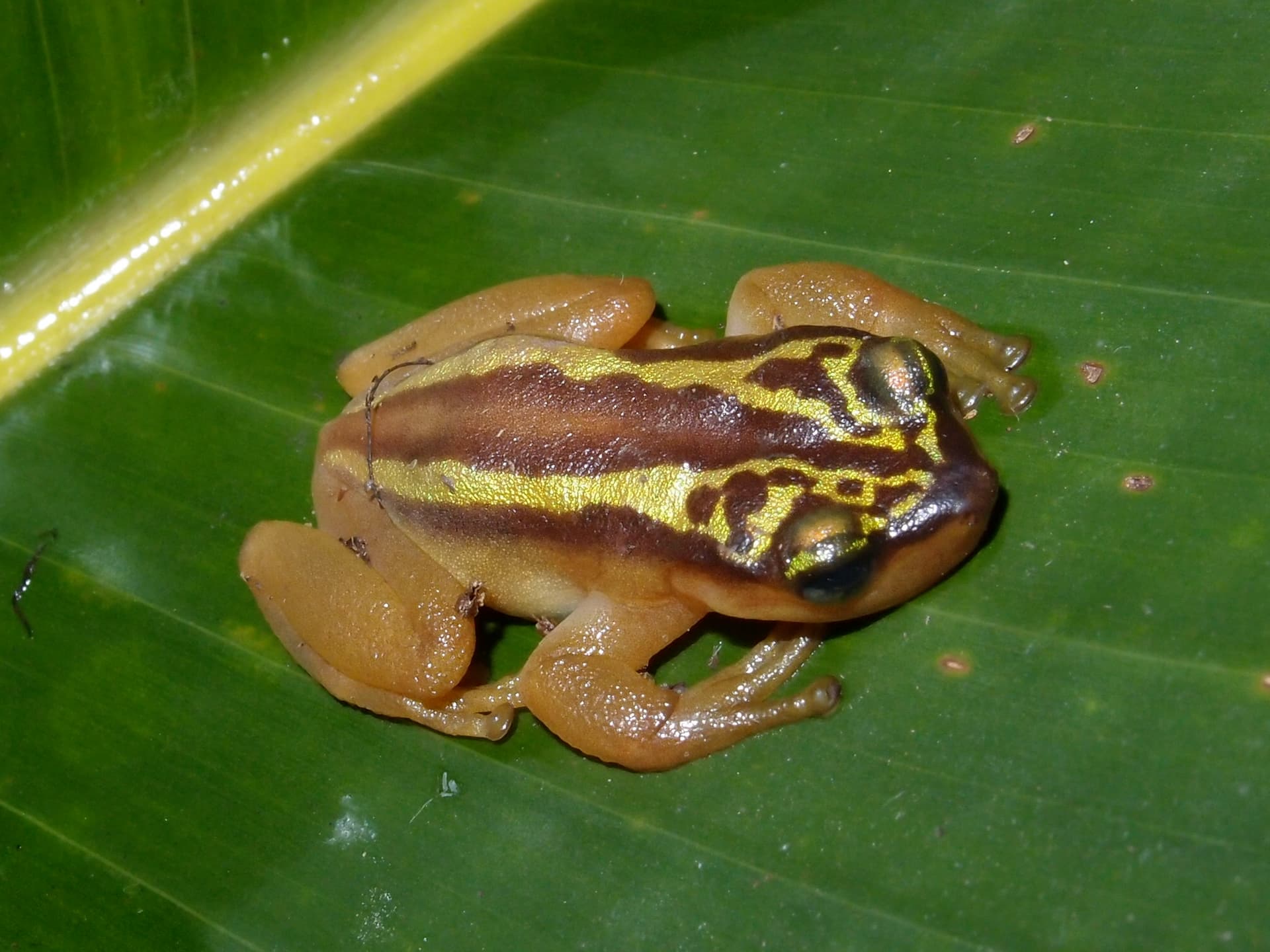
The Golden Tree Frog is one of the rarest and most extraordinary amphibians on Earth, found nowhere else but the mist-shrouded cloud forests of Trinidad's Northern Range.
The Golden Tree Frog is one of the rarest and most extraordinary amphibians on Earth, found nowhere else but the mist-shrouded cloud forests of Trinidad's Northern Range. Brilliantly coloured in gold and green, this tiny frog has evolved an intimate dependency on tank bromeliads, completing its entire life cycle within the water-filled cups of these high-altitude plants. Its restricted range, specialised habitat requirements, and the accelerating threats of deforestation and climate change make it one of Trinidad's most critically imperilled endemics.
The Golden Tree Frog is a small arboreal frog reaching roughly 35–45 mm in snout-vent length, with females slightly larger than males. Its dorsal surface is a striking combination of vivid yellow-gold and bright green, providing surprisingly effective camouflage among the leaf axils and bromeliads of the montane forest. First described by Rivero in 1968, the genus name Phytotriades, meaning "bromeliad-dweller", captures its defining ecological relationship. It is classified within family Phyllomedusidae.
This species is confined to cloud forests above approximately 700 m elevation in the Northern Range of Trinidad, where near-constant moisture and abundant epiphytic bromeliads persist. It is an obligate tank-bromeliad breeder: females deposit eggs on bromeliad leaves directly above or within the water trapped in the plant's leaf axils, and tadpoles develop entirely within these natural phytotelms without ever entering a stream or pond. This extraordinary breeding strategy ties the species' reproduction to the continued health and abundance of its host bromeliads, particularly large-bodied species capable of holding sufficient water.
The Golden Tree Frog is listed as Critically Endangered on the IUCN Red List, reflecting its extremely limited range, declining habitat quality, and the ongoing loss and degradation of Northern Range cloud forest. The primary threats are deforestation from agricultural encroachment and charcoal production, climate change-induced upward shifts in cloud level which shrink suitable habitat from below, illegal collection for the exotic pet trade, and the loss of host bromeliad plants. The species is fully protected under Trinidad's Conservation of Wildlife Act and is an Environmentally Sensitive Species under EMA designation. No large-scale recovery programme is currently documented, though UWI has conducted field surveys and the species benefits from protected forest areas in the Northern Range.
Why This Matters
The Golden Tree Frog exists at the intersection of two extraordinary evolutionary stories: the story of Trinidad's continental origins, and the story of what happens when a species has nowhere left to retreat to. Restricted entirely to the two highest peaks in Trinidad's Northern Range, El Cerro del Aripo and El Tucuche, this frog has evolved a life strategy of complete dependence on a single type of plant: a giant bromeliad that grows only in cloud forest above 700 metres. This is not a generalist that can adapt to changing conditions; it is a specialist whose entire world is a few kilometres of misty summit forest. That makes the health of that cloud forest, and the specific conditions that sustain it, a matter of the species' continued existence.
Cloud forests at altitude are among the most efficient water-producing ecosystems on Earth. The forests at Aripo and Tucuche intercept moisture from the clouds that roll in from the northeast, releasing it slowly into rivers that feed communities across the Northern Range's eastern slopes. The Golden Tree Frog's presence in those forests is not incidental to this water production story; it is evidence that the summit ecosystem is intact and functioning as it should. As climate change raises temperatures and lifts cloud bases to higher elevations, the zone of suitable habitat literally shrinks from below. Every hectare of cloud forest lost is habitat the frog cannot move down into.
To encounter a Golden Tree Frog in the wild is to see something genuinely irreplaceable: a jewel-coloured animal visible in almost no other place on Earth, living in a bromeliad perched above a forest that has existed in near-continuous form since Trinidad separated from the South American mainland. The case for protecting the Northern Range summits rests on many foundations. This tiny golden frog sits at the top of all of them.
Threats to Survival
- Deforestation and agricultural encroachment in the Northern Range
- Climate change: upward shift of cloud base reduces cloud forest area
- Illegal collection for the exotic pet trade
- Loss of host bromeliad plants
- Charcoal production causing localised forest clearing
- Small range: entire global population on one mountain range
Seen a Golden Tree Frog?
Sighting records help us track population status and distribution. If you observe this species, please report the location, date, time, and any photos to WEPTT.
Report a Sighting